The 60-second verdict
Quick answer: product managers can use an AI voice recorder for approved customer discovery, roadmap discussions, decision reviews and launch retrospectives, but the tool cannot validate demand, decide priority or replace analytics, research, product and delivery systems. Every feature request should be decomposed into behaviour, impact, evidence and uncertainty before prioritisation.
Best fit: Product Managers who need recoverable audio and human-verified notes in an authorised workflow. Use another method when: recording is prohibited, a participant declines or the approved process requires manual notes.
Evidence basis and limits
- Decision factors covered: Start with the request-decomposition card; Use the NEEDS note; Separate discovery signals.
- Evidence rule: A claim earns weight only when the source, date, configuration and limitation are clear enough for a reader to check.
- Boundary: Examples and workflow recommendations must be tested with representative recordings, the intended users and the actual approval process before rollout.

Assess Halo against the product managers workflow matrix can preserve approved customer language and decision context while accountable product judgement remains human.
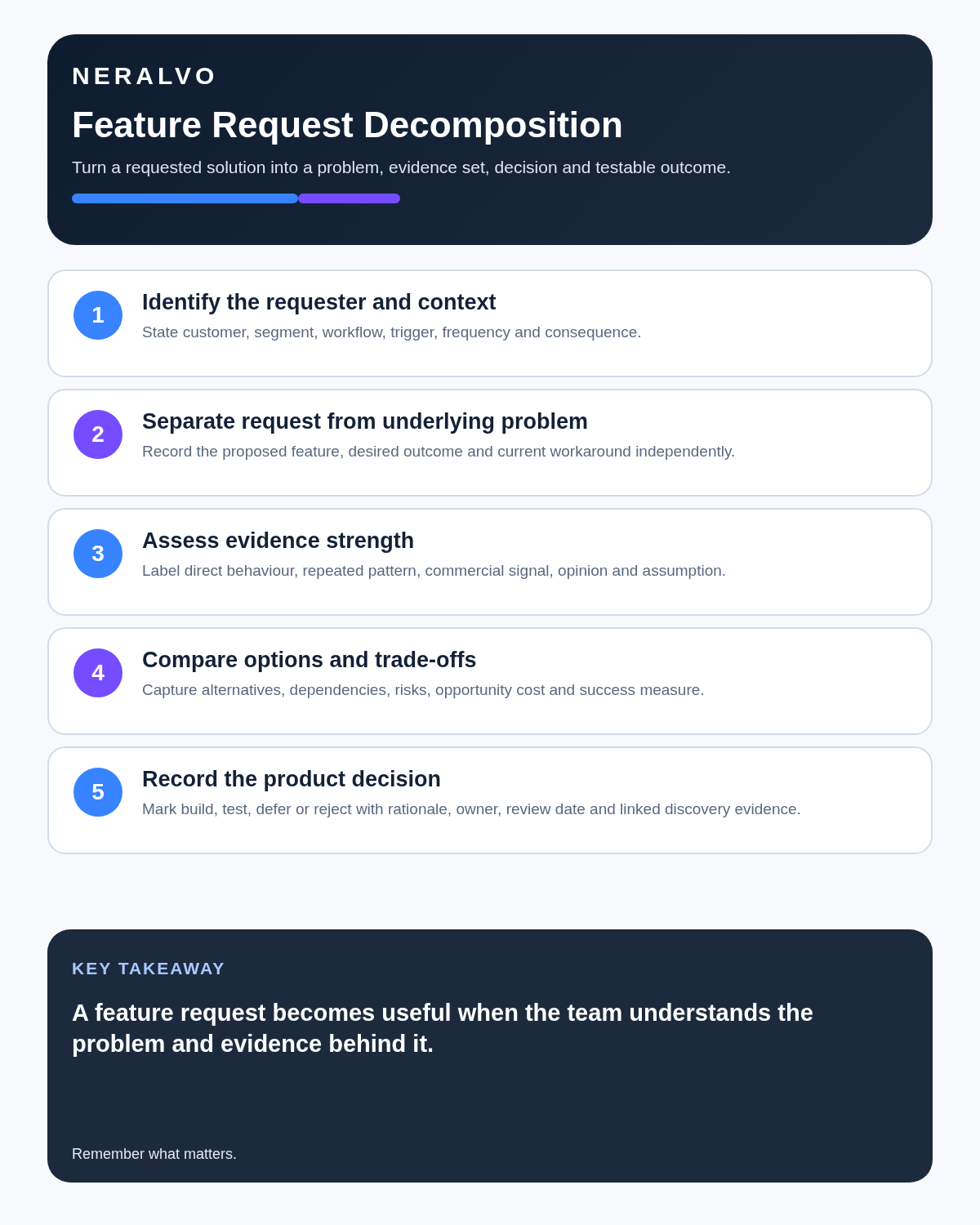
Start with the request-decomposition card
| Field | Question |
|---|---|
| Segment and role | Who is experiencing the problem and in which context? |
| Trigger | What situation causes the need? |
| Task | What is the customer trying to achieve? |
| Current behaviour | What do they do today? |
| Friction | Where does time, risk, confusion or failure occur? |
| Consequence | Why does the problem matter? |
| Requested feature | What solution did the customer propose? |
| Evidence of scale | Which analytics, support, sales or wider research supports it? |
| Uncertainty | What remains unknown or contradictory? |
A feature request is a proposed solution. Discovery begins by recovering the task and evidence underneath it.
Use the NEEDS note
- N — Nature: segment, role and relevant context.
- E — Event: trigger and task.
- E — Existing behaviour: current process and workaround.
- D — Difficulty: friction, frequency and impact.
- S — Signal: evidence, uncertainty and next question.
Separate discovery signals
| Signal | Meaning | Control |
|---|---|---|
| Customer quote | Attributed statement from one participant | Preserve context and sample limits |
| Observed behaviour | What the user actually did | Record task, environment and evidence |
| Analytics | Measured product behaviour | Check definition, period and denominator |
| Support pattern | Repeated operational evidence | Check volume, severity and duplication |
| Sales request | Commercial signal or account need | Separate customer importance from market prevalence |
| Stakeholder preference | Internal view or strategic proposal | Do not label as validated user need |
| Assumption | Belief requiring a test | State confidence and evidence required |
AI must not combine different signal types into one confident demand claim.
Run behaviour-led interviews
- Define the research question.
- Recruit participants who match the relevant segment and context.
- Explain recording, internal analysis and any quotation permissions.
- Ask about a recent real event before hypothetical solutions.
- Explore trigger, task, current process, workarounds and consequences.
- Clarify frequency, severity and alternatives.
- Correct product terms, names and quotations.
- Decompose each requested feature.
- Code evidence consistently.
- Search for contradictions and missing segments.
- Compare with analytics, support and commercial evidence.
- Create an insight with confidence and limitations.
A leading question such as “Would you use an automated dashboard?” is weaker than “Tell me about the last time you needed this information.”
Do not count quotes as market size
Repeated customer language may show a pattern in the sample. It does not establish prevalence, willingness to pay or product impact. Use broader data and a representative research plan to assess scale.
Create an opportunity record
For each opportunity, capture:
- User segment and context.
- Desired outcome.
- Trigger and current behaviour.
- Frequency and severity.
- Workaround and cost.
- Evidence sources.
- Contradictory evidence.
- Strategic relevance.
- Unknowns and next test.
- Confidence and limitations.
Control roadmap language
| Status | Meaning |
|---|---|
| Idea | Unreviewed possibility |
| Discovery | Problem and evidence under investigation |
| Candidate | Potential work awaiting priority and feasibility decisions |
| Committed | Approved for a defined planning horizon under stated conditions |
| In delivery | Implementation has started |
| Released | Available to the intended users |
| Measured | Outcome evidence reviewed |
A customer conversation, prototype preference or stakeholder statement should not become a roadmap promise without the authorised process.
Create the product-decision record
Document:
- Problem and user segment.
- Evidence and its limitations.
- Options considered.
- Strategic fit.
- Technical, operational and commercial trade-offs.
- Dependencies and risks.
- Decision authority.
- Build, test, defer or reject outcome.
- Expected user and business effect.
- Success and guardrail measures.
- Revisit or stop condition.
“Customers asked for it” is not a complete rationale. Preserve why alternatives were rejected.
Turn meetings into controlled delivery actions
Move requirements, assumptions, decisions, risks and actions into the product, design and project systems that own them. Every action needs a specific output, one owner, deadline, dependency and completion evidence.
Do not use the transcript as a parallel roadmap or requirements system.
Review launches through outcomes
Compare the expected and actual effect across:
- Activation and adoption.
- Task completion and user behaviour.
- Satisfaction and qualitative feedback.
- Revenue, retention or conversion where relevant.
- Reliability, performance and accessibility.
- Support burden and operational cost.
- Unintended consequences.
Separate correlation from causation and define what evidence would lead the team to continue, adapt, scale or stop.
Protect customer confidentiality and consent
Separate permission to record, analyse internally, share anonymised themes and use named quotations or clips. Use participant references, minimise identifiers and delete source material when the approved purpose ends.
Do not upload confidential customer, product or strategy information to an unapproved AI service.
How NERALVO Halo fits product management
NERALVO Halo includes NOTE mode, supported CALL mode, 64GB local storage, up to 35 hours of recording and Bluetooth sync with DOWAY. DOWAY can create transcripts, summaries, speaker-separated notes, templates, translations, mind maps and exports, with one year of DOWAY Max included.
It may support approved discovery interviews, workshops and decision reviews. Halo is not a research repository, analytics, roadmap or delivery system.
Cloud software, a dedicated recorder or manual notes?
For Product Managers, the right answer changes with the setting. This matrix deliberately gives each method a situation where it can be the strongest choice.
| Situation | Best starting point | Reason |
|---|---|---|
| scheduled remote client meetings | Cloud meeting software | Auto-join and central collaboration can remove routine admin. |
| in-person visits and travel | Dedicated recorder | Dedicated hardware suits movement, variable rooms and offline source capture. |
| a client declines or policy requires manual notes | Manual notes or an approved alternative | A clear alternative respects policy and participant choice. |
| mixed CRM and field work | Governed hybrid | One governed process prevents gaps between desk and field work. |
Frequently asked questions
Does a repeated feature request prove demand?
No. Decompose the request and assess wider behavioural and market evidence.
Can AI prioritise the roadmap?
It can organise inputs, but accountable people must assess evidence, strategy, feasibility, risk and trade-offs.
Does a customer quote permit public use?
No. Recording and public quotation require separate permissions.
What makes a product decision reviewable?
A clear problem, evidence, options, authority, rationale, expected outcome and revisit condition.
Final product checklist
- Segment, trigger and task precise.
- Requested solution separated from underlying problem.
- Current behaviour and workaround captured.
- Evidence types and limitations visible.
- Contradictions and unknowns preserved.
- Roadmap status accurate.
- Decision and authority clear.
- Trade-offs and rejected options recorded.
- Actions transferred to delivery systems.
- Outcome and guardrail measures defined.
- Consent and customer confidentiality controlled.
Bottom line: AI recording keeps customer language accessible. Product judgement begins when each proposed feature is decomposed into behaviour, consequence, evidence and uncertainty before a controlled decision.
Related guides
See the guides for customer discovery, software developers and project managers.
On this page
Related guides
See whether Halo fits this workflow
Review the NERALVO Halo specifications, included services, delivery information and current offer only after completing the guide.
Found an error or an out-of-date claim? Email support@neralvo.com with the article address and a supporting source.