The 60-second verdict
Quick answer: marketing managers can use an AI voice recorder for approved customer interviews, campaign reviews, agency meetings and idea capture, but every objective claim, testimonial, price, offer condition and performance conclusion must be connected to adequate evidence and approval before publication.
Best fit: Marketing Managers who need recoverable audio and human-verified notes in an authorised workflow. Use another method when: recording is prohibited, a participant declines or the approved process requires manual notes.
Evidence basis and limits
- Decision factors covered: Use the evidence chain; Build the claim-evidence register; Use the PROOF brief.
- Evidence rule: A claim earns weight only when the source, date, configuration and limitation are clear enough for a reader to check.
- Boundary: Examples and workflow recommendations must be tested with representative recordings, the intended users and the actual approval process before rollout.

Assess Halo against the marketing managers workflow matrix can preserve authorised discussions while analytics, research, brand, legal and approval systems remain authoritative.
Use the evidence chain
| Stage | Example | Control |
|---|---|---|
| Customer evidence | An interviewee says setup took two hours | Preserve source, context and sample limitations |
| Insight | Setup complexity may reduce activation | Test with wider evidence |
| Message | “Start faster” | Review the likely audience meaning |
| Objective claim | “Set up in five minutes” | Hold adequate documentary evidence |
| Testimonial | “I was running in minutes” | Verify wording, accuracy and permission |
A customer quote can inspire a message. It does not prove an objective product-performance claim.
Build the claim-evidence register
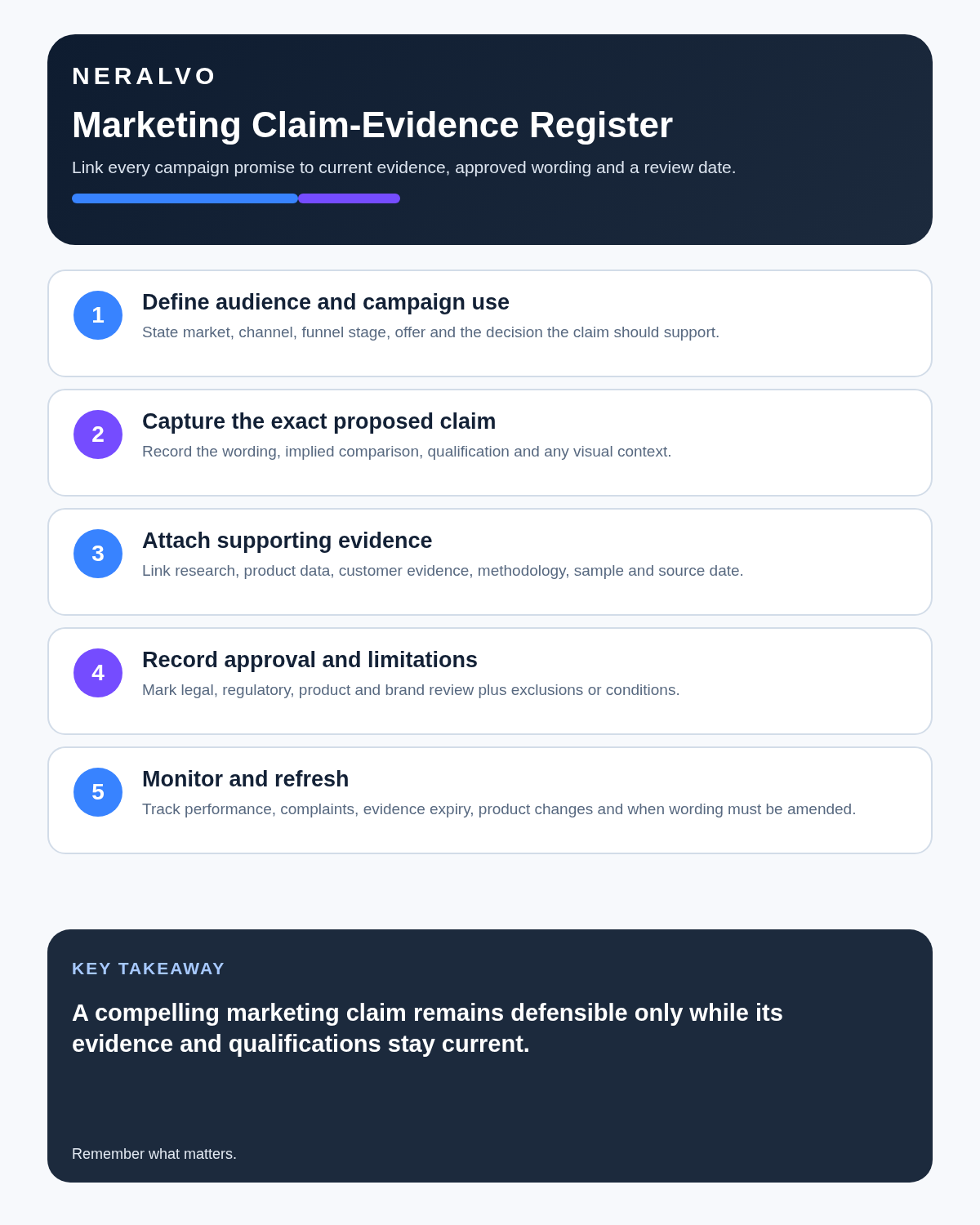
For every explicit or implied factual claim, record:
- Exact wording and likely audience interpretation.
- Audience, market and channel.
- Evidence source and date.
- Method, sample, conditions and limitations.
- Comparison basis and denominator.
- Qualification or disclosure required.
- Testimonial permission and permitted uses where relevant.
- Product, price and availability version.
- Approver and approval date.
- Expiry, monitoring or update trigger.
Keep the register connected to the exact creative version. A previously approved claim may become misleading when the product, offer, audience or evidence changes.
For UK marketing, objective claims should be supported by adequate documentary evidence before publication, and material qualifications must remain clear. Review the CAP Code rules on misleading advertising and substantiation.
Use the PROOF brief
- P — Problem: customer need and evidence.
- R — Result: audience and measurable business or communication outcome.
- O — Offer: proposition, price, availability and conditions.
- O — Objective evidence: substantiation, method, limits and qualifications.
- F — Format: channels, assets, owner, approval and review date.
Separate insight from assumption
- Customer statement: attributed interview evidence.
- Observed behaviour: research or usage evidence.
- Analytics result: measured performance under stated attribution.
- Team interpretation: explanation of what the evidence may mean.
- Untested hypothesis: proposition requiring a test.
- Approved strategy: authorised course of action.
AI summaries often make a plausible hypothesis sound established or turn repeated comments from a small sample into a market-wide conclusion.
Set research and recording permissions clearly
Recording permission is not blanket marketing permission. Separate:
- Participation in internal research.
- Use of anonymised themes.
- Named quotation.
- Public testimonial.
- Paid advertising.
- Editing, translation and future reuse.
- Permitted channels, territories and duration.
Do not move private research comments into public creative without the required authority.
Create a campaign-decision log
Record the target audience, objective, offer, creative angle, channel, budget, metric, attribution method, test duration, stop condition, decision authority and next review date.
Preserve rejected options and the evidence that changed the decision. This helps the team understand why a campaign moved rather than reconstructing the rationale from memory.
Identify implied claims
Claims can arise from headlines, images, demonstrations, comparisons, before-and-after material, pricing layout and omissions—not only from explicit sentences. Review the overall impression a reasonable audience is likely to receive.
A qualification cannot repair a headline whose main impression is materially misleading.
Verify performance conclusions
Before claiming that a campaign, channel or creative caused an outcome, check:
- Date range and comparison period.
- Attribution model.
- Spend and delivery.
- Sample size and statistical limitations.
- Revenue, conversion or lead definition.
- Audience and placement changes.
- Seasonality and external factors.
- Tracking or data-quality issues.
- Whether the evidence shows correlation or causation.
A recording can preserve the discussion, but analytics and experiment evidence determine the conclusion.
Control testimonials
Confirm the wording against the source audio, preserve material qualifications, verify that the experience is genuine and accurately represented, and record the permitted channels and duration.
Do not edit a customer’s words in a way that changes meaning. Testimonials alone do not substantiate objective claims such as speed, savings, accuracy or typical results.
Control price and offer claims
Verify price, tax treatment, subscription, delivery, eligibility, stock, geographical limits, start and end dates, renewal terms and any conditions. Ensure the landing page and checkout match the advertised offer.
An old transcript or brief must not override the current commercial system.
Use a controlled campaign workflow
- Define the campaign or research question.
- Confirm recording and data-use permission.
- Generate and correct the transcript in the approved environment.
- Separate evidence, insight, idea, message and claim.
- Identify every explicit and implied factual claim.
- Populate the claim-evidence register.
- Check price, availability and offer conditions.
- Verify testimonial wording and permissions.
- Complete brand, product, legal and compliance approval.
- Publish the exact approved version.
- Monitor performance, complaints, changes and evidence expiry.
Control agency and stakeholder actions
Every action needs a defined deliverable, one owner, deadline, dependency and approval route. Move work into the project or campaign system rather than leaving it in transcripts.
Separate an agency recommendation, an internal preference, a budget approval and a final publishing instruction.
Protect customer and research data
Use approved accounts, minimise identifiers and follow research, direct-marketing and platform rules. Raw customer audio may require tighter access and shorter retention than the final de-identified insight.
Do not record payment details, passwords or unrelated sensitive information. Restrict exports and delete source files when their approved purpose ends.
How NERALVO Halo fits marketing management
NERALVO Halo includes NOTE mode, supported CALL mode, 64GB local storage, up to 35 hours of recording and Bluetooth sync with DOWAY. DOWAY can create transcripts, summaries, speaker-separated notes, templates, translations, mind maps and exports, with one year of DOWAY Max included.
It may support approved customer interviews, campaign workshops and agency calls. It is not an analytics, advertising-compliance, claim-substantiation or campaign-management system.
Cloud software, a dedicated recorder or manual notes?
For Marketing Managers, the right answer changes with the setting. This matrix deliberately gives each method a situation where it can be the strongest choice.
| Situation | Best starting point | Reason |
|---|---|---|
| scheduled remote client meetings | Cloud meeting software | Auto-join and central collaboration can remove routine admin. |
| in-person visits and travel | Dedicated recorder | Dedicated hardware suits movement, variable rooms and offline source capture. |
| a client declines or policy requires manual notes | Manual notes or an approved alternative | A clear alternative respects policy and participant choice. |
| mixed CRM and field work | Governed hybrid | One governed process prevents gaps between desk and field work. |
Frequently asked questions
Does a customer testimonial prove a performance claim?
No. Objective claims require appropriate substantiation beyond individual experience.
Can a private research quote be used in an advert?
Only when the relevant permission and use rights are clear.
Can AI decide whether a claim is compliant?
No. It can help identify claims and evidence gaps, but authorised reviewers must assess the final creative and context.
Can a qualification fix any headline?
No. The main advertising impression must itself be accurate and not materially misleading.
Final marketing checklist
- Audience and objective precise.
- Customer evidence separated from insight and assumption.
- Explicit and implied claims identified.
- Claim-evidence register complete.
- Method, sample and limitations recorded.
- Testimonials verified and permissioned.
- Price, availability and conditions current.
- Campaign conclusions use appropriate attribution.
- Brand, legal and compliance approval recorded.
- Customer data and source retention controlled.
- Evidence expiry and review triggers monitored.
Bottom line: AI recording keeps real customer language accessible. Marketing control begins when every claim is identified, evidenced, qualified, approved and reviewed before publication.
Related guides
See the guides for copywriters, content creators and customer discovery.
On this page
Related guides
See whether Halo fits this workflow
Review the NERALVO Halo specifications, included services, delivery information and current offer only after completing the guide.
Found an error or an out-of-date claim? Email support@neralvo.com with the article address and a supporting source.