The 60-second verdict
Cricket produces long periods of information: individual deliveries, changing fields, scoring pressure, bowling spells, match phases and net-session experiments. A useful coaching record should connect a specific event to evidence and the next practice design—not turn an innings result into a permanent judgement about the player.
Best fit: Cricket Coaches who need recoverable audio and human-verified notes in an authorised workflow. Use another method when: recording is prohibited, a participant declines or the approved process requires manual notes.
Evidence basis and limits
- Decision factors covered: The delivery → phase → evidence → net design system; Start with the delivery, not the label; Separate outcome, decision and execution.
- Evidence rule: The decision is based on the complete capture-to-action workflow, not a single feature or marketing accuracy percentage.
- Boundary: Examples and workflow recommendations must be tested with representative recordings, the intended users and the actual approval process before rollout.
An AI voice recorder for cricket coaches can support private post-match debriefs, permitted player reviews and short notes after nets. It cannot supervise a live ball, analyse technique independently, assess concussion, safeguard a player or make selection decisions.
The delivery → phase → evidence → net design system
| Layer | Coaching question | Useful output |
|---|---|---|
| Delivery | What happened on the specific ball or action? | Observable behaviour |
| Phase | What score, field, role and tactical context shaped it? | Match meaning |
| Evidence | What do video, score data and player intent confirm? | Verified finding |
| Net design | What constraint will test the next decision or skill? | Focused practice plan |
The note begins with cricket’s smallest meaningful unit—the delivery—then works outward to the wider match phase and the next practice decision.
Start with the delivery, not the label
Record the event using cricket-specific detail:
- Match or session.
- Innings, over and delivery where available.
- Batter, bowler and role.
- Line, length, pace, movement or shot option.
- Field and scoring context.
- Observable decision and execution.
- Clip or data needed to verify it.
“Attempted a cover drive to the fourth ball of over 14 with two boundary riders and required rate increasing” creates a reviewable question. “Poor shot selection” does not preserve enough context.
Separate outcome, decision and execution
Cricket outcomes are noisy. A good shot can find a fielder; a false shot can produce runs; a correct bowling plan can be defeated by excellent batting. Keep these layers separate:
| Layer | Example |
|---|---|
| Outcome | Caught at extra cover |
| Decision | Chose an attacking option outside the agreed scoring plan |
| Execution | Contact occurred away from the body |
| Context | Required rate, field and previous deliveries |
| Player intent | What the player saw and tried to achieve |
An AI summary may collapse all five into “technical error.” The coach should verify the clip and ask the player before deciding what needs to change.
Turn a bowling spell into a pattern
A bowling note should preserve spell context, not just wickets or economy. Check:
- Planned line and length.
- Delivery sequence and setup.
- Field support.
- Changes in pace, angle or movement.
- Control under fatigue.
- Batter response.
- Workload or medical restrictions supplied through the correct process.
Do not ask AI to invent ball-by-ball data or safe workload limits. Use the official score, analysis system and authorised medical information.
Design a net that tests the finding
After review, create one practice problem rather than a list of generic corrections. Define:
- Target behaviour: the decision or skill to improve.
- Representative context: field, score or delivery pattern.
- Constraint: scoring zone, fielders, sequence or consequence.
- Volume: suitable repetitions or spell structure.
- Feedback: when and how the coach intervenes.
- Success evidence: what will show progress.
For example, if evidence shows the batter loses scoring options after dot-ball pressure, the net can reproduce a short sequence with a changing field and a clear decision objective.
Keep the recorder outside the live-ball area
Nets, throwdowns, bowling machines and close-catching drills require active control of players, protective equipment and space. Do not operate the recorder while balls are live. Use a safe break or create the note after the session.
The device is not a first-aid or emergency system. Player welfare and communication take priority over documentation.
Use an immediate head-injury route
The ECB says suspected concussion or head injury requires formal medical assessment, and a player should be removed where there are concerns and medically cleared before returning. Coaches should follow the current club and ECB process rather than relying on the player’s reassurance or an AI-generated note.
See the ECB’s concussion guidance for coaches.
Record only the factual circumstances needed by the authorised incident or medical process after immediate action is complete. Keep medical detail out of the general development note.
Protect children, young people and adults at risk
The ECB states that safeguarding is everyone’s responsibility. Follow club and county arrangements for communication, one-to-one coaching, changing facilities, transport, tours, photography and reporting concerns.
Never record changing rooms, bedrooms, toilets or medical areas. A disclosure should be handled through the club safeguarding route immediately—not retained inside an ordinary coaching transcript. See the ECB’s safeguarding information.
Make player reviews evidence-led and two-way
A useful review includes:
- The player’s role and goal.
- A specific delivery, spell, phase or clip.
- The player’s view and intent.
- A strength to preserve.
- One priority to practise.
- Support from coach or specialist staff.
- A review date and evidence measure.
Avoid automated ratings of temperament, resilience, potential or commitment. Those labels are difficult to evidence and can distort fair development decisions.
Keep selection decisions accountable
Selection should use current performance, role balance, availability, opposition context and accountable human judgement. Before saving a selection note, check:
- Were the criteria relevant and understood?
- Was the player observed in a comparable role?
- Is the evidence current?
- Did opportunity, injury, education or development stage affect the sample?
- Are health and safeguarding details restricted?
- Who made and communicated the decision?
AI can organise evidence; it should not rank players or recommend the final team.
A concise cricket debrief script
- Event: identify delivery, over, spell or drill.
- Context: state score, field, role and tactical plan.
- Observation: describe visible behaviour without judgement.
- Player question: note what needs to be explored with the player.
- Evidence: identify video or data to check.
- Practice idea: state one provisional net constraint.
- Welfare route: move medical or safeguarding information to the correct system.
How NERALVO Halo can support cricket coaching
View Halo specifications for cricket coaches use can support private post-match notes, permitted player reviews and staff planning. It includes NOTE mode, supported CALL capture, 64GB local storage, up to 35 hours of recording and Bluetooth sync with DOWAY. DOWAY can create transcripts, summaries, speaker-separated notes, templates, translations, mind maps and exportable files, with one year of DOWAY Max included from activation.
Halo is not a video-analysis platform, medical device, workload monitor or safeguarding system. Clubs remain responsible for approval, consent, access and retention.
Cricket-note quality check
- Does the note identify a delivery, spell, phase or drill?
- Are outcome, decision and execution separated?
- Was the player’s intent checked?
- Does the conclusion rely on video or score evidence?
- Was the recorder kept away from live-ball supervision?
- Were head-injury and safeguarding concerns moved immediately to authorised routes?
- Does the finding create one representative net design?
- Is selection human, fair and traceable?
- Has temporary audio been handled under club policy?
A strong cricket note turns one observed delivery or phase into a verified coaching question and a better-designed practice session.
Cloud software, a dedicated recorder or manual notes?
For Cricket Coaches, the right answer changes with the setting. This matrix deliberately gives each method a situation where it can be the strongest choice.
| Situation | Best starting point | Reason |
|---|---|---|
| scheduled remote meetings | Cloud meeting software | Native remote-meeting workflows can be more efficient here. |
| in-person or mobile work | Dedicated recorder | A separate battery and recoverable local source improve resilience. |
| recording is refused or prohibited | Manual notes or an approved alternative | Manual notes are the correct control when recording is unavailable. |
| mixed online and offline work | Governed hybrid | A hybrid can combine automation with reliable physical capture. |
Related AI voice recorder guides
See the guides for sports coaches, football coaches and rugby coaches.
Related guides
Profession workflow
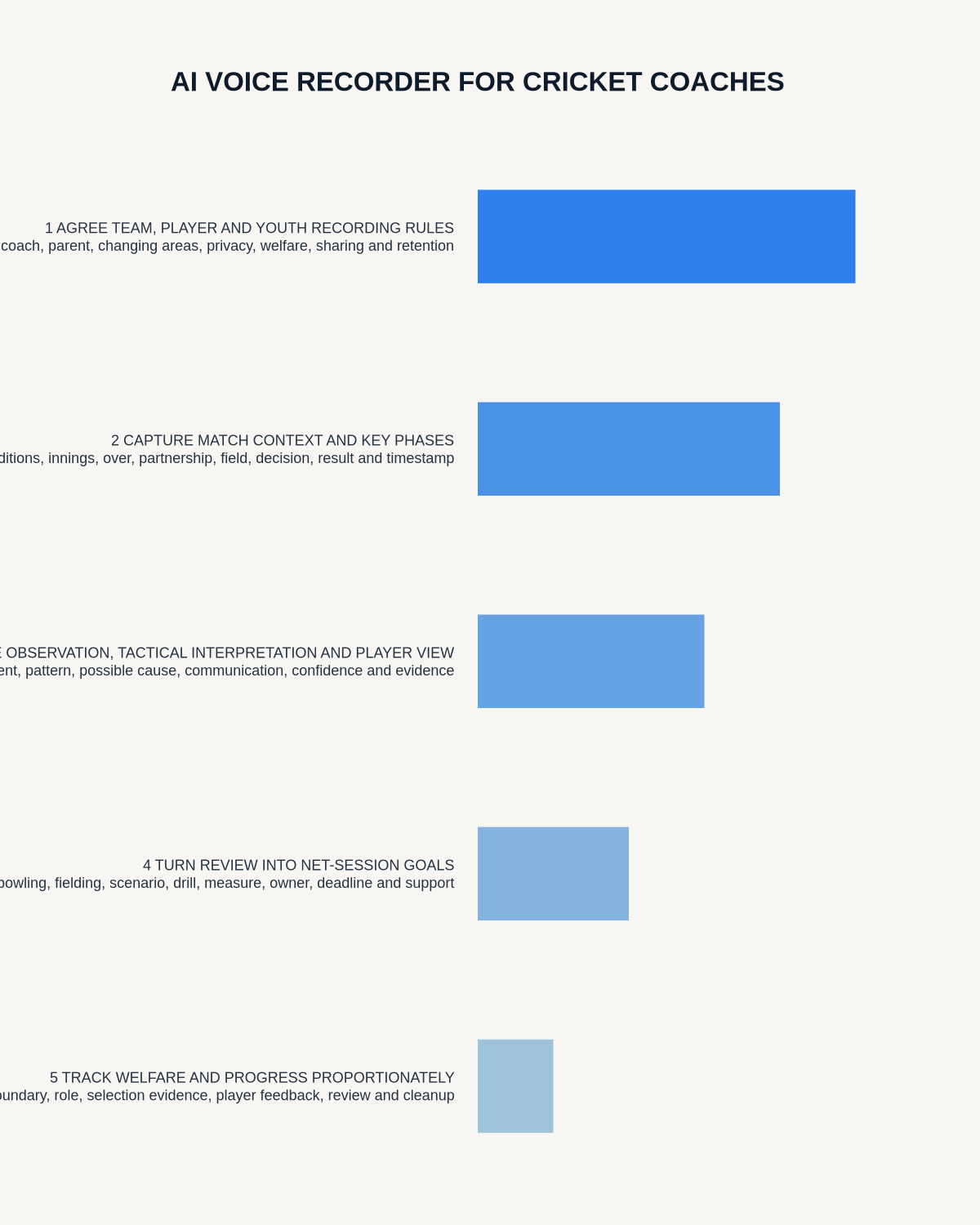
Visual map for AI Voice Recorder for Cricket Coaches: Match Analysis, Player Reviews and Net-Session Notes
- Prepare the approved useDefine purpose, safe position, permission and the required formal record.
- Capture context firstState the case, asset, person, location or event identifier before detail.
- Human-verify evidenceCheck technical terms, units, names, dates, decisions and uncertainty.
- Complete the formal recordTransfer only verified information and apply access and retention controls.
On this page
Related guides
See whether Halo fits this workflow
Review the NERALVO Halo specifications, included services, delivery information and current offer only after completing the guide.
Found an error or an out-of-date claim? Email support@neralvo.com with the article address and a supporting source.