The 60-second verdict
Rugby coaching notes must connect tactical observations with contact exposure, player welfare and medical restrictions. A useful debrief should never blur a coaching impression with a medical decision or allow analysis to take priority over immediate player safety.
Best fit: Rugby Coaches who need recoverable audio and human-verified notes in an authorised workflow. Use another method when: recording is prohibited, a participant declines or the approved process requires manual notes.
Evidence basis and limits
- Decision factors covered: Use a contact–context–consequence record; Apply a player-welfare stop rule; Separate system failure from player technique.
- Evidence rule: Claims are weighted by consequence: capture failure, changed meaning, access and recovery matter more than polished wording.
- Boundary: Examples and workflow recommendations must be tested with representative recordings, the intended users and the actual approval process before rollout.
An AI voice recorder for rugby coaches can support private post-match reviews, authorised player meetings and staff planning. It cannot supervise contact, diagnose concussion, assess injury or approve return to training or competition.
Use a contact–context–consequence record
| Area | What to capture |
|---|---|
| Contact event | Tackle, carry, breakdown, scrum, maul or collision phase |
| Context | Minute, field position, fatigue, score and role |
| Observable behaviour | Body position, decision, support and control |
| Consequence | Performance result, welfare concern or stoppage |
| Evidence | Video, match data, staff observation or medical record |
| Next route | Coaching action, medical referral or safeguarding process |
Keep the route explicit. A contact observation may require coaching, medical or safeguarding action—and those records should not be merged.
Apply a player-welfare stop rule
Where concussion, injury, distress or safeguarding concern is suspected:
- Stop participation or respond through the appropriate live process.
- Remove the player from immediate risk.
- Use the club’s medical, emergency or safeguarding route.
- Notify the responsible people.
- Record factual circumstances only after immediate action.
AI cannot decide that a player is fit to continue or return. Coaching notes should refer to the current restriction without reproducing unnecessary medical detail.
Separate system failure from player technique
Before assigning an individual action, review:
- team spacing and line speed
- inside and outside support
- role clarity
- decision made before contact
- fatigue and repeated exposure
- opposition pattern
- video evidence
A missed tackle may reflect an earlier system problem. AI summaries often attach responsibility too quickly unless the structure is preserved.
Create a contact-load discussion boundary
Coaches may record participation, planned contact level and observed response, but medical restrictions and return decisions belong in the authorised medical pathway. The coaching record should show only what the coach needs to deliver the session safely.
Do not allow a transcript to invent workload limits, medical diagnoses or clearance.
Use a player review with role evidence
A useful review contains:
| Review field | Required detail |
|---|---|
| Role | What the position and team plan required |
| Evidence | Specific phases, clips and patterns |
| Player view | What the player saw, felt and intended |
| Strength | Behaviour to retain |
| Priority | One coachable action |
| Support | Coach, unit, medical or performance staff action |
Keep selection discussion separate from confidential health or safeguarding disclosures.
Translate the debrief into safe practice design
For each priority, define:
- session objective
- contact level and progression
- player grouping and staff coverage
- technical or tactical constraint
- stop condition
- evidence of improvement
Do not operate the recorder while supervising tackles, scrums, lineouts, mauls or other active contact. Complete the coaching first and record later.
Keep selection accountable
Selection should use current evidence, role need, availability, welfare and accountable human judgement. AI should not rank resilience, toughness, character or readiness from recorded comments.
How NERALVO Halo may support rugby coaching
Check whether NERALVO Halo fits rugby coaches work provides NOTE recording, supported CALL capture, 64GB local storage, up to 35 hours of recording and Bluetooth sync with DOWAY. DOWAY can create transcripts, summaries, templates, translations, mind maps and exports, with one year of DOWAY Max included from activation.
Halo is not a concussion tool, medical device, performance sensor or safeguarding system. Clubs should approve the device and player-data workflow before use.
Rugby-note release check
- Does each point identify the contact or tactical context?
- Were welfare concerns acted on before documentation?
- Are coaching and medical records kept separate?
- Is individual responsibility checked against system evidence?
- Does the player’s perspective appear?
- Is the next training action safe and specific?
- Are health and safeguarding details restricted?
- Is selection a human, traceable decision?
The strongest rugby debrief connects verified match evidence with a safe coaching response while keeping concussion, injury and safeguarding decisions inside the appropriate professional systems.
Cloud software, a dedicated recorder or manual notes?
For Rugby Coaches, the right answer changes with the setting. This matrix deliberately gives each method a situation where it can be the strongest choice.
| Situation | Best starting point | Reason |
|---|---|---|
| scheduled remote meetings | Cloud meeting software | Calendar automation and shared integrations are usually the strongest advantage. |
| in-person or mobile work | Dedicated recorder | Independent capture reduces reliance on an active phone or laptop. |
| recording is refused or prohibited | Manual notes or an approved alternative | The boundary takes priority over convenience. |
| mixed online and offline work | Governed hybrid | Use each method only in the setting it actually fits. |
Related coaching guides
See football match debriefs, general sports-coaching notes and rehabilitation progress records.
Related guides
Profession workflow
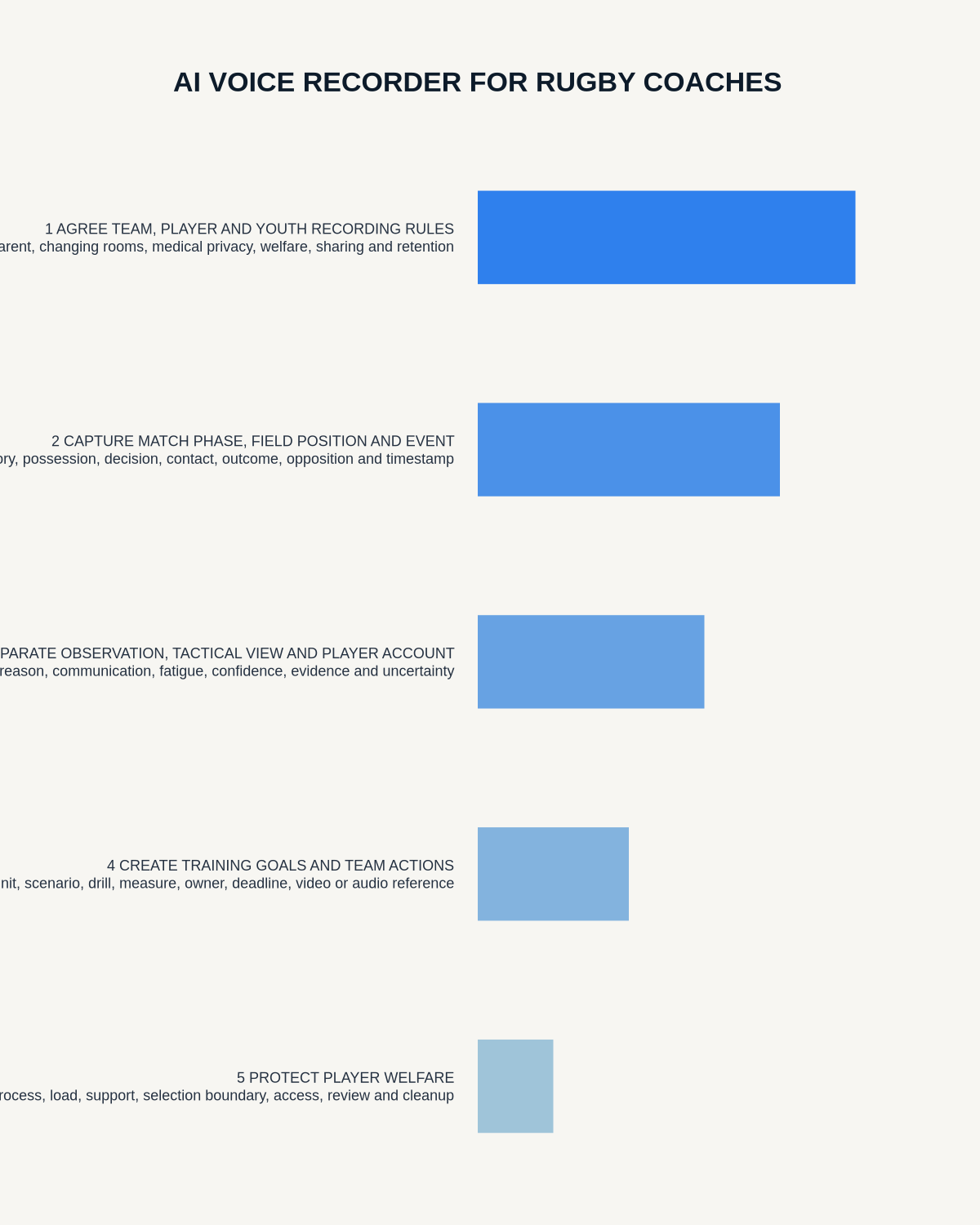
Visual map for AI Voice Recorder for Rugby Coaches: Match Reviews, Player Welfare and Training Notes
- Prepare the approved useDefine purpose, safe position, permission and the required formal record.
- Capture context firstState the case, asset, person, location or event identifier before detail.
- Human-verify evidenceCheck technical terms, units, names, dates, decisions and uncertainty.
- Complete the formal recordTransfer only verified information and apply access and retention controls.
On this page
Related guides
See whether Halo fits this workflow
Review the NERALVO Halo specifications, included services, delivery information and current offer only after completing the guide.
Found an error or an out-of-date claim? Email support@neralvo.com with the article address and a supporting source.