The 60-second verdict
Quick answer: use an AI voice recorder for due-diligence interviews to preserve authorised source conversations, identify evidence gaps and create a structured follow-up list. Do not treat interview statements as verified facts or allow an AI summary to make the investment, legal, financial, tax, technical or commercial conclusion.
Best fit: Due Diligence Interviews who need recoverable audio and human-verified notes in an authorised workflow. Use another method when: recording is prohibited, a participant declines or the approved process requires manual notes.
Evidence basis and limits
- Decision factors covered: Define the diligence scope and authority; Confirm recording and confidentiality; How NERALVO Halo may fit approved diligence interviews.
- Evidence rule: A claim earns weight only when the source, date, configuration and limitation are clear enough for a reader to check.
- Boundary: Examples and workflow recommendations must be tested with representative recordings, the intended users and the actual approval process before rollout.

Due-diligence interviews produce explanations about operations, finance, customers, contracts, technology, people and risk. The interview can reveal information that is difficult to find in a data room, but a confident answer is not the same as verified evidence. Recording can improve traceability only when the transaction, confidentiality and data-handling process permits it.
Define the diligence scope and authority
Before interviewing anyone, confirm:
- The transaction or review purpose.
- The workstream being examined.
- The interviewer’s remit.
- The interviewee’s role and likely knowledge.
- Confidentiality and clean-team restrictions.
- Whether recording is permitted.
- Which advisers and team members can access the material.
- Whether the transcript may enter the data room or formal report.
- The retention and destruction requirements.
Organise questions by evidence, not curiosity
| Workstream | Example evidence link |
|---|---|
| Financial | Management accounts, forecasts, reconciliations and policies |
| Commercial | Customer contracts, pipeline, pricing and churn data |
| Operational | Process maps, capacity data, service records and supplier terms |
| Technology | Architecture, licences, technical debt, security and resilience records |
| People | Organisation charts, key-person dependencies and employment records |
| Legal | Contracts, disputes, licences and compliance records |
| Data protection | Processing records, contracts, incidents and governance |
| ESG or safety | Policies, incidents, audits and corrective actions |
Every important question should have a reason: confirm a document, explain a variance, test an assumption or identify missing evidence.
Confirm recording and confidentiality
Explain:
- Why the interview is being recorded.
- Who controls the source file.
- Whether AI transcription or summarisation will be used.
- Which approved supplier or account processes it.
- Who can access audio, transcript and exports.
- Whether the material will be quoted or attributed.
- How corrections and follow-up will work.
- When source and working copies will be deleted.
Do not record passwords, authentication secrets, legally restricted content or information outside the approved scope.
How NERALVO Halo may fit approved diligence interviews
Assess Halo against the due diligence interviews workflow matrix is an ultra-slim, phone-mounted AI voice recorder with NOTE mode for suitable face-to-face interviews, supported CALL mode for lawful and disclosed compatible remote conversations, 64GB local storage, up to 35 hours of recording and Bluetooth sync with the DOWAY app. DOWAY can generate transcripts, summaries, templates, translations, mind maps and exports. One year of DOWAY Max is included.
Halo can provide a portable authorised source. It does not validate a statement or replace secure data-room, advisory and transaction-record controls.
Use a traceable question structure
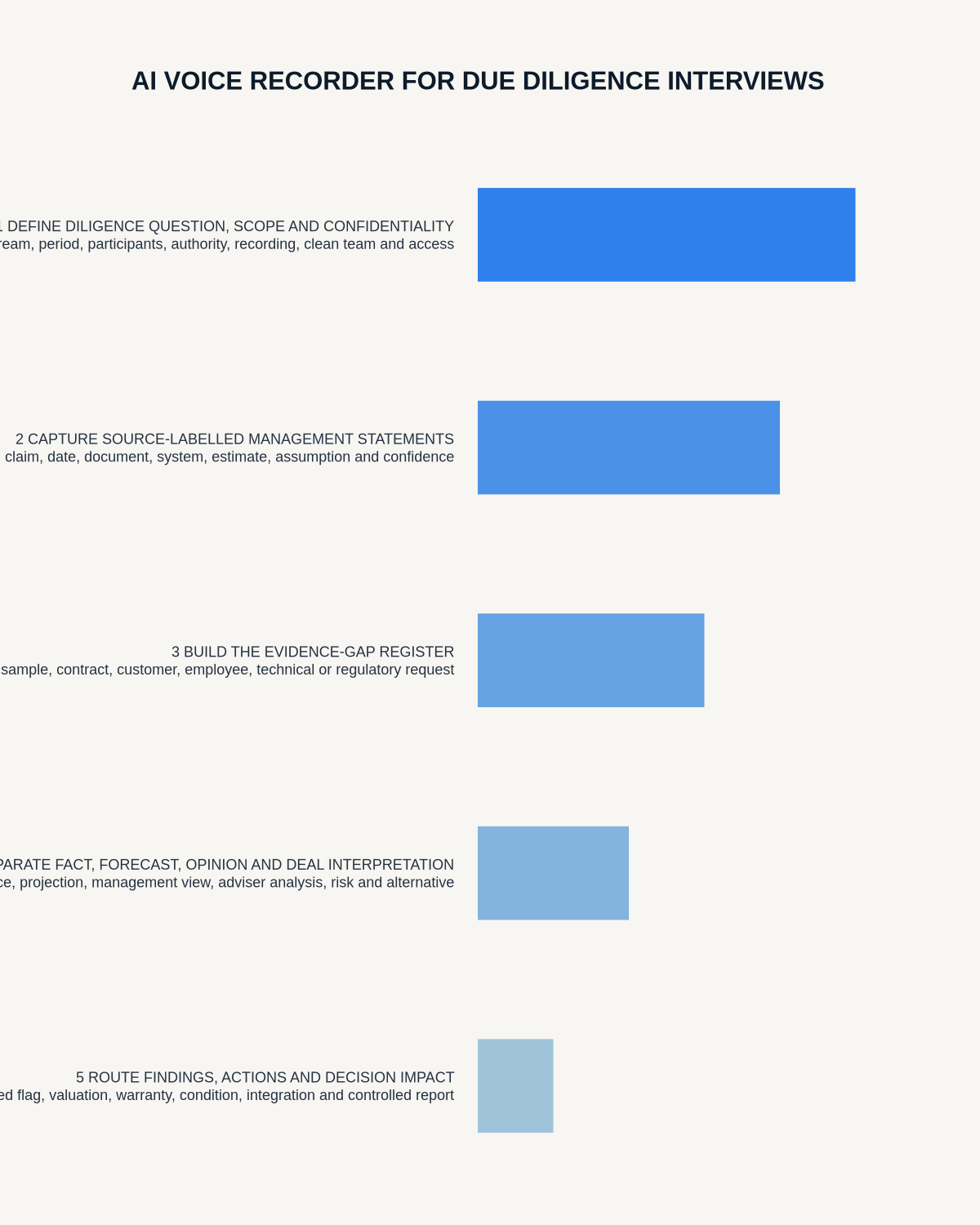
For each material topic, capture:
- Question: what the reviewer needs to understand.
- Respondent: name, role and basis of knowledge.
- Statement: the answer in context.
- Qualification: uncertainty, assumption or limitation.
- Evidence: document, dataset or system referenced.
- Contradiction: any conflict with existing material.
- Gap: evidence still missing.
- Follow-up: owner, deadline and required output.
Preserve qualifications exactly
Phrases such as these may be material:
- “To the best of my knowledge”.
- “Subject to confirmation”.
- “I believe”.
- “Approximately”.
- “Historically”.
- “Excluding”.
- “We have not tested”.
- “The data is incomplete”.
- “I am not the owner of that process”.
An AI summary can remove these qualifiers and create false certainty. Verify the complete passage.
Distinguish statement, evidence and conclusion
| Record type | Example |
|---|---|
| Management statement | “Customer churn has remained stable” |
| Evidence reference | Monthly cohort report in data-room folder 4.2 |
| Reviewer observation | Report excludes one acquired business |
| Unresolved gap | Combined churn series not supplied |
| Preliminary conclusion | Stability cannot yet be verified across the full group |
Do not present the interviewee’s statement as the reviewer’s verified finding.
Test the basis of knowledge
Ask:
- How does the interviewee know this?
- Which period or business unit does the answer cover?
- Is the information measured or estimated?
- Who owns the underlying process?
- Which system contains the source data?
- What changed recently?
- What exceptions are excluded?
- Who should confirm the answer?
Use verbal markers
- “Document reference:” identifies the source.
- “Estimate:” marks a non-final figure.
- “Assumption:” identifies something being taken as true.
- “Exception:” records a limit or excluded case.
- “Contradiction:” flags a conflict requiring investigation.
- “Follow-up:” identifies required evidence and owner.
- “Not known:” prevents an uncertain answer becoming a guess.
- “Potential risk:” identifies an issue for specialist assessment.
Investigate contradictions rather than smoothing them away
Where the answer conflicts with documents, another interview or observed data:
- Record both sources accurately.
- Check whether they cover the same period and definition.
- Ask the interviewee to explain the difference.
- Request the underlying evidence.
- Assign a specialist owner.
- Assess whether the issue is error, timing, scope or material risk.
- Update the finding only when the evidence supports it.
Protect sensitive and restricted material
Due diligence may involve:
- Personal data and employee information.
- Customer confidentiality.
- Trade secrets.
- Security architecture.
- Legal advice or dispute strategy.
- Competition-sensitive information.
- Unannounced transaction information.
- Regulatory or criminal-offence data.
Use authorised devices, accounts and storage, and follow clean-team, access, redaction and disclosure rules.
Correct the transcript in priority order
- Confirm the interview, date, workstream and participants.
- Correct names, entities, currencies, figures and dates.
- Preserve qualifications and uncertainty.
- Link statements to document references.
- Mark contradictions and unresolved gaps.
- Separate interviewee statements from reviewer observations.
- Remove unnecessary third-party or out-of-scope data.
- Create the controlled interview note.
- Move actions into the diligence tracker.
Build a gap-and-follow-up tracker
| Question | Statement | Evidence | Gap | Owner | Due date |
|---|---|---|---|---|---|
| Example topic | Management response | Document or dataset | Missing confirmation | Named reviewer | Agreed date |
Use the organisation’s controlled diligence platform or tracker rather than leaving unresolved issues inside the transcript.
Do not ask AI to determine materiality
An automated tool may highlight words or inconsistencies, but specialists must assess:
- Whether the information is reliable.
- The financial or operational magnitude.
- Likelihood and timing.
- Legal or regulatory implications.
- Deal structure or valuation impact.
- Remediation feasibility.
- Whether further specialist work is required.
Create clear final outputs
- Controlled interview note: checked statements, qualifications and references.
- Evidence request list: missing documents or datasets.
- Risk or issue log: matter, evidence, impact and owner.
- Report input: reviewed conclusion with limitations.
- Disclosure or transaction record: only where the approved process requires it.
Retention and destruction
Set separate rules for source audio, raw transcript, corrected note, evidence tracker and final report. Follow transaction hold, disclosure, archive and destruction instructions. Avoid retaining personal copies after the deal or review closes.
Due-diligence interview checklist
| Before | During | After |
|---|---|---|
| Confirm scope and recording permission | Use evidence-linked questions | Secure and inventory files |
| Map access restrictions | Preserve qualifications | Correct high-risk details |
| Prepare document references | Mark contradictions | Link evidence and gaps |
| Identify specialist owners | Avoid unsupported conclusions | Update diligence tracker |
| Set retention and destruction | Assign follow-up | Create reviewed report input |
Cloud software, a dedicated recorder or manual notes?
For Due Diligence Interviews, the right answer changes with the setting. This matrix deliberately gives each method a situation where it can be the strongest choice.
| Situation | Best starting point | Reason |
|---|---|---|
| scheduled remote meetings | Cloud meeting software | Auto-join and central collaboration can remove routine admin. |
| in-person or mobile work | Dedicated recorder | Dedicated hardware suits movement, variable rooms and offline source capture. |
| recording is refused or prohibited | Manual notes or an approved alternative | A clear alternative respects policy and participant choice. |
| mixed online and offline work | Governed hybrid | One governed process prevents gaps between desk and field work. |
Frequently asked questions
Can AI identify red flags automatically?
It may highlight inconsistencies or repeated concerns, but specialists must investigate, verify evidence and assess materiality.
Is a management statement evidence?
It is evidence of what management said, but the underlying factual claim usually requires independent support.
Should the transcript enter the data room?
Follow the transaction’s disclosure, confidentiality and legal process. Do not upload it automatically.
Can qualifications be removed for readability?
No. Material qualifications and uncertainty must remain visible.
What should the final note show?
Who said what, the basis of knowledge, supporting evidence, contradictions, unresolved gaps and follow-up ownership.
Keep statements connected to proof
A strong due-diligence record helps the team see what was said, what supports it, what conflicts with it and what remains unverified. AI can improve navigation; accountable specialists must reach the conclusion.
Related guides
On this page
Related guides
See whether Halo fits this workflow
Review the NERALVO Halo specifications, included services, delivery information and current offer only after completing the guide.
Found an error or an out-of-date claim? Email support@neralvo.com with the article address and a supporting source.