
The 60-second verdict
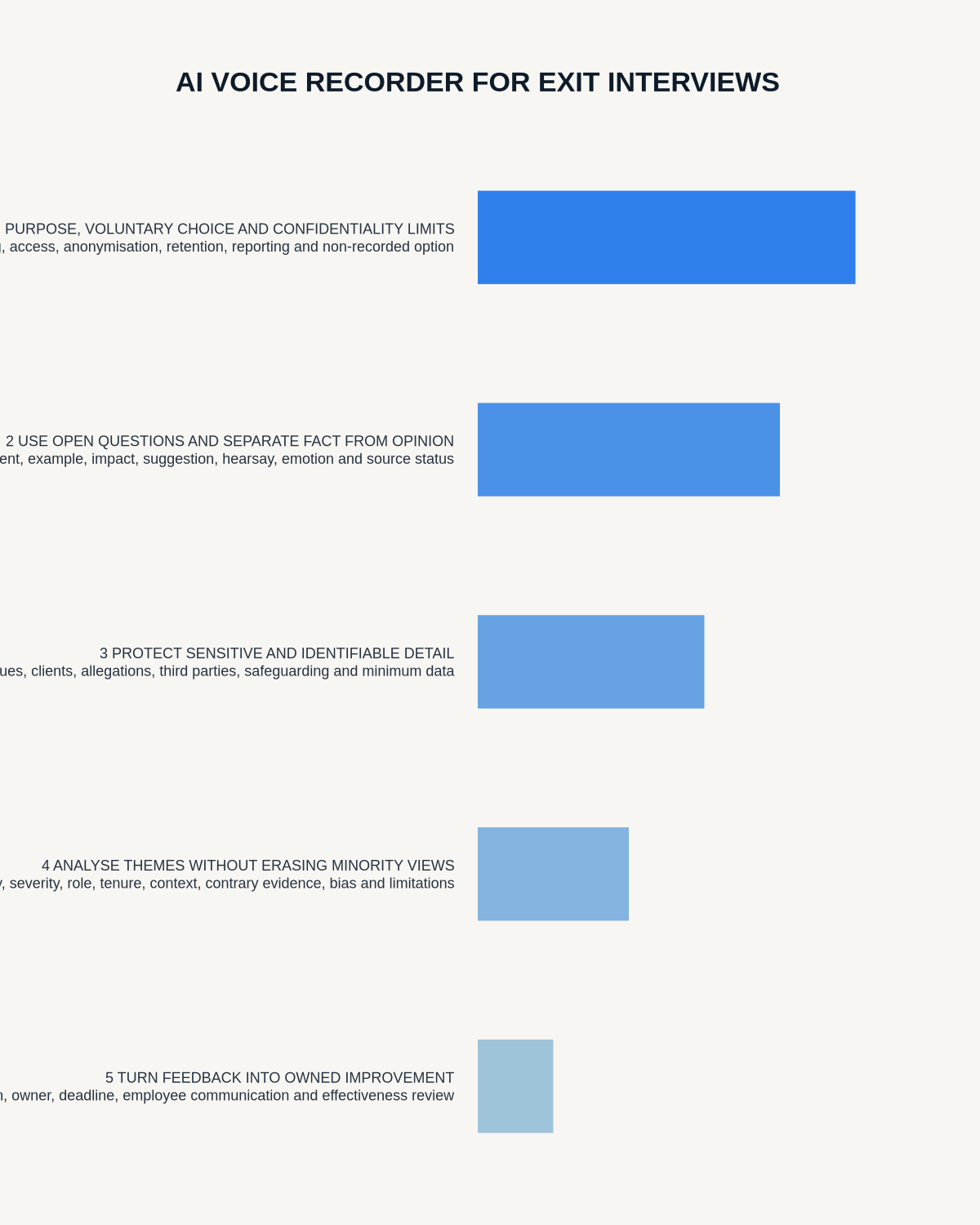
Quick answer: use an AI voice recorder for exit interviews only through a transparent HR process, then create two separate outputs: a protected individual record and a de-identified organisational learning record. Do not treat one person’s account as a proven trend or promise anonymity the organisation cannot guarantee.
Best fit: Exit Interviews who need recoverable audio and human-verified notes in an authorised workflow. Use another method when: recording is prohibited, a participant declines or the approved process requires manual notes.
Evidence basis and limits
- Decision factors covered: Use a two-output model; Explain the process before the interview begins; Separate experience, evidence and allegation.
- Evidence rule: The decision is based on the complete capture-to-action workflow, not a single feature or marketing accuracy percentage.
- Boundary: Examples and workflow recommendations must be tested with representative recordings, the intended users and the actual approval process before rollout.
Exit interviews can reveal workload, management, progression, inclusion and process problems that other data misses. They also have limits: participation may be voluntary, people may hold back and small teams can make supposedly anonymous comments easy to identify.
Use a two-output model
| Output | Purpose | Audience |
|---|---|---|
| Individual exit record | Preserves authorised discussion, commitments and matters requiring follow-up | Restricted HR or named case roles |
| Organisational themes | Identifies repeated strengths, friction and improvement opportunities | Appropriate leaders and process owners |
The individual record may contain names, examples and allegations. The theme record should contain only the detail needed for improvement, with identification risk assessed before sharing.
Explain the process before the interview begins
- State whether participation is voluntary.
- Explain why recording is proposed.
- Offer a non-recorded alternative where appropriate.
- Describe who can access the audio, transcript and final outputs.
- Explain whether comments will be attributed, paraphrased or aggregated.
- State that serious concerns may need separate escalation.
- Define how long source material will be retained.
Do not promise absolute anonymity or confidentiality when the organisation may have to act on a serious disclosure.
Use a balanced question map
| Area | Useful prompt |
|---|---|
| Reason for leaving | What factors most influenced your decision? |
| Role reality | How did the role compare with what you expected? |
| Management and support | What helped or obstructed your work? |
| Workload and tools | Which pressures, systems or processes created avoidable friction? |
| Progression | Did you have a credible route to learn or advance? |
| Inclusion and safety | Did you feel respected, heard and able to raise concerns? |
| Retention trigger | What realistic change might have influenced you to stay? |
| Strengths | What should the organisation protect? |
| Improvement | What one change would make the greatest difference? |
Use the same core areas across interviews, but allow the employee to explain issues in their own words. Avoid arguing with their experience or forcing every answer into a preselected category.
Separate experience, evidence and allegation
- Experience: how the employee describes the effect of work or events.
- Observed event: something the employee says they directly saw or heard.
- Referenced evidence: a message, document, system record or witness mentioned.
- Interpretation: the employee’s explanation of why something happened.
- Allegation: a claim requiring the appropriate review process.
- Suggestion: a proposed improvement, not an established fact.
AI summaries can merge these categories. Human review should restore the correct status before the information is used.
Use an urgent escalation lane
Do not bury serious concerns inside a quarterly theme report. Follow the organisation’s approved route when the interview suggests:
- harassment, discrimination or retaliation;
- safeguarding or immediate wellbeing risk;
- health and safety danger;
- fraud, corruption or serious misconduct;
- data or security incidents;
- evidence that may be lost.
Escalation does not mean the allegation is proven. It means the matter receives the correct fair review.
Create the individual record
- Confirm the employee, interviewer, date and purpose.
- Correct names, teams, dates and terminology.
- Preserve qualifications such as “in my experience” or “I cannot confirm.”
- Mark uncertain or inaudible passages honestly.
- Identify commitments made during the interview.
- Separate serious issues for the correct process.
- Remove unnecessary third-party detail from the concise HR note.
- Apply access and retention controls.
Build themes without false precision
Use a stable coding structure such as management, role clarity, workload, pay and recognition, progression, tools, flexibility, inclusion, reasons for staying and suggested improvements.
Record both frequency and consequence. A common minor irritation and a rare serious risk are not equivalent. Do not imply that exit-interview participants represent every departing employee, and avoid percentages based on very small groups.
Test de-identification before sharing
Removing a name may not remove identity. Job title, team size, project, location, departure date or a distinctive quotation may reveal the person. Before sharing a theme or quotation:
- remove unnecessary detail;
- consider what the audience already knows;
- paraphrase where exact wording creates risk;
- combine categories only when meaning remains accurate;
- restrict source access to authorised roles;
- avoid team-level reporting where the group is too small.
Analyse themes responsibly
Compare interviews by team, role, tenure and time period only where fair and meaningful. Preserve contradictory evidence and avoid presenting frequency as proof of cause. Combine exit interviews with turnover data, surveys, grievances, absence, workload and other relevant evidence.
Turn findings into accountable action
Each accepted theme should have:
- an evidence description;
- confidence and limitations;
- an accountable owner;
- a specific action;
- a target date;
- a measure or review point.
Without an action and review loop, recording exit interviews becomes information extraction rather than organisational learning.
How NERALVO Halo may support exit interviews
View Halo specifications for exit interviews use provides NOTE recording for approved in-person interviews, supported CALL capture for compatible remote conversations, 64GB local storage, up to 35 hours of recording and Bluetooth sync with DOWAY. DOWAY can generate transcripts, summaries and structured outputs, with one year of DOWAY Max included from activation.
Use the output as working source material. The verified individual record and de-identified theme record should live in the organisation’s controlled HR or insight systems.
Cloud software, a dedicated recorder or manual notes?
For Exit Interviews, the right answer changes with the setting. This matrix deliberately gives each method a situation where it can be the strongest choice.
| Situation | Best starting point | Reason |
|---|---|---|
| scheduled remote meetings | Cloud meeting software | Native remote-meeting workflows can be more efficient here. |
| in-person or mobile work | Dedicated recorder | A separate battery and recoverable local source improve resilience. |
| recording is refused or prohibited | Manual notes or an approved alternative | Manual notes are the correct control when recording is unavailable. |
| mixed online and offline work | Governed hybrid | A hybrid can combine automation with reliable physical capture. |
Frequently asked questions
Should every exit interview be recorded?
No. Use the least intrusive method that meets the stated purpose.
Can AI identify whether the employee is truthful?
No. Do not infer credibility or emotion from voice.
Can one comment justify a policy change?
It may trigger investigation, but broader change should use proportionate evidence and accountable judgement.
Can anonymity be guaranteed?
Not always. Small teams and distinctive details may identify a person even after names are removed.
Exit-interview closeout
- Participation and recording arrangements were clear.
- The individual and thematic outputs remain separate.
- Experience, evidence and allegation were not merged.
- Serious concerns entered the correct process.
- Identification risk was tested before sharing themes.
- Actions have owners, dates and review measures.
- Audio, transcript and final records have defined retention.
Bottom line: the value of an exit interview is not the volume of audio collected. It is the organisation’s ability to listen fairly, protect the individual and make credible improvements.
Related AI voice recorder guides
On this page
Related guides
See whether Halo fits this workflow
Review the NERALVO Halo specifications, included services, delivery information and current offer only after completing the guide.
Found an error or an out-of-date claim? Email support@neralvo.com with the article address and a supporting source.