The 60-second verdict
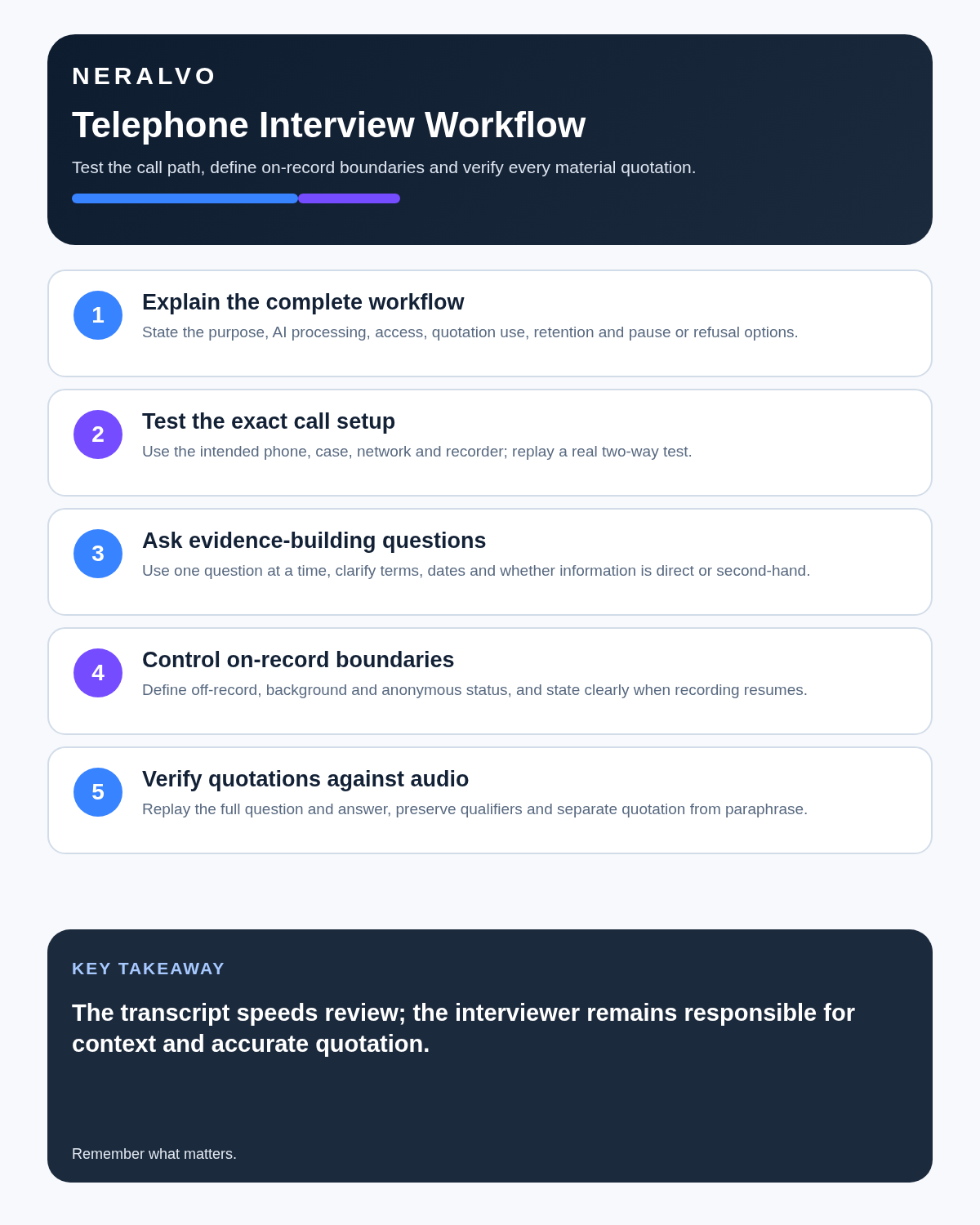
Quick answer: choose an AI voice recorder for telephone interviews by explaining the recording and intended use, testing the exact phone and app route, asking clean questions, protecting on-record boundaries and verifying every material quotation against the original audio.
Best fit: Telephone Interviews who need recoverable audio and human-verified notes in an authorised workflow. Use another method when: recording is prohibited, a participant declines or the approved process requires manual notes.
Evidence basis and limits
- Decision factors covered: Define the interview and its rules first; Tell the interviewee what recording means; Recording permission and interview participation are separate.
- Evidence rule: A claim earns weight only when the source, date, configuration and limitation are clear enough for a reader to check.
- Boundary: Examples and workflow recommendations must be tested with representative recordings, the intended users and the actual approval process before rollout.

Telephone interviews may support journalism, research, recruitment, customer discovery and professional casework. Assess Halo against the telephone interviews workflow matrix provides supported CALL recording, but compatibility, permission and governance must be tested for the exact workflow.
Define the interview and its rules first
“Telephone interview” can describe very different activities:
- Journalism or podcast research.
- Academic or market research.
- Customer discovery.
- Recruitment.
- Witness or investigative interviewing.
- Case, complaint or service interviews.
- Expert consultation.
Each can have different legal, ethical, professional and organisational rules. Confirm the applicable process before arranging the call.
Tell the interviewee what recording means
A recording may contain personal data and requires a defined purpose, appropriate lawful basis, security and retention plan. Consent may be suitable in some contexts, but it is not the only possible lawful basis. Do not use vague wording that hides what will happen.
A useful pre-interview notice explains:
- That audio recording is proposed.
- Why it is needed.
- Whether AI transcription or summarisation will be used.
- Who can access the audio and transcript.
- Whether direct quotations may be published.
- How long source material is expected to be retained.
- Whether the participant may decline, pause or stop recording.
- How off-record, anonymous or confidential material will be handled.
- Where to find the full privacy or research information.
Repeat the essential points at the beginning of the call and record the participant’s response where the process requires it.
Recording permission and interview participation are separate
A person may agree to be interviewed but decline audio recording. Decide in advance whether authorised written notes are an acceptable alternative. Do not pressure somebody into recording because the call has already begun.
Where consent is the chosen basis, withdrawal and preference management should be genuinely possible. Other contexts may rely on another lawful basis and require different controls.
Test the exact telephone setup
| Setup factor | Risk | Control |
|---|---|---|
| Phone model and case | The call path or physical coupling may differ | Test the exact phone and case |
| Call app or network | Compatibility and audio quality vary | Run a test through the same service |
| Signal or internet | Dropouts can remove words without obvious gaps | Use stable connectivity and repeat affected answers |
| Interviewer environment | Typing, fans and other voices enter the recording | Use a quiet private room |
| Interviewee environment | Traffic, public spaces and interruptions reduce privacy and clarity | Confirm they are somewhere suitable |
| Battery and storage | A long interview may stop unexpectedly | Check both before calling |
Use a pre-call technical test
- Call a colleague through the intended network or app.
- Use the exact phone, recorder and case.
- Test normal speech from both sides.
- Include a quiet voice and a specialist name.
- Record at least one minute.
- Play it back through headphones.
- Confirm both sides are present and balanced.
- Do not rely on the setup if the remote participant is faint or absent.
Prepare an interview evidence sheet
- Participant’s preferred name and spelling.
- Role, organisation and relevant background.
- Purpose and intended audience.
- Main questions and optional probes.
- Known dates, figures and technical terms.
- Quotation, anonymity and off-record rules.
- Potentially sensitive topics.
- Required referral or safeguarding process.
- Retention and publication plan.
Preparation reduces the temptation to correct the transcript from memory later.
Ask questions that produce clean evidence
- Ask one question at a time.
- Use open questions before detailed prompts.
- Allow silence rather than filling every pause.
- Do not speak over the answer.
- Ask what unfamiliar terms mean.
- Separate what happened from what the participant believes it means.
- Ask for dates and sequence.
- Confirm whether a statement is direct experience or second-hand information.
- Repeat an answer lost to a connection problem.
- Summarise the central point and invite correction.
Use clear on-record and off-record boundaries
Terms such as “off the record,” “background” and “anonymous” can mean different things in different professions. Define them before relying on them.
When status changes during a call:
- Pause and state the change clearly.
- Confirm which material is affected.
- Follow the agreed process for stopping or continuing recording.
- State when the interview returns on the record.
- Document any restriction in the final record.
Do not publish restricted material merely because it remains in the source audio.
Protect names, numbers and quotations
High-risk details should be repeated and confirmed:
- Names and spellings.
- Dates and times.
- Addresses and locations.
- Amounts and percentages.
- Case, product or reference numbers.
- Technical and legal terminology.
- Negatives such as “not approved.”
- Who said or did what.
Connection compression can make fifteen and fifty, can and cannot, or similar names sound dangerously alike.
A quotation-verification workflow
- Locate the passage by timestamp.
- Replay the full question and answer.
- Confirm the speaker.
- Correct recognition errors without changing meaning.
- Preserve qualifications, hesitation and uncertainty where material.
- Distinguish direct quotation from paraphrase.
- Check whether the quote was on record and within the agreed use.
- Seek participant, editorial or research review where the process requires it.
- Store the final quotation with its source timestamp.
Never quote directly from an unchecked AI transcript.
Review the transcript in four passes
| Pass | Check |
|---|---|
| Integrity | File start, end, gaps, retakes and dropped connections |
| Identity | Names, roles and speaker labels |
| Risk | Numbers, dates, negatives, allegations, decisions and quotations |
| Meaning | Context, uncertainty, sequence and restrictions on use |
Do not let AI flatten the interview
An AI summary can:
- Remove pauses that show uncertainty.
- Combine separate answers.
- Prefer a dramatic statement over the participant’s main point.
- Turn a possibility into a fact.
- Lose the distinction between direct and second-hand experience.
- Omit contradictory evidence.
- Assign an answer to the wrong speaker.
- Ignore off-record restrictions.
Use summaries for navigation and drafting. Human editorial, research or professional judgement remains controlling.
Privacy, security and retention
Tell people that the call is being recorded and why. Provide the remaining privacy information through an appropriate notice. Keep access limited, store material in approved systems and remember that recordings may be relevant to data-access requests, complaints, investigations or legal holds.
Set separate retention decisions for:
- Original audio.
- Raw transcript.
- Corrected transcript.
- Research coding or editorial notes.
- Published quotation or final report.
Do not keep source audio indefinitely merely because it might be useful one day.
Official privacy guidance
How NERALVO Halo fits telephone interviews
NERALVO Halo includes CALL mode for supported compatible phone and social-app routes where recording is lawful, disclosed and permitted; NOTE mode for in-person interviews and private post-interview notes; 64GB local storage; up to 35 hours of recording; and Bluetooth sync with DOWAY. DOWAY provides transcripts, summaries, speaker-separated notes, templates, translations, mind maps and exports, with one year of DOWAY Max included.
Compatibility varies by phone, case, network and app. Run a realistic test before every important interview type.
Cloud software, a dedicated recorder or manual notes?
For Telephone Interviews, the right answer changes with the setting. This matrix deliberately gives each method a situation where it can be the strongest choice.
| Situation | Best starting point | Reason |
|---|---|---|
| scheduled remote meetings | Cloud meeting software | Auto-join and central collaboration can remove routine admin. |
| in-person or mobile work | Dedicated recorder | Dedicated hardware suits movement, variable rooms and offline source capture. |
| recording is refused or prohibited | Manual notes or an approved alternative | A clear alternative respects policy and participant choice. |
| mixed online and offline work | Governed hybrid | One governed process prevents gaps between desk and field work. |
Frequently asked questions
Must every telephone interview use consent as the data-protection basis?
No. Organisations must identify the appropriate lawful basis for the specific purpose. Some research or editorial processes may separately require consent or agreement.
Should the interviewee be told that AI transcription is used?
Yes. Explain material processing, access and use clearly rather than referring only to recording.
Can the transcript be used directly for quotations?
No. Check every material quotation against the complete source audio.
What if the connection breaks up?
Stop, explain the problem and ask the participant to repeat the answer. Mark the unusable passage.
Can somebody decline recording but still be interviewed?
That depends on the interview process. Decide beforehand whether authorised written notes are an acceptable alternative.
Does CALL mode work with every app?
No. Test the exact phone, case, operating system and app first.
Telephone-interview checklist
- Interview type and rules defined.
- Purpose, lawful basis and participant information clear.
- Alternative available where appropriate.
- Exact route tested.
- Both voices confirmed.
- Questions and evidence sheet prepared.
- On-record boundaries documented.
- High-risk details repeated and verified.
- Quotations checked against full source audio.
- AI summary limitations reviewed.
- Source access and retention controlled.
Bottom line: a dependable telephone interview record begins with a transparent process, a tested call path and patient questioning. AI can accelerate transcription, but the interviewer remains responsible for context, quotation accuracy, privacy and final use.
Related guides
On this page
Related guides
See whether Halo fits this workflow
Review the NERALVO Halo specifications, included services, delivery information and current offer only after completing the guide.
Found an error or an out-of-date claim? Email support@neralvo.com with the article address and a supporting source.