The 60-second verdict
Quick answer: facilities managers can use an AI voice recorder for authorised inspections, contractor calls and handovers by linking each issue to an exact location, required standard, observable condition, immediate control, owner, deadline and verified closure evidence.
Best fit: Facilities Managers who need recoverable audio and human-verified notes in an authorised workflow. Use another method when: recording is prohibited, a participant declines or the approved process requires manual notes.
Evidence basis and limits
- Decision factors covered: Use six acceptance checks; Create a BUILD field note; Separate observation, report and diagnosis.
- Evidence rule: Claims are weighted by consequence: capture failure, changed meaning, access and recovery matter more than polished wording.
- Boundary: Examples and workflow recommendations must be tested with representative recordings, the intended users and the actual approval process before rollout.
Facilities work fails when a vague observation such as “air-conditioning problem on level two” becomes a work order without the asset, location, impact, evidence or acceptance test needed to close it.
Use six acceptance checks
| Check | Question |
|---|---|
| Location | Which site, building, floor, room, zone or asset? |
| Requirement | Which standard, contract, schedule or user need applies? |
| Condition | What was directly observed, measured or reported? |
| Immediate control | What safety, access or service action is required now? |
| Action | Who must do what, by when and with which dependency? |
| Closure | What inspection, test or document proves completion? |
Create a BUILD field note
- B — Building: site, block, floor and area.
- U — Unit: asset, room or service affected.
- I — Issue: neutral observable condition.
- L — Limit or impact: safety, service, user or compliance consequence.
- D — Decision: immediate control, work order, owner and closure evidence.
Example: “North House, level three, meeting room 3.14, fan-coil unit FCU-3-14. Occupants report intermittent noise; vibration audible during cooling cycle. Room remains usable. Contractor inspection requested by Thursday; closure requires cause, repair record and operational test.”
Separate observation, report and diagnosis
- Observed: directly seen, heard, smelled or measured.
- Reported: information supplied by an occupant, contractor or colleague.
- Possible cause: a hypothesis awaiting competent review.
- Confirmed cause: supported by inspection, test or specialist evidence.
- Action: agreed control or work instruction.
An AI summary must not turn “possible water ingress” into a confirmed leak source.
Link photographs, measurements and records
State the photograph, meter, drawing, permit, asset register or maintenance reference aloud. Verify figures, units, asset IDs and document revisions before creating the work order.
Control intrusive work
Before opening ceilings, isolating services, entering plant rooms, disturbing materials or working at height, follow the site’s competent-person, permit, risk-assessment and method-statement process. The recorder is not a permit or safety-control system.
Use an inspection-to-work-order workflow
- Confirm recording is approved and safe.
- State the exact site and asset anchor.
- Record the requirement and observable condition.
- Apply any immediate restriction or escalation.
- Link photographs, readings and reports.
- Generate and correct the transcript.
- Create the formal work order with priority, owner and deadline.
- Confirm contractor attendance and access.
- Verify repair through inspection, test or document.
- Update the asset, compliance and maintenance records.
Contractor commitments need complete fields
Record:
- contractor and responsible contact;
- scope and exclusions;
- attendance date and access window;
- permit, isolation or escort requirement;
- parts, equipment and specialist dependency;
- temporary control;
- cost or quotation status;
- completion evidence;
- warranty or follow-up.
“Engineer coming tomorrow” is not sufficient without the asset, purpose, time, access and acceptance condition.
Use priority based on consequence
| Priority | Typical meaning | Response |
|---|---|---|
| Immediate | Safety, security, critical service or serious damage risk | Apply emergency or escalation process now |
| Urgent | Material service interruption or worsening condition | Named owner and rapid response |
| Planned | Repair can be scheduled safely | Work order with due date and dependencies |
| Monitor | No current repair justified | Define observation method and review trigger |
Shift and site handover
Each open item should contain exact location, current condition, immediate control, contractor or team owner, deadline, access requirement, user communication and closure test. Move it into the approved facilities system rather than leaving it in the recording.
Protect security and personal information
Facilities recordings can reveal access routes, alarm locations, vulnerable assets, staff schedules and personal information. Avoid speaking door codes, credentials or unnecessary occupant details. Restrict source audio, exports and public links to authorised roles.
How NERALVO Halo may support facilities management
Check whether NERALVO Halo fits facilities managers work can support approved walkarounds, contractor calls and private debriefs through NOTE mode, supported CALL capture, 64GB local storage and DOWAY transcription tools. It is not a measuring instrument, permit system, asset register or emergency device.
Cloud software, a dedicated recorder or manual notes?
For Facilities Managers, the right answer changes with the setting. This matrix deliberately gives each method a situation where it can be the strongest choice.
| Situation | Best starting point | Reason |
|---|---|---|
| scheduled remote client meetings | Cloud meeting software | Calendar automation and shared integrations are usually the strongest advantage. |
| in-person visits and travel | Dedicated recorder | Independent capture reduces reliance on an active phone or laptop. |
| a client declines or policy requires manual notes | Manual notes or an approved alternative | The boundary takes priority over convenience. |
| mixed CRM and field work | Governed hybrid | Use each method only in the setting it actually fits. |
Frequently asked questions
Can a voice note become the work order?
It can support drafting, but the formal system should contain the verified location, asset, priority, owner and closure evidence.
Can AI diagnose a building-services fault?
No. It can organise observations and questions; competent inspection determines the cause.
Should access codes be recorded?
No. Use the approved secure access process.
What proves a task is closed?
The defined evidence, such as a test, inspection, certificate, photograph or user confirmation where appropriate.
Final facilities checklist
- Exact location and asset identified.
- Requirement and observed condition separated.
- Immediate controls applied.
- Measurements and evidence linked.
- Intrusive work follows permits and competent review.
- Contractor commitments are complete.
- Work order has owner, deadline and priority.
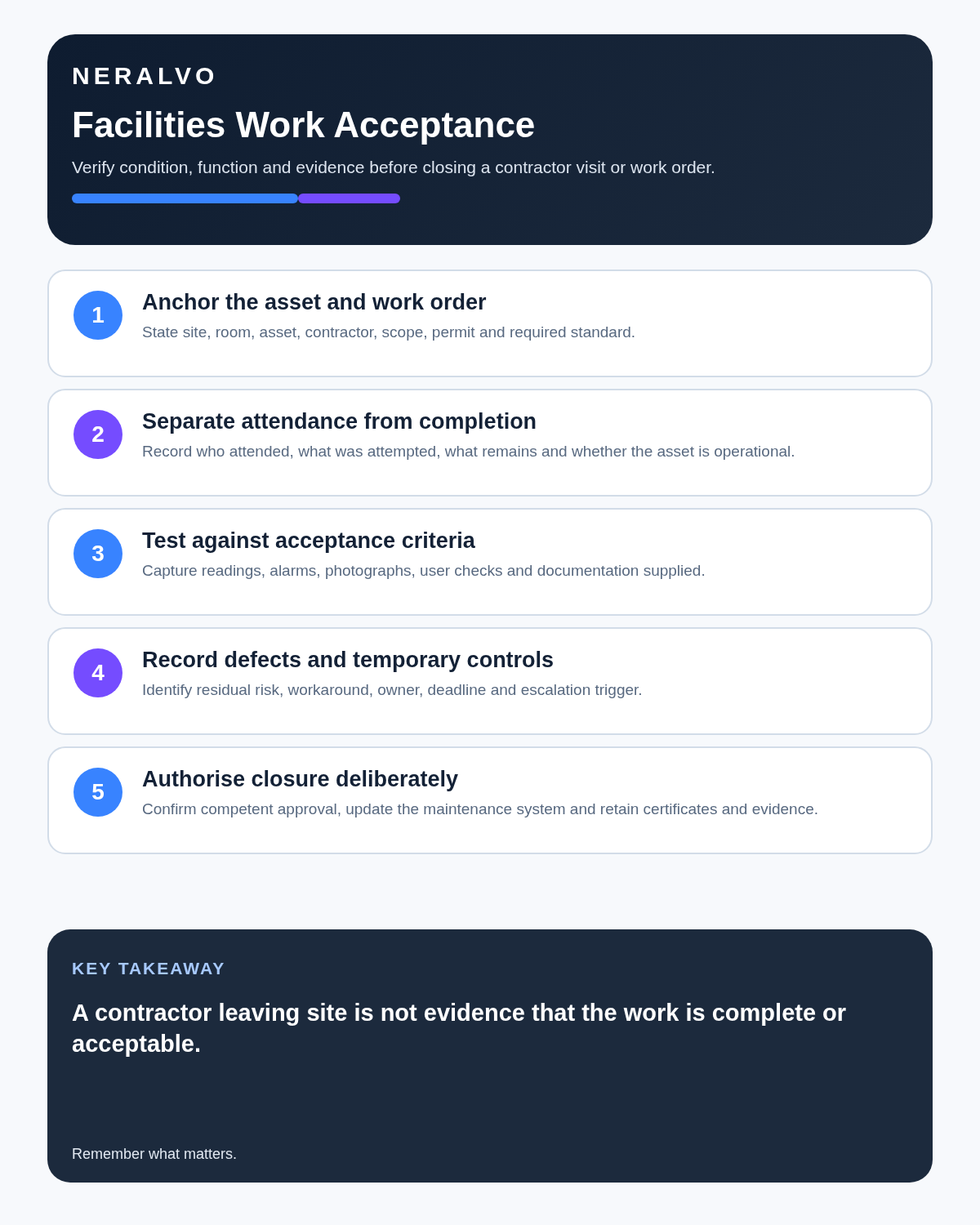
- Closure is verified, not merely promised.
- Security and personal information are restricted.
Bottom line: a strong facilities voice note turns a precise observation into a controlled work order and verified asset record without inventing diagnosis or closure.
Related guides
Profession workflow
Visual map for AI Voice Recorder for Facilities Managers: Accept the Work, Not the Attendance
- Prepare the approved useDefine purpose, safe position, permission and the required formal record.
- Capture context firstState the case, asset, person, location or event identifier before detail.
- Human-verify evidenceCheck technical terms, units, names, dates, decisions and uncertainty.
- Complete the formal recordTransfer only verified information and apply access and retention controls.
On this page
Related guides
See whether Halo fits this workflow
Review the NERALVO Halo specifications, included services, delivery information and current offer only after completing the guide.
Found an error or an out-of-date claim? Email support@neralvo.com with the article address and a supporting source.