The 60-second verdict
General-practice notes must preserve the patient’s agenda, relevant history, examination, clinical reasoning, decisions, safety net and follow-up. Automated documentation becomes unsafe when it produces a fluent narrative that hides uncertainty, misses a red flag or assigns a plan to the wrong person.
Best fit: General Practitioners who need recoverable audio and human-verified notes in an authorised workflow. Use another method when: recording is prohibited, a participant declines or the approved process requires manual notes.
Evidence basis and limits
- Decision factors covered: Use a consultation risk funnel; Separate patient report from clinician assessment; Create a medicine and identity verification gate.
- Evidence rule: Claims are weighted by consequence: capture failure, changed meaning, access and recovery matter more than polished wording.
- Boundary: Examples and workflow recommendations must be tested with representative recordings, the intended users and the actual approval process before rollout.
An AI voice recorder for general practitioners may support an organisation-approved consultation workflow or a private post-consultation draft. A consumer recorder is not automatically suitable for patient data or clinical use. Diagnosis, prescribing, urgency, safeguarding and the electronic patient record remain the responsibility of the healthcare team.
Use a consultation risk funnel
| Layer | What the final record must preserve |
|---|---|
| Patient agenda | Reason for attendance, priorities and expectations |
| Clinical context | History, medicines, allergies, risks and relevant background |
| Evidence | Examination, observations, results and source |
| Assessment | Working diagnosis, differentials and uncertainty |
| Decision | Options, patient preference, treatment or referral |
| Safety net | What to watch, when to seek help and who owns follow-up |
The draft should not compress “possible infection, review if worse” into “infection diagnosed.”
Separate patient report from clinician assessment
Use explicit labels:
- Patient reported: symptoms, timing, impact and concerns.
- Measured: observations, values and tests checked at source.
- Observed: examination findings.
- Possible: differential or provisional explanation.
- Clinical assessment: the clinician’s current conclusion and confidence.
- Plan: agreed investigation, treatment, referral or review.
A summary should preserve uncertainty rather than rewriting it as certainty.
Create a medicine and identity verification gate
Before signing the note, verify patient identity, allergies, adverse reactions, current medicines, new medicine, formulation, strength, dose, route, frequency, duration, quantity, monitoring and prescription status. Numerical observations and laboratory values should be checked against the clinical system.
AI must not prescribe, select treatment or determine urgency.
Use a red-flag retention check
Review whether the draft preserved:
- serious deterioration indicators
- mental-health or self-harm risk
- safeguarding, coercion or capacity concerns
- pregnancy-related considerations where relevant
- exact timing and progression
- negative findings that influenced the decision
- why urgent referral was or was not chosen
Short summaries often lose the details that explain clinical risk.
Build referrals around a specific clinical question
A referral should include the reason, urgency, relevant history, findings, results, treatment tried, risk information, pending investigations and the exact question for the receiving service. Verify destination, priority and attached evidence before sending.
Create a safety-net contract
The record should show:
| Element | Required detail |
|---|---|
| Expected course | What may happen if the condition follows the current assessment |
| Warning sign | Specific symptom, result or deterioration |
| Action | Where and how the patient should seek help |
| Timeframe | When review, test or follow-up should occur |
| Owner | Patient, practice, clinician or other service responsibility |
“Return if worse” is weaker than specific, checked advice.
Protect sensitive consultations
Recording may be unsuitable for consultations involving highly sensitive information, companions, interpreters, children, capacity concerns or patients who are uncomfortable with the process. Use the organisation’s approved alternative. Explain capture, processing, access, retention and the choice not to record.
How NERALVO Halo may fit a governed workflow
Check whether NERALVO Halo fits general practitioners work can record notes and supported calls, with 64GB local storage, up to 35 hours of recording and Bluetooth sync with DOWAY. DOWAY can create transcripts, summaries, templates, translations, mind maps and exports, with one year of DOWAY Max included from activation.
Halo is a consumer AI voice recorder. Healthcare use would require the relevant organisation to assess the device, application, data flow, clinical risk, information governance, procurement and patient-facing process before use.
Record-release check
- Is the correct patient identified?
- Is the patient agenda visible?
- Are reported symptoms separated from findings and assessment?
- Are medicines, allergies and numbers verified?
- Are red flags and safeguarding context preserved?
- Does the referral reflect the clinician’s actual decision?
- Is the safety net specific and owned?
- Has the final record been authorised in the clinical system?
The value of AI-supported documentation in general practice is a more complete draft, not autonomous care. The clinician must remain able to see what is known, what is uncertain and what action protects the patient next.
Cloud software, a dedicated recorder or manual notes?
For General Practitioners, the right answer changes with the setting. This matrix deliberately gives each method a situation where it can be the strongest choice.
| Situation | Best starting point | Reason |
|---|---|---|
| scheduled remote meetings | Cloud meeting software | Calendar automation and shared integrations are usually the strongest advantage. |
| in-person or mobile work | Dedicated recorder | Independent capture reduces reliance on an active phone or laptop. |
| recording is refused or prohibited | Manual notes or an approved alternative | The boundary takes priority over convenience. |
| mixed online and offline work | Governed hybrid | Use each method only in the setting it actually fits. |
Related healthcare guides
See nursing handovers, medicine consultation checks and dental treatment discussions.
Related guides
Profession workflow
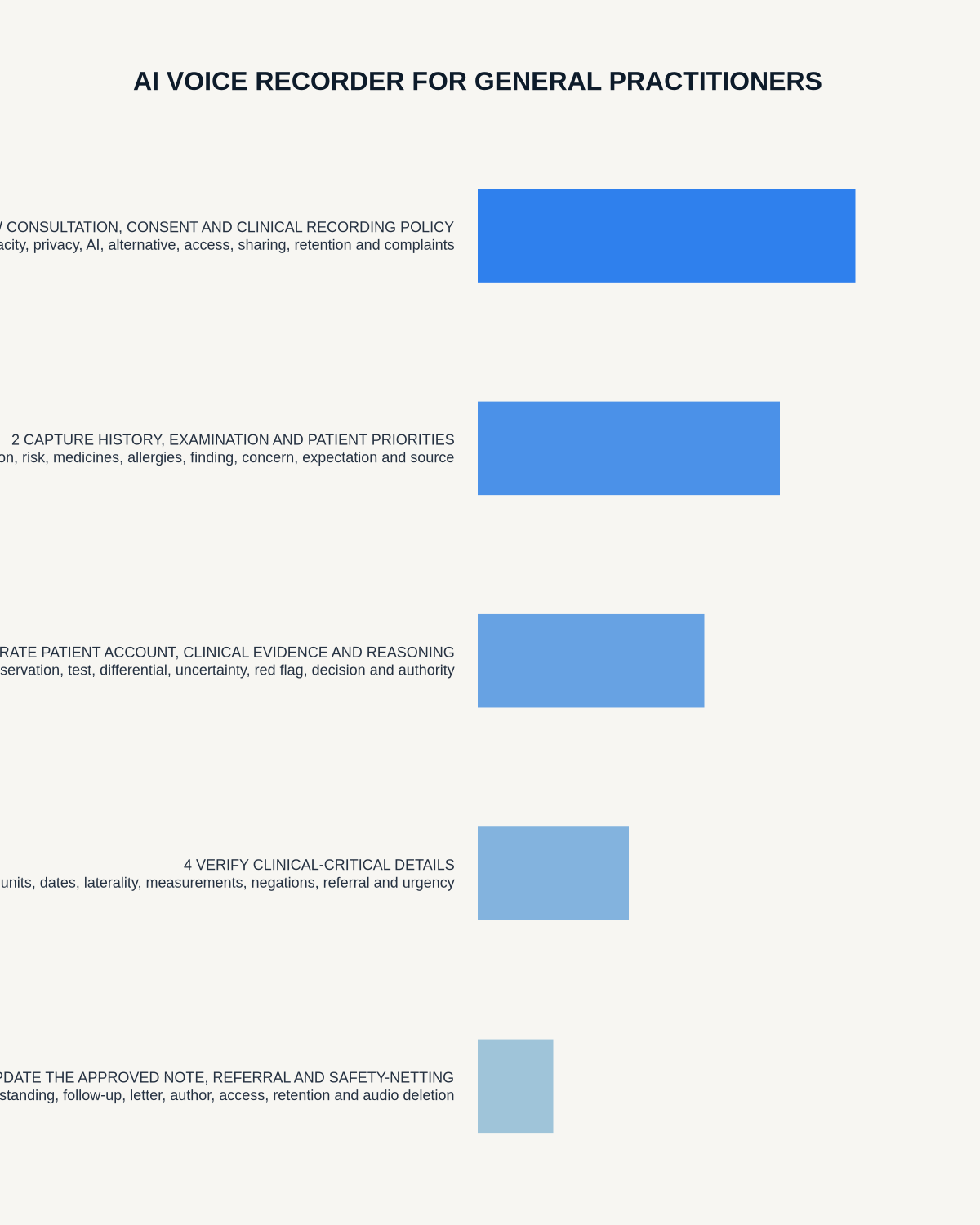
Visual map for AI Voice Recorder for General Practitioners: Consultations, Referrals and Clinical Notes
- Prepare the approved useDefine purpose, safe position, permission and the required formal record.
- Capture context firstState the case, asset, person, location or event identifier before detail.
- Human-verify evidenceCheck technical terms, units, names, dates, decisions and uncertainty.
- Complete the formal recordTransfer only verified information and apply access and retention controls.
On this page
Related guides
See whether Halo fits this workflow
Review the NERALVO Halo specifications, included services, delivery information and current offer only after completing the guide.
Found an error or an out-of-date claim? Email support@neralvo.com with the article address and a supporting source.