The 60-second verdict
Quick answer: an AI voice recorder can help dentists create more accurate drafts after consultations, treatment discussions and team meetings, but it must sit inside an approved clinical and information-governance process. The dentist remains responsible for consent, diagnosis, treatment decisions, safeguarding and the final patient record.
Best fit: Dentists who need recoverable audio and human-verified notes in an authorised workflow. Use another method when: recording is prohibited, a participant declines or the approved process requires manual notes.
Evidence basis and limits
- Decision factors covered: Use a concern-to-plan workflow; Keep information states separate; Protect consent and treatment-choice detail.
- Evidence rule: The decision is based on the complete capture-to-action workflow, not a single feature or marketing accuracy percentage.
- Boundary: Examples and workflow recommendations must be tested with representative recordings, the intended users and the actual approval process before rollout.
A device such as View Halo specifications for dentists use can reduce the pressure to remember every detail, but the recording and machine transcript should remain working sources rather than the authoritative dental record.
Use a concern-to-plan workflow
- Concern: record the patient’s reason for attendance and priorities in their own terms.
- Evidence: separate reported symptoms from examination, imaging and other verified findings.
- Assessment: preserve diagnosis, differentials and uncertainty accurately.
- Options: document reasonable choices, material risks, benefits, costs and alternatives.
- Decision: state what the patient agreed, declined or deferred.
- Plan: identify treatment, owner, timing, review and safety-net advice.
Keep information states separate
- Patient reported: pain, sensitivity, history, preferences and concerns.
- Observed or measured: examination findings, charting, periodontal measures and imaging results.
- Clinical assessment: the dentist’s interpretation and confidence.
- Proposed treatment: an option not yet accepted.
- Consent decision: what was agreed after discussion.
- Action completed: treatment actually delivered and any complication.
AI summaries can accidentally turn a possibility into a diagnosis or a proposed procedure into completed treatment. Verify every status against the source and clinical system.
Protect consent and treatment-choice detail
A useful record should show that the patient received understandable information about the condition, proposed treatment, material risks, alternatives, likely consequences of no treatment, costs where relevant and the opportunity to ask questions. Preserve any limitation, interpreter need, capacity concern or change of mind.
Recording does not create valid consent by itself. Consent remains an ongoing human conversation.
Verify dental terminology and numbers
Check tooth notation, surface, quadrant, side, measurement, medicine, dose, allergy, material, laboratory item, appointment date and quotation amount. Similar-sounding numbers and abbreviations can create serious errors.
Use a treatment-completion check
- Correct patient and procedure
- Site and tooth verified
- Local anaesthetic and medicines checked
- Materials and laboratory details accurate
- Complications or deviations recorded
- Post-operative advice reviewed
- Follow-up and safety net clear
Handle safeguarding and urgent risk immediately
Do not wait for transcription where there is uncontrolled bleeding, spreading infection, significant trauma, medical deterioration or a safeguarding concern. Follow the practice’s emergency or safeguarding process first, then complete the restricted factual record.
Protect privacy in the surgery
Dental surgeries may capture staff discussion, other patients, computer screens and sensitive medical information. Record only through an approved process, explain the purpose and alternative, limit access and delete temporary audio when its purpose ends.
How NERALVO Halo may fit dental practice
NERALVO Halo offers NOTE mode, supported CALL capture, 64GB local storage, up to 35 hours of recording and Bluetooth sync with DOWAY. DOWAY can create transcripts, summaries and structured exports. These features do not make the device automatically suitable for patient information; the dental provider must approve the full device, app, storage and deletion route.
Final dental-record checklist
- Patient concern preserved accurately
- Reported information separated from findings
- Diagnosis and uncertainty verified
- Options and consent decision clear
- Tooth, side, medicines and figures checked
- Treatment status accurate
- Safety net and follow-up assigned
- Final note stored in the authorised system
Bottom line: AI can accelerate drafting, but safe dental documentation still depends on verified findings, informed choice and accountable clinical judgement.
Dental treatment-decision and release toolkit
The final record should show a traceable path from the patient’s concern to the evidence, treatment choice and aftercare. Use the following control matrix for restorative, periodontal, endodontic, surgical, orthodontic and prosthodontic discussions.
| Control field | What to verify | Authoritative source |
|---|---|---|
| Tooth and site | Notation system, surface, quadrant, side and current chart status | Clinical chart and examination |
| Evidence | Symptoms, tests, periodontal values, radiograph or image date | Clinical record and imaging system |
| Diagnosis status | Confirmed, provisional, differential or awaiting investigation | Dentist’s documented assessment |
| Option status | Discussed, recommended, accepted, declined or deferred | Checked consultation note |
| Commercial detail | Price, estimate version, inclusions, exclusions and validity | Approved treatment plan or quotation |
| Delivery status | Planned, started, completed, abandoned or modified | Procedure and appointment record |
Complex-plan version control
For multi-stage treatment, state the current plan revision, diagnostic information still outstanding, provisional components, stage completed, next dependency and the point at which consent must be revisited. A later change to prognosis, cost, material, laboratory design or patient preference should create a new version rather than silently altering the earlier plan.
Medicine and local-anaesthetic verification
- Product and formulation.
- Concentration or strength.
- Dose, route and quantity.
- Allergy and interaction considerations.
- Batch or traceability information where required.
- Advice, warning signs and follow-up.
Numbers and similar product names should be checked against the clinical or medicines source, not accepted from the transcript.
Aftercare release standard
Patient-facing information should state what was done, expected short-term effects, practical care, medicine instructions, restrictions, specific warning signs, emergency contact and review arrangements. Confirm the information matches the actual treatment, not the original proposal.
NERALVO Halo workflow
Use Halo only within the practice-approved process. Test the surgery or consultation room, explain the capture clearly, create a draft through the approved DOWAY account and check every material clinical and consent detail before filing. Restrict raw audio more tightly than the final clinical note and apply the deletion date deliberately.
Cloud software, a dedicated recorder or manual notes?
For Dentists, the right answer changes with the setting. This matrix deliberately gives each method a situation where it can be the strongest choice.
| Situation | Best starting point | Reason |
|---|---|---|
| scheduled remote consultations | Cloud meeting software | Native remote-meeting workflows can be more efficient here. |
| in-person consultations or ward handovers | Dedicated recorder | A separate battery and recoverable local source improve resilience. |
| a patient declines or policy prohibits recording | Manual notes or an approved alternative | Manual notes are the correct control when recording is unavailable. |
| mixed remote and clinical work | Governed hybrid | A hybrid can combine automation with reliable physical capture. |
Related AI voice recorder guides
Profession workflow
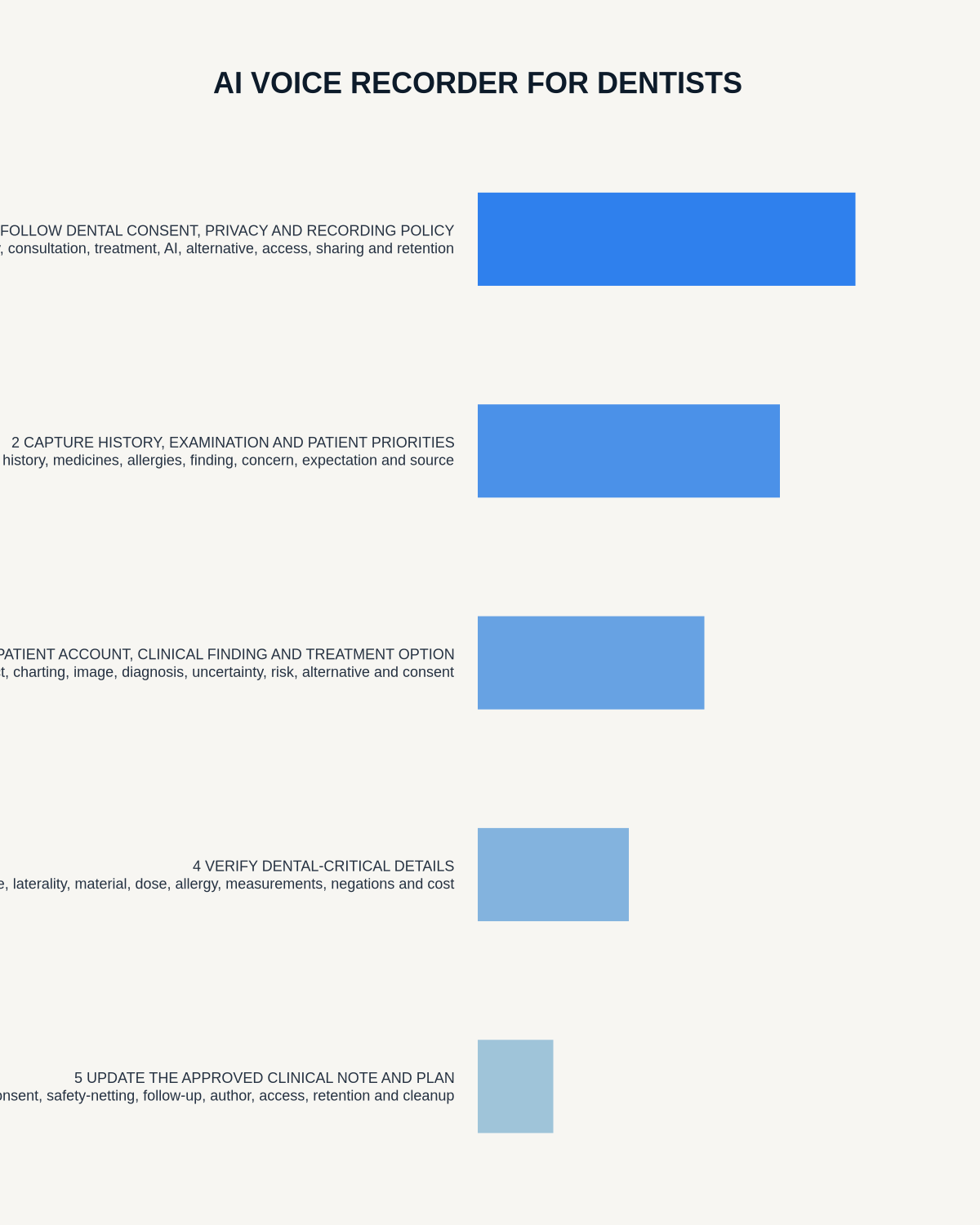
Visual map for AI Voice Recorder for Dentists: Consultations, Consent, Treatment Plans and Clinical Notes
- Prepare the approved useDefine purpose, safe position, permission and the required formal record.
- Capture context firstState the case, asset, person, location or event identifier before detail.
- Human-verify evidenceCheck technical terms, units, names, dates, decisions and uncertainty.
- Complete the formal recordTransfer only verified information and apply access and retention controls.
On this page
Related guides
Check permission, retention and access before choosing hardware
Once the policy requirements in this guide are satisfied, compare Halo’s specifications, local storage, included services and current offer against your approved workflow.
Found an error or an out-of-date claim? Email support@neralvo.com with the article address and a supporting source.