The 60-second verdict
Quick answer: health and safety managers can use an AI voice recorder for approved inspections, consultation, incident debriefs and action tracking, but it cannot assess risk independently or replace immediate control, competent investigation or formal safety records.
Best fit: Health and Safety Managers who need recoverable audio and human-verified notes in an authorised workflow. Use another method when: recording is prohibited, a participant declines or the approved process requires manual notes.
Evidence basis and limits
- Decision factors covered: Use the immediate-response sequence; Use a hazard → exposure → control → verification workflow; Keep evidence categories separate.
- Evidence rule: A claim earns weight only when the source, date, configuration and limitation are clear enough for a reader to check.
- Boundary: Examples and workflow recommendations must be tested with representative recordings, the intended users and the actual approval process before rollout.

Assess Halo against the health and safety managers workflow matrix can support approved evidence capture from a safe location. Competent people and controlled safety systems retain authority.
Use the immediate-response sequence
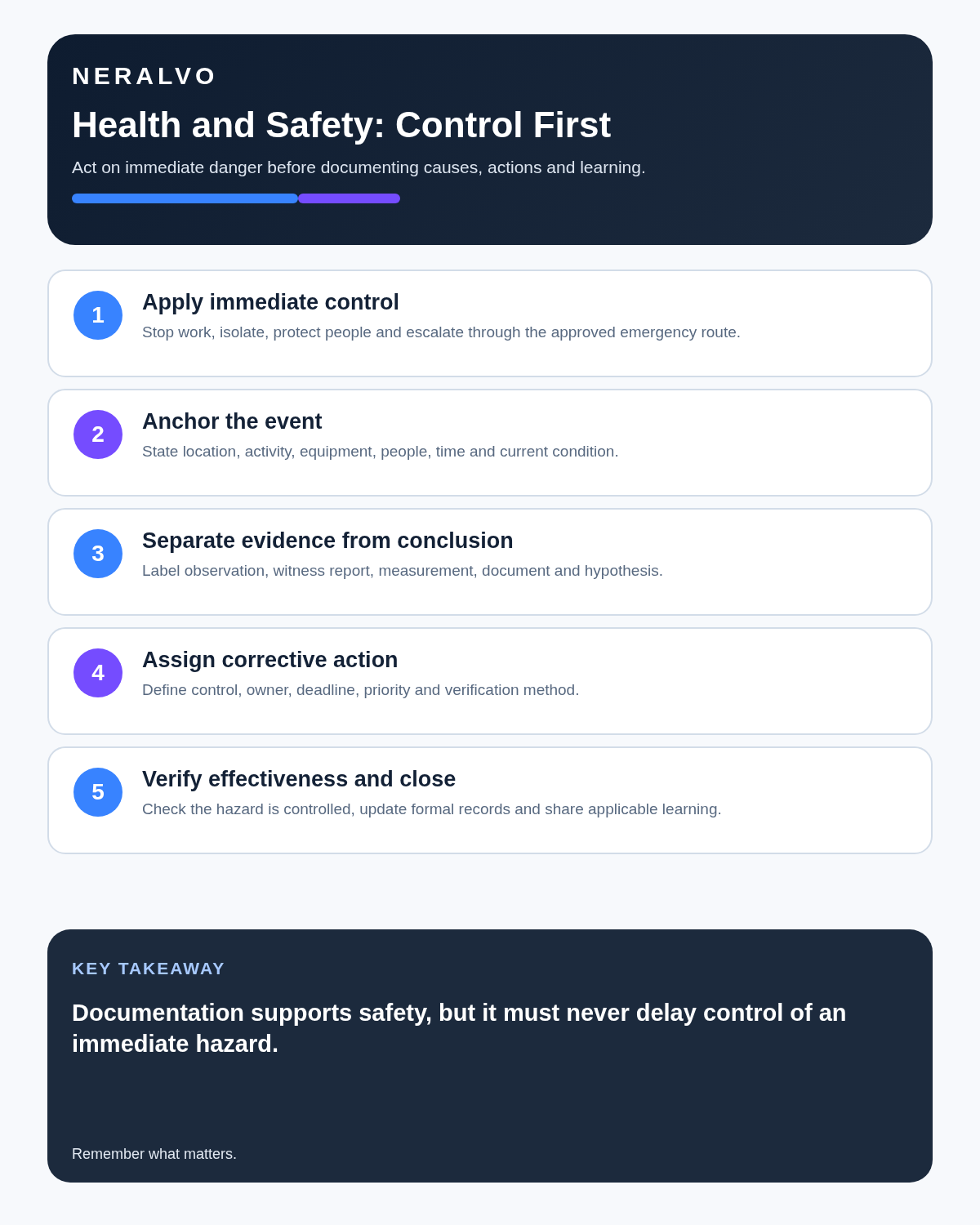
- Protect life and prevent further harm.
- Call emergency services and provide first aid where required.
- Stop work, isolate equipment or restrict access through the authorised process.
- Notify responsible people and regulators where required.
- Preserve relevant evidence without leaving the area unsafe.
- Record initial facts from a safe, private location.
- Begin the formal investigation.
The recorder has no role before urgent controls are active.
Use a hazard → exposure → control → verification workflow
| Stage | Required detail |
|---|---|
| Hazard | Source of potential harm |
| Exposure | Who may be harmed, how and under which conditions |
| Control | Existing and additional measures |
| Residual risk | What remains after controls are applied |
| Verification | Inspection, test, observation or monitoring that proves the control works |
Keep evidence categories separate
| Category | Example | Rule |
|---|---|---|
| Direct observation | Oil visible across a marked walkway | State time, location and evidence |
| Witness report | Alarm sounded after the vehicle moved | Attribute the speaker and preserve uncertainty |
| Documented state | Inspection record dated 18 July | Record exact reference and version |
| Hypothesis | Leak may have come from a hose | Label as untested |
| Conclusion | Inspection control was ineffective | Show evidence, analysis and authority |
AI must not turn a witness account into a verified fact, a hypothesis into a cause or a discussion into an admission of responsibility.
Use the FACTS note
- F — Frame: date, time, exact location, activity and people present.
- A — Actual observation: what was directly seen, heard or measured.
- C — Control: immediate isolation, restriction, care or protection.
- T — Trace: photographs, documents, equipment, samples and witnesses.
- S — Steps next: reporting, investigation, owner and review time.
Interview witnesses fairly
Where recording is lawful, approved and proportionate, explain the purpose, access and retention before starting. Ask open questions, avoid leading, distinguish direct knowledge from information learned later and allow the account to be checked through the organisation’s procedure.
Do not use automated emotion, credibility, personality or blame scoring. Stress, injury, language, disability and the interview setting can all affect how somebody sounds.
Investigate beyond the nearest error
Separate the event, immediate cause, contributing conditions, management-system weaknesses and root-cause hypotheses. Review equipment design, workload, supervision, competence, maintenance, procedures, communication and conflicting production pressures.
A fluent summary such as “operator error” is not a complete investigation.
Choose controls using the hierarchy
- Eliminate the hazard where reasonably practicable.
- Substitute a safer material, method or process.
- Use engineering controls and physical safeguards.
- Apply organisational controls, permits, supervision and safe systems.
- Use personal protective equipment for remaining exposure.
Training or reminders may be necessary, but they should not hide poor equipment design, impractical procedures or inadequate supervision.
Keep legal and reporting decisions human-controlled
AI can organise dates, people and descriptions, but it cannot determine whether an event is reportable, establish legal responsibility or decide enforcement action. The responsible competent person must apply current law, HSE guidance and organisational procedure to verified facts.
Turn findings into verified corrective action
- Control immediate risk.
- Capture factual evidence safely.
- Correct transcript errors and source attribution.
- Assess risk using the approved method.
- Investigate technical, human and organisational factors.
- Select controls using the hierarchy.
- Assign one owner, deadline, interim measure and required completion evidence.
- Verify implementation.
- Test effectiveness after a suitable interval.
- Update the formal safety, incident and risk systems.
“Remind staff” is not adequate closure unless the investigation shows that information or competence was the true control gap and effectiveness is checked.
Protect sensitive safety records
Incident recordings may contain health data, allegations, employee information and legally sensitive material. Use a defined purpose, restrict access, minimise identifiers and avoid continuous or covert workplace audio. Apply separate retention rules to source audio, working transcripts, investigation evidence and the authorised record.
How NERALVO Halo fits health and safety
NERALVO Halo includes NOTE mode, supported CALL mode, 64GB local storage, up to 35 hours of recording and Bluetooth sync with DOWAY. DOWAY can create transcripts, summaries, speaker-separated notes, templates, translations, mind maps and exports, with one year of DOWAY Max included.
It may support safe-position inspection notes, approved interviews and debriefs. It is not a risk-assessment, emergency, legal-compliance or incident-management system.
Cloud software, a dedicated recorder or manual notes?
For Health and Safety Managers, the right answer changes with the setting. This matrix deliberately gives each method a situation where it can be the strongest choice.
| Situation | Best starting point | Reason |
|---|---|---|
| scheduled remote consultations | Cloud meeting software | Auto-join and central collaboration can remove routine admin. |
| in-person consultations or ward handovers | Dedicated recorder | Dedicated hardware suits movement, variable rooms and offline source capture. |
| a patient declines or policy prohibits recording | Manual notes or an approved alternative | A clear alternative respects policy and participant choice. |
| mixed remote and clinical work | Governed hybrid | One governed process prevents gaps between desk and field work. |
Frequently asked questions
Should an incident be recorded before the area is controlled?
No. Protect people and prevent further harm first.
Can AI decide the root cause?
No. It may organise evidence and hypotheses, but competent investigators must test causation.
Can a transcript determine RIDDOR reportability?
No. The responsible person must apply current requirements to verified facts.
Final safety-note checklist
- Immediate danger controlled.
- Care and emergency response completed.
- Hazard and exposure precise.
- Facts, reports, hypotheses and conclusions separated.
- Witness information attributed fairly.
- Legal reporting decided by an authorised person.
- Controls follow a suitable hierarchy.
- Actions have owners, dates and evidence.
- Effectiveness review planned and completed.
- Formal safety systems updated.
Bottom line: use recording only after people and the workplace are safe. Preserve evidence categories, investigate beyond the nearest error and verify that the chosen controls actually reduce risk.
Related guides
See the guides for security managers, manufacturing supervisors and inspections and corrective actions.
On this page
Related guides
See whether Halo fits this workflow
Review the NERALVO Halo specifications, included services, delivery information and current offer only after completing the guide.
Found an error or an out-of-date claim? Email support@neralvo.com with the article address and a supporting source.