The 60-second verdict
Quick answer: hotel managers can use an AI voice recorder to preserve guest requests, service-recovery decisions, departmental handoffs and promised follow-up, but every promise must have clear authority, conditions, owner and deadline. The property-management, maintenance, incident and finance systems remain authoritative.
Best fit: Hotel Managers who need recoverable audio and human-verified notes in an authorised workflow. Use another method when: recording is prohibited, a participant declines or the approved process requires manual notes.
Evidence basis and limits
- Decision factors covered: Why guest promises are easily distorted; The guest → stay → issue → impact → remedy → owner → closure workflow; Use the STAY handover.
- Evidence rule: Claims are weighted by consequence: capture failure, changed meaning, access and recovery matter more than polished wording.
- Boundary: Examples and workflow recommendations must be tested with representative recordings, the intended users and the actual approval process before rollout.

Check whether NERALVO Halo fits hotel managers work can support approved desk, telephone and private post-event notes. It cannot authorise refunds, upgrades, security access or contractual remedies.
Why guest promises are easily distorted
A guest may explain a problem to reception, housekeeping, maintenance and management. Each conversation can create a different expectation. An AI summary can also turn “we will see what is possible” into “upgrade confirmed.”
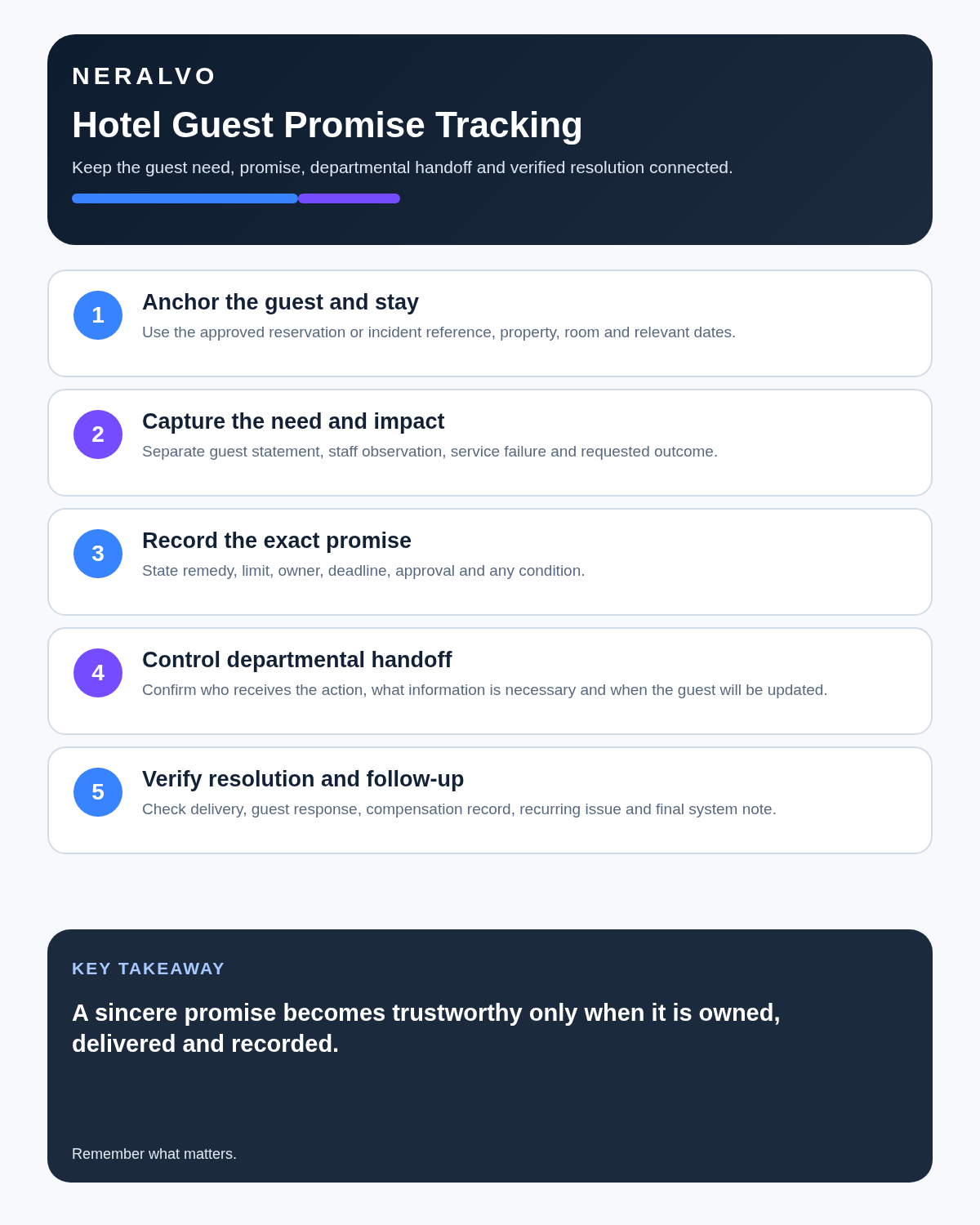
The guest → stay → issue → impact → remedy → owner → closure workflow
| Stage | Question | Output |
|---|---|---|
| Guest | Who is affected and how may they be contacted? | Verified identity |
| Stay | Which booking, room and dates? | Stable reference |
| Issue | What happened or was requested? | Accurate account |
| Impact | How did it affect safety, access, comfort or purpose? | Priority |
| Remedy | What is proposed or approved? | Clear status |
| Owner | Which person or department acts? | Accountability |
| Closure | How is delivery and guest understanding confirmed? | Resolved record |
Use the STAY handover
- S — Situation: what happened, what the guest needs and any immediate risk.
- T — Tracking reference: booking, room, event, complaint or maintenance ticket.
- A — Action taken: immediate response, temporary control and exact authorised promise.
- Y — Your next owner: named person or department, deadline, next guest update and completion evidence.
A handover fails when the next shift knows what happened but not what the guest was promised.
Verify the stay without exposing sensitive data
Check the booking reference, guest name, room, dates, package and contact preference through the approved system. Do not speak payment-card data, door codes, identity-document numbers or detailed security arrangements into a recording.
Separate proposal, approval and delivery
- Requested: the guest asks for an outcome.
- Exploring: staff are checking availability or authority.
- Proposed: a possible remedy has been discussed.
- Approved: an authorised person has confirmed it.
- Communicated: the guest has been told.
- Delivered: the remedy has happened.
- Accepted: the guest understands the outcome.
Capture the guest’s impact, not only the defect
“Air conditioning not working” is incomplete. State when it began, room condition, sleep or accessibility impact, previous contacts, temporary steps and the guest’s priority. This helps the manager choose a proportionate response.
Create a service-recovery record
- Guest account and verified facts.
- Operational finding.
- Immediate action.
- Options considered.
- Approved remedy and authority.
- Financial or inventory effect.
- Departmental owner.
- Guest update time.
- Delivery evidence.
- Final satisfaction or unresolved complaint route.
Fire alarms and immediate danger come first
Do not record during a fire alarm, evacuation, suspected fire, medical emergency, violent incident or other immediate danger. Follow the hotel’s emergency procedure, protect guests and staff, contact emergency services and preserve safe access before documenting.
A later voice note may support the chronology, but it cannot replace the fire-risk assessment, training, checks, evacuation record or formal incident process. Use current government sleeping-accommodation fire guidance and competent advice.
Official source: the UK government’s fire-safety risk-assessment guidance for sleeping accommodation covers hotels, guest houses and other sleeping premises. Use the current guidance alongside the property’s competent fire-safety arrangements.
Manage departmental handoffs
| Department | Useful handoff content |
|---|---|
| Reception | Guest contact, room, promise and update time |
| Housekeeping | Exact room issue, access and completion standard |
| Maintenance | Fault, urgency, access, safety and test required |
| Food and beverage | Order, dietary or service issue and authorised remedy |
| Security | Minimum necessary incident information and escalation |
| Finance or manager | Refund, credit or compensation authority |
Share only the information each team needs.
Control supplier and maintenance calls
Capture the attendance window, exact scope, affected room or asset, access arrangement, temporary control, parts or dependencies, cost authority and evidence required before closure. Send the approved instruction through the authorised system.
Do not return a room or facility to inventory merely because a contractor attended. Verify the repair, test the required function and record the person who accepted the work.
Handle accessibility and vulnerability carefully
Record the guest’s requested assistance accurately and route it through the correct operational process. Avoid unnecessary medical history. Do not promise suitability until the responsible team confirms it.
Control estimated times
Distinguish estimated technician arrival, room readiness, supplier response and confirmed completion. When timing is uncertain, provide a reliable next-update time rather than an invented deadline.
Close the loop with the guest
- Required service completed.
- Room or facility checked.
- Charge or credit applied correctly.
- Guest contacted through the agreed route.
- Remaining limitation explained.
- Complaint or incident escalated if unresolved.
- Pattern or root-cause action opened where appropriate.
Use a controlled post-conversation workflow
- Respond to safety and guest needs first.
- Move to a private approved location.
- Record the STAY note and exact guest promise.
- Correct room numbers, times, names and amounts.
- Update the property-management, maintenance, incident or HR system.
- Assign the next owner and deadline.
- Brief the next shift with minimum necessary detail.
- Verify delivery and contact the guest.
- Delete temporary audio under policy.
Protect guest privacy and security
Never leave a recorder running at reception, in corridors or in guest areas. Use approved accounts, restricted access and minimum necessary detail. Raw recordings may contain other guests, room numbers and personal circumstances. Apply separate retention to audio, working transcripts and final service records.
How NERALVO Halo fits hotel management
NERALVO Halo includes NOTE mode, supported CALL mode, 64GB local storage, up to 35 hours of recording and Bluetooth sync with DOWAY. CALL mode is not universal, so test the exact phone, case and route.
DOWAY supports transcripts, summaries, speaker-separated notes, templates, translations, mind maps and exports, with one year of DOWAY Max included. A trained manager must verify and transfer every useful detail into the official hotel systems.
Cloud software, a dedicated recorder or manual notes?
For Hotel Managers, the right answer changes with the setting. This matrix deliberately gives each method a situation where it can be the strongest choice.
| Situation | Best starting point | Reason |
|---|---|---|
| scheduled remote client meetings | Cloud meeting software | Calendar automation and shared integrations are usually the strongest advantage. |
| in-person visits and travel | Dedicated recorder | Independent capture reduces reliance on an active phone or laptop. |
| a client declines or policy requires manual notes | Manual notes or an approved alternative | The boundary takes priority over convenience. |
| mixed CRM and field work | Governed hybrid | Use each method only in the setting it actually fits. |
Frequently asked questions
Can an AI summary authorise compensation?
No. The remedy must be approved by a person with the required authority.
Should the full guest conversation be stored in the PMS?
Usually no. Save the concise verified service record needed for follow-up.
Can staff promise an exact repair time?
Only when the responsible department has confirmed it. Otherwise promise the next update.
Can recording continue during an emergency?
No. Emergency action, evacuation and guest safety take priority.
Final hotel checklist
- Guest and stay verified.
- Request, impact and prior contacts clear.
- Immediate danger handled first.
- Proposal separated from approved promise.
- Authority and conditions recorded.
- Departmental and supplier handoffs precise.
- Privacy and security protected.
- Repair or remedy delivered and checked.
- Guest updated and system closed.
Bottom line: a strong hotel voice note prevents a service failure from becoming a broken promise by making safety, authority, ownership and closure explicit.
Related guides
See the guides for restaurant managers, customer service teams and facilities managers.
On this page
Related guides
See whether Halo fits this workflow
Review the NERALVO Halo specifications, included services, delivery information and current offer only after completing the guide.
Found an error or an out-of-date claim? Email support@neralvo.com with the article address and a supporting source.