The 60-second verdict
Quick answer: restaurant managers can use an AI voice recorder for approved post-service debriefs, supplier calls, recipe-change discussions and operational actions. They must never rely on a transcript or AI summary to answer a live allergen question. Current approved ingredient and food-safety information controls the response.
Best fit: Restaurant Managers who need recoverable audio and human-verified notes in an authorised workflow. Use another method when: recording is prohibited, a participant declines or the approved process requires manual notes.
Evidence basis and limits
- Decision factors covered: Why allergen information cannot come from remembered conversation; The dish → version → ingredient → allergen → control → communication workflow; Use a live-guest fast lane.
- Evidence rule: Claims are weighted by consequence: capture failure, changed meaning, access and recovery matter more than polished wording.
- Boundary: Examples and workflow recommendations must be tested with representative recordings, the intended users and the actual approval process before rollout.

Check whether NERALVO Halo fits restaurant managers work can support safe post-task documentation. It is not an allergen, recipe, temperature or incident-control system.
Why allergen information cannot come from remembered conversation
Recipes, brands, supplier substitutions, garnishes and preparation methods can change. A confident transcript may describe an old version or omit cross-contact risk. The answer to a guest must come from the restaurant’s current controlled information and trained process.
The dish → version → ingredient → allergen → control → communication workflow
| Stage | Question | Output |
|---|---|---|
| Dish | Which menu item and location? | Stable identity |
| Version | Which current recipe and supplier specification? | Controlled source |
| Ingredient | What changed or is being queried? | Exact component |
| Allergen | What is present and what cross-contact applies? | Verified risk information |
| Control | What preparation and service process is required? | Safe operation |
| Communication | Who must update menus, systems and staff? | Consistent information |
Use a live-guest fast lane
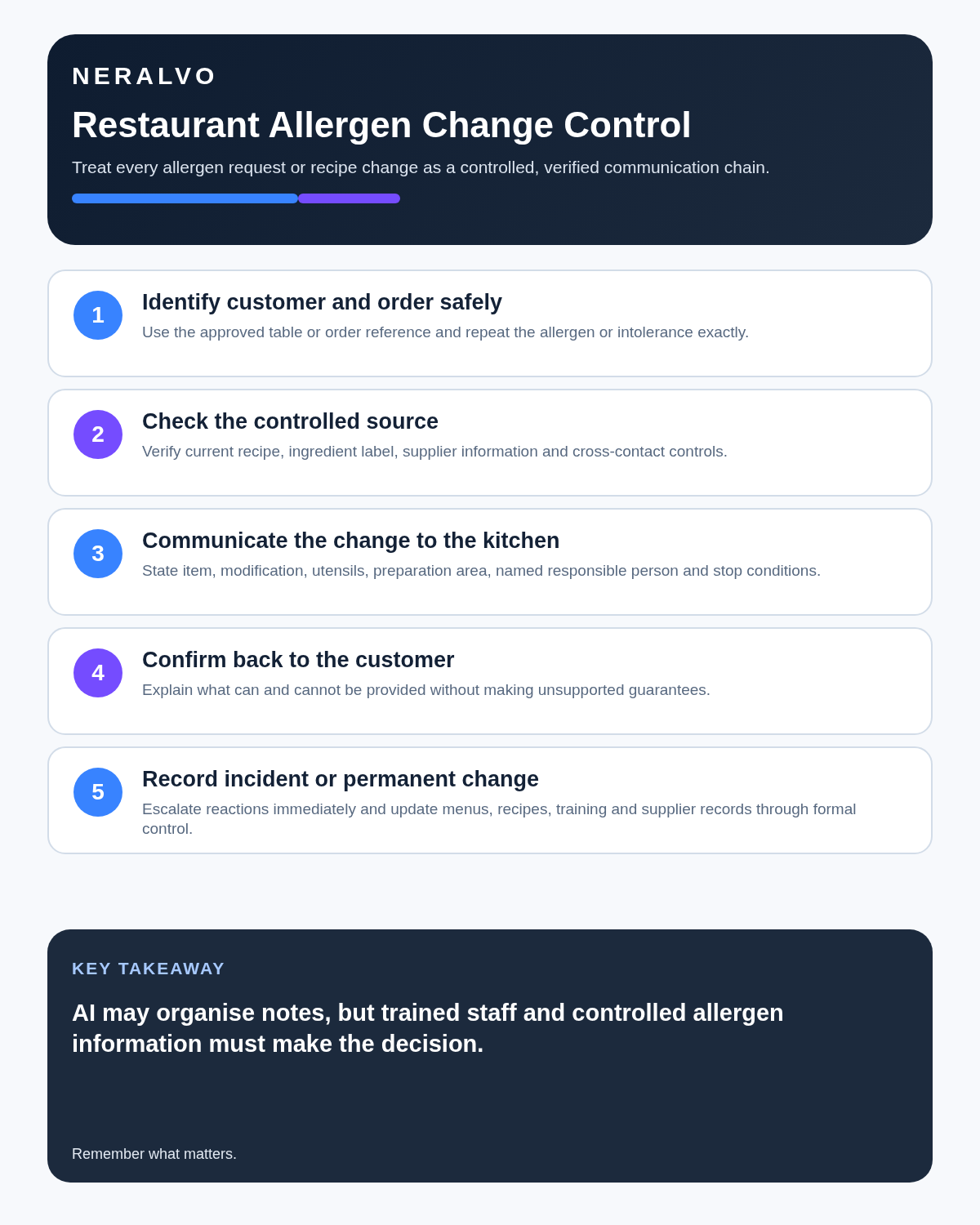
- Listen to the guest’s exact question.
- Pause the order where necessary.
- Check the current approved information.
- Consult the trained responsible person.
- Explain known information and limitations clearly.
- Confirm the order and guest understanding.
- Communicate the requirement to the kitchen through the approved process.
- Document only after immediate safety is controlled.
Never guess, infer from similar dishes or wait for an AI output.
Control ingredient substitutions
Before using a replacement ingredient, verify:
- Exact brand and product code.
- Supplier specification and label.
- Allergens and advisory statements.
- Recipe and yield impact.
- Cross-contact and preparation implications.
- Menu, digital ordering and printed information.
- Staff briefing and effective date.
- Approval by the responsible person.
Use a supplier-call card
- Supplier and named contact.
- Original product and code.
- Substitute product and code.
- Pack size, price and delivery date.
- Official ingredient and allergen document received.
- Person authorised to accept the substitution.
- Recipes, menus, labels and digital systems affected.
- Kitchen and front-of-house communication owner and deadline.
A verbal supplier statement is a lead to verify, not the controlled allergen source.
Use clear change statuses
- Proposed substitution.
- Awaiting specification.
- Approved temporary change.
- Approved permanent recipe.
- Menu and system updated.
- Staff briefed and checked.
- Old stock or information withdrawn.
Do not allow “chef knows about it” to substitute for a controlled update.
Separate observation, report and finding
| Status | Example |
|---|---|
| Guest reported | Reaction symptoms or previous advice |
| Staff observed | Order, label or preparation event |
| Documented | Recipe, specification or temperature record |
| Possible cause | Unverified explanation |
| Confirmed issue | Supported by investigation |
| Corrective action | Controlled change and effectiveness check |
Build an allergen or food-safety incident record
Follow the restaurant’s emergency and reporting process first. Then preserve the guest and order reference, dish and recipe version, time, staff and kitchen sequence, ingredient evidence, immediate response, medical or emergency escalation, retained evidence, notifications and corrective actions.
Do not assign blame or claim a confirmed cause before suitable investigation.
Verify staff communication
Attendance at a briefing does not prove understanding. Use practical checks, questions, supervision and current reference materials. Record who requires follow-up training.
Use current official allergen guidance
The Food Standards Agency states that food businesses must manage allergens and provide accurate information. Follow the restaurant’s approved food-safety process and review the current Food Standards Agency allergen guidance.
Control other restaurant operations
The same discipline applies to temperature deviations, cleaning failures, pest findings, foreign objects, equipment faults and supplier non-conformance: identify the exact area or batch, apply immediate control, preserve evidence, assign authority and verify closure.
Protect guest and employee information
Health and incident information requires restricted access. Record only what is necessary, use approved accounts and avoid capturing payment data or unrelated conversations.
How NERALVO Halo fits restaurant management
NERALVO Halo includes NOTE mode, supported CALL mode, 64GB local storage, up to 35 hours of recording and Bluetooth sync with DOWAY. DOWAY can create transcripts, summaries, speaker-separated notes, templates, translations, mind maps and exports, with one year of DOWAY Max included. Use it for approved debriefs and supplier notes—not real-time allergen decisions.
Cloud software, a dedicated recorder or manual notes?
For Restaurant Managers, the right answer changes with the setting. This matrix deliberately gives each method a situation where it can be the strongest choice.
| Situation | Best starting point | Reason |
|---|---|---|
| scheduled remote client meetings | Cloud meeting software | Calendar automation and shared integrations are usually the strongest advantage. |
| in-person visits and travel | Dedicated recorder | Independent capture reduces reliance on an active phone or laptop. |
| a client declines or policy requires manual notes | Manual notes or an approved alternative | The boundary takes priority over convenience. |
| mixed CRM and field work | Governed hybrid | Use each method only in the setting it actually fits. |
Frequently asked questions
Can AI answer whether a dish is allergen-free?
No. Use the restaurant’s current verified ingredient and preparation information.
Can a supplier’s verbal statement approve a substitution?
No. Obtain and review the required specification and update the controlled recipe process.
Does a staff briefing prove competence?
No. Understanding and correct application should be checked.
Final restaurant checklist
- Guest safety action taken first.
- Dish, recipe and supplier version identified.
- Allergen information checked from controlled sources.
- Substitution status and authority clear.
- Kitchen and front-of-house communication verified.
- Incident facts separated from cause.
- Health and personal data restricted.
- Menus, systems and training updated.
Bottom line: safe allergen communication depends on current controlled information and trained people, never remembered discussion or an AI summary.
Related guides
See the guides for hotel managers, quality managers and health and safety managers.
On this page
Related guides
See whether Halo fits this workflow
Review the NERALVO Halo specifications, included services, delivery information and current offer only after completing the guide.
Found an error or an out-of-date claim? Email support@neralvo.com with the article address and a supporting source.