The 60-second verdict
Quick answer: insurance brokers can use an AI voice recorder to capture the renewal delta—what has changed since the expiring placement—but the transcript cannot determine cover, underwriting acceptance, disclosure sufficiency or suitability. Client statements, evidence, market terms and advice must remain separate.
Best fit: Insurance Brokers who need recoverable audio and human-verified notes in an authorised workflow. Use another method when: recording is prohibited, a participant declines or the approved process requires manual notes.
Evidence basis and limits
- Decision factors covered: Why renewal meetings should focus on change; The expiring programme → client report → evidence → market impact → option → advice → placement workflow; Label evidence states.
- Evidence rule: A claim earns weight only when the source, date, configuration and limitation are clear enough for a reader to check.
- Boundary: Examples and workflow recommendations must be tested with representative recordings, the intended users and the actual approval process before rollout.

Assess Halo against the insurance brokers workflow matrix can support approved client meetings and calls. It cannot bind cover or replace broking and insurer systems.
Why renewal meetings should focus on change
Repeating the entire previous fact-find can hide the material developments that affect the risk. The renewal delta should identify changes in activity, locations, people, assets, revenue, claims, contracts, security and required protection.
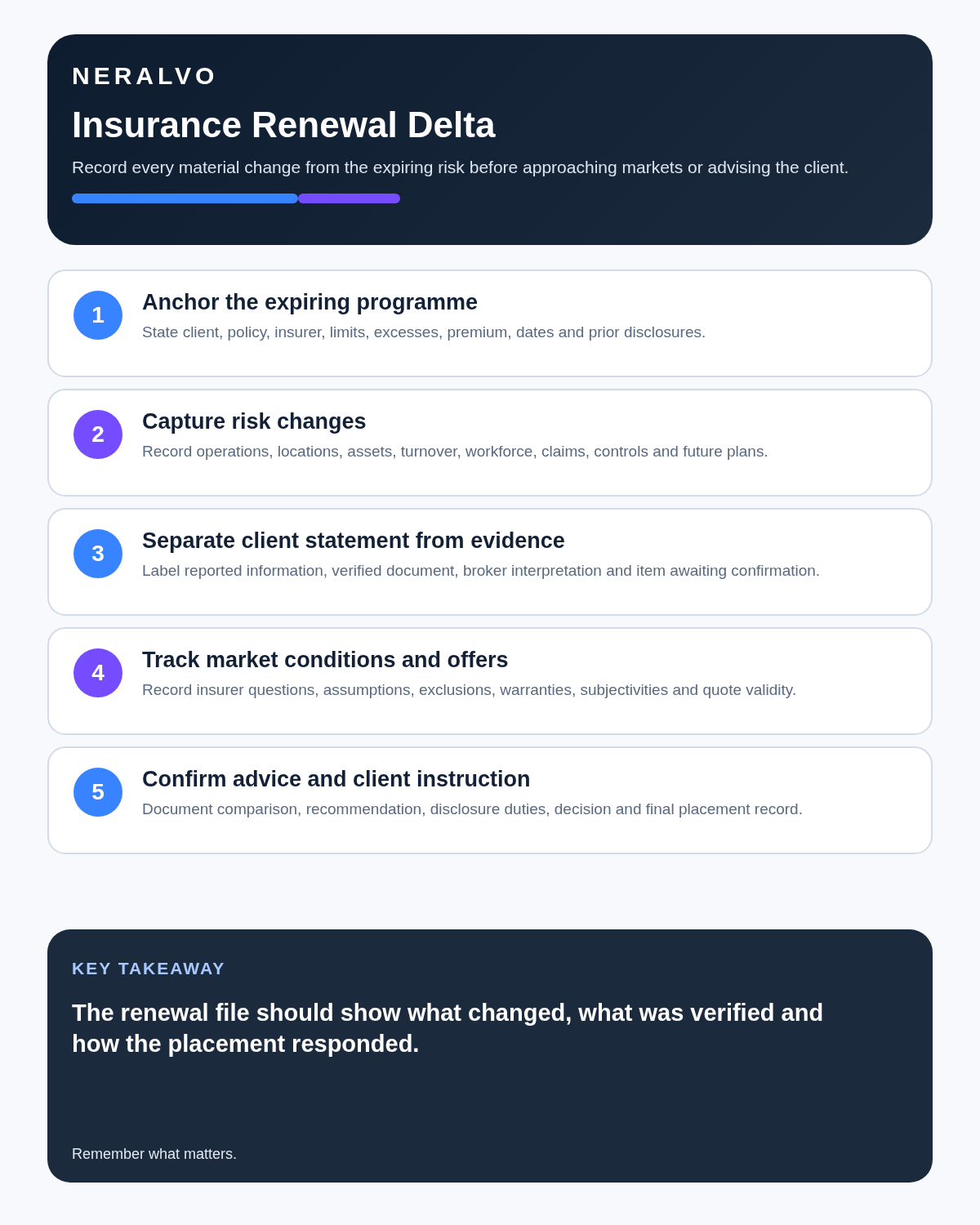
The expiring programme → client report → evidence → market impact → option → advice → placement workflow
| Stage | Question | Output |
|---|---|---|
| Expiring programme | What cover, limits, excesses and conditions currently apply? | Baseline |
| Client report | What has changed? | Attributed information |
| Evidence | What supports the material facts? | Verified presentation |
| Market impact | How might changes affect appetite or terms? | Broking analysis |
| Option | What quotation or structure is available? | Conditional offer |
| Advice | What does the broker recommend and why? | Client-ready comparison |
| Placement | What is instructed, bound and documented? | Final record |
Use a renewal-delta checklist
- Business activities, products and services.
- Locations and territories.
- Turnover, payroll and asset values.
- Vehicles, equipment and stock.
- Claims, incidents and near misses.
- Contracts and customer dependencies.
- Staffing, subcontractors and work patterns.
- Security, continuity and risk controls.
- Required limits, excesses and extensions.
- Known future changes.
Label evidence states
- Client reported.
- Estimated.
- Document verified.
- Insurer requested.
- Outstanding.
- Broker analysis.
- Insurer condition.
- Bound and confirmed.
Do not allow an AI summary to turn a client statement such as “the alarm is serviced annually” into “the insurer’s alarm requirement is satisfied.”
Demands and needs must be derived, not copied
A transcript can show the client’s answers, but it cannot establish that the approved questions were complete, material information was identified or the proposed product is consistent with the customer’s demands and needs.
The broker remains responsible for asking appropriate follow-up questions, comparing changes with the previous record, identifying missing evidence, assessing the customer’s required outcome and completing the firm’s authorised demands-and-needs and advice record. Review the current FCA ICOBS demands-and-needs rules.
Consumer understanding needs an active check
The existence of a recording does not prove the customer understood the explanation. Check whether material exclusions, excesses, limits, warranties, subjectivities and conditions were prominent; whether technical language was clarified; whether the client had time to ask questions; and whether a vulnerable customer needed a different pace, format or support.
The reviewed written follow-up should match the spoken explanation and make material differences from the expiring programme easy to identify. Review the FCA’s Consumer Duty overview for the current consumer-understanding framework.
Do not promise cover
| Status | Meaning |
|---|---|
| Market indication | Preliminary position |
| Quotation | Offer subject to stated terms |
| Client preference | Desired option, not placement |
| Instruction | Client directs action |
| Bound | Cover placed under authorised process |
| Confirmed | Documentation checked and issued |
Verify material figures and dates
Check values, limits, claims, addresses, occupations, vehicle details, policy periods, retroactive dates and deadlines against suitable evidence. Record the source date because stale information can be misleading.
Preserve terms and exclusions
AI summaries may highlight premium and omit warranties, subjectivities, exclusions, endorsements and claims conditions. Use the full insurer wording and explain material differences.
Build accountable follow-up
Every outstanding item should have an exact document or answer, owner, deadline, insurer dependency and consequence if not supplied. Distinguish information needed for quotation from conditions required before inception.
Claims notifications need an uncertainty log
At first notification, separate what the client personally observed, what another person reported, estimated loss or damage, confirmed injury or urgent safety concern, evidence available, action already taken and facts still subject to insurer or loss-adjuster investigation.
Do not delay urgent medical, safety or loss-mitigation action to complete a recording. The transcript is a source, not a liability or causation decision.
Protect sensitive personal and commercial data
Insurance conversations may include health, criminal-offence, financial, employee and claims information. Use only the approved device, account and processing route; minimise identifiers; restrict access; and apply separate retention rules to audio, transcripts and the regulated record.
Pause or stop before payment-card details, passwords, one-time codes, security answers or unrelated sensitive information are spoken. Use approved secure channels for identity, claims and financial documents.
A controlled renewal-call protocol
- Prepare the expiring risk record and known changes.
- Confirm the approved recording arrangement.
- Review every material risk area rather than asking only “has anything changed?”
- Repeat names, addresses, dates and figures clearly.
- Generate and correct the transcript.
- Populate the renewal-delta record.
- Compare statements with supporting evidence.
- Identify insurer, product and advice questions.
- Complete demands-and-needs and advice controls.
- Send a reviewed written confirmation.
- Apply retention separately to audio, draft transcript and official record.
How NERALVO Halo fits insurance broking
NERALVO Halo includes NOTE mode, supported CALL mode, 64GB local storage, up to 35 hours of recording and Bluetooth sync with DOWAY. CALL mode is not universal, so test the exact phone, case and route.
DOWAY provides transcripts, summaries, speaker-separated notes, templates, translations, mind maps and exports, with one year of DOWAY Max included. It cannot bind cover, assess suitability or interpret policy wording authoritatively.
Cloud software, a dedicated recorder or manual notes?
For Insurance Brokers, the right answer changes with the setting. This matrix deliberately gives each method a situation where it can be the strongest choice.
| Situation | Best starting point | Reason |
|---|---|---|
| scheduled remote meetings | Cloud meeting software | Auto-join and central collaboration can remove routine admin. |
| in-person or mobile work | Dedicated recorder | Dedicated hardware suits movement, variable rooms and offline source capture. |
| recording is refused or prohibited | Manual notes or an approved alternative | A clear alternative respects policy and participant choice. |
| mixed online and offline work | Governed hybrid | One governed process prevents gaps between desk and field work. |
Frequently asked questions
Can a client statement be copied directly into the market presentation?
It should be reviewed, clarified and supported appropriately.
Does a quotation mean the client is covered?
No. Cover begins only through the required binding and confirmation process.
Can AI summarise policy wording safely?
It can assist review, but material terms must be checked against the full insurer documents.
Does a recorded explanation prove customer understanding?
No. The broker should actively check comprehension and provide a clear reviewed follow-up.
Final insurance checklist
- Expiring baseline clear.
- Changed risks identified.
- Client report and evidence separated.
- Demands and needs assessed.
- Customer understanding checked.
- Outstanding information owned.
- Market status accurately labelled.
- Claims uncertainty preserved.
- Terms, exclusions and conditions retained.
- Client instruction and binding distinct.
- Broking and policy systems reconciled.
- Audio, drafts and regulated records controlled separately.
Bottom line: the strongest renewal voice note shows exactly what changed, what supports it, what the customer needs and what remains conditional before cover is confirmed.
Related guides
See the guides for financial advisers, mortgage brokers and accountants.
On this page
Related guides
See whether Halo fits this workflow
Review the NERALVO Halo specifications, included services, delivery information and current offer only after completing the guide.
Found an error or an out-of-date claim? Email support@neralvo.com with the article address and a supporting source.