The 60-second verdict
Quick answer: mortgage brokers can use an AI voice recorder to preserve applicant objectives, fact-find gaps, lender questions and agreed follow-up, but the transcript cannot prove affordability, eligibility, product availability or suitability. Client statements, evidence, sourcing results and advice must remain separate.
Best fit: Mortgage Brokers who need recoverable audio and human-verified notes in an authorised workflow. Use another method when: recording is prohibited, a participant declines or the approved process requires manual notes.
Evidence basis and limits
- Decision factors covered: Why mortgage transcripts can create false certainty; The objective → statement → evidence → gap → sourcing → advice → application workflow; Capture the objective precisely.
- Evidence rule: Claims are weighted by consequence: capture failure, changed meaning, access and recovery matter more than polished wording.
- Boundary: Examples and workflow recommendations must be tested with representative recordings, the intended users and the actual approval process before rollout.

Check whether NERALVO Halo fits mortgage brokers work can support approved meetings and post-call drafting. It is not a sourcing, credit, affordability, identity or regulated-advice system.
Why mortgage transcripts can create false certainty
Applicants often provide approximate income, expenditure, deposit and property information during an early call. A fluent summary may present those estimates as verified facts or treat an indicative conversation as a lender decision.
The objective → statement → evidence → gap → sourcing → advice → application workflow
| Stage | Question | Output |
|---|---|---|
| Objective | What is the applicant trying to achieve and by when? | Clear need |
| Statement | What has the applicant reported? | Attributed fact-find |
| Evidence | What supports material facts? | Verified data |
| Gap | What remains missing, inconsistent or uncertain? | Action list |
| Sourcing | Which current products and criteria may fit? | Market evidence |
| Advice | What recommendation follows and why? | Regulated record |
| Application | What is submitted, declared and tracked? | Controlled case |
Capture the objective precisely
- Purchase, remortgage, product transfer or further advance.
- Property type, price or estimated value.
- Deposit source and amount.
- Target completion or rate-expiry date.
- Term, repayment preference and budget.
- Future changes the applicant expects.
- Protection or related needs requiring separate discussion.
Separate the product request from the underlying objective
A client may ask for a five-year fixed product. The broker should still establish the reason: payment certainty, expected move or remortgage date, rate concerns, future income changes, early-repayment flexibility, fee priorities or monthly-payment limits.
The requested product is part of the client’s stated preference. It is not the completed suitability conclusion.
Use four clear information states
| State | Example | Required action |
|---|---|---|
| Client statement | “My bonus is usually about £8,000.” | Record attribution and qualification |
| Document-verified fact | Bonus shown in accepted evidence | Enter the verified amount under firm process |
| Broker interpretation | Income may be variable or only partly usable | Apply current firm and lender criteria |
| Outstanding gap | Evidence or explanation remains missing | Assign request, owner and deadline |
An AI summary must not collapse these states into one clean figure.
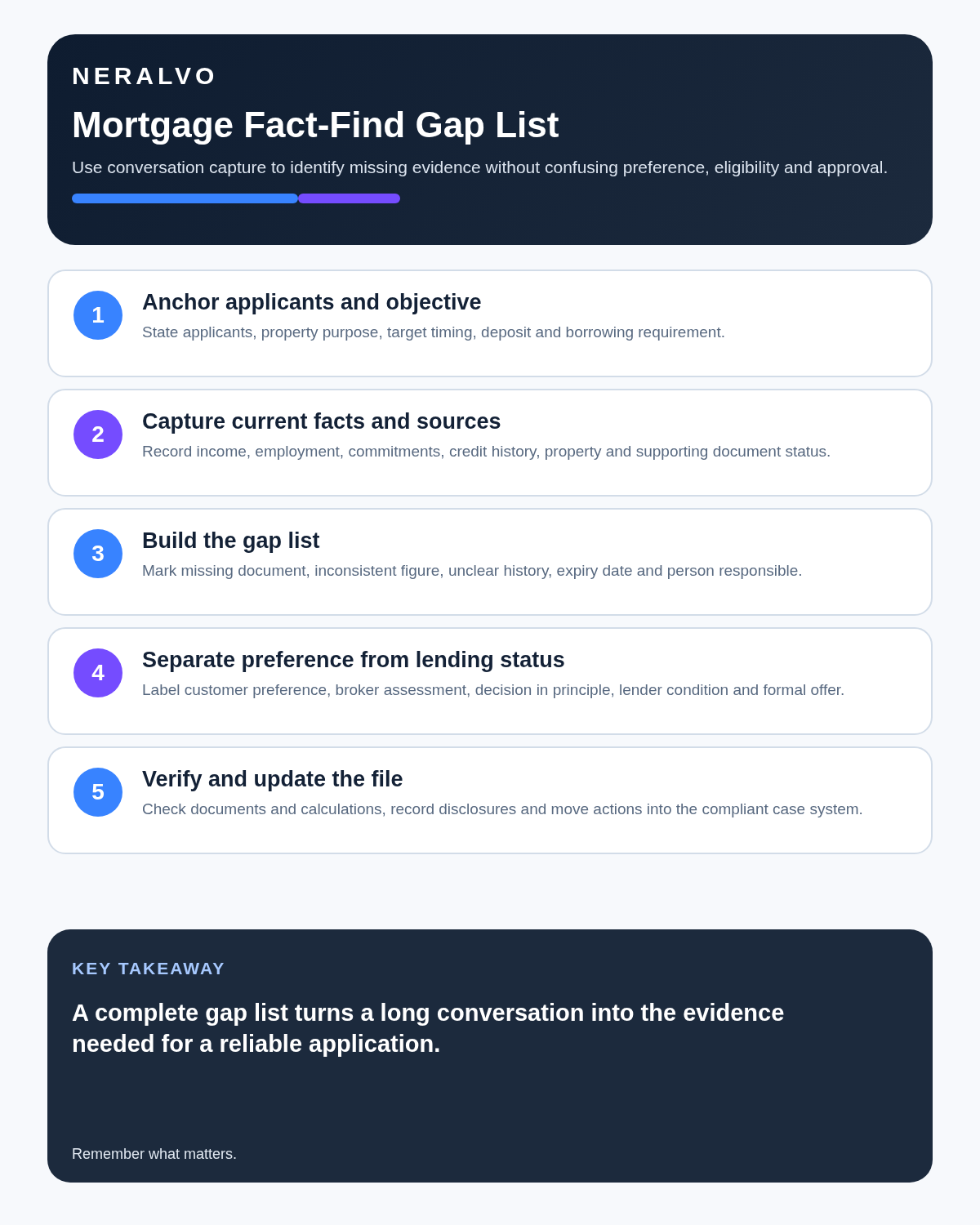
Open the gap tracker before the meeting
Prepare headings for identity and household, employment and income, expenditure and commitments, deposit and source, credit history, property objective, timescale and foreseeable changes, preferences and priorities, and documents or explanations required.
The recorder supports the conversation. The gap tracker controls what the case still needs.
Build the fact-find gap card
| Field | Record |
|---|---|
| Topic | Income, deposit, credit, commitment or another area |
| Client account | What was stated and by whom |
| Inconsistency | Conflict with another answer, document or existing record |
| Evidence needed | Document, explanation or third-party confirmation |
| Reason | Why it matters to advice or application |
| Owner | Client, broker, administrator or lender contact |
| Deadline | Latest useful date |
| Status | Requested, received, checked or unresolved |
Repeat consequential figures clearly
Use confirmation questions:
- Is that monthly or annual?
- Is the income guaranteed, variable or discretionary?
- Does it include overtime, commission or allowance?
- Is the deposit saved, gifted, borrowed or from a sale?
- What change is expected before completion?
- Which document can verify the figure?
Clear repetition reduces transcription error but does not replace documentary evidence.
Verify material numbers
Check income, bonuses, overtime, self-employed figures, committed expenditure, debts, deposit, term, rate, fees, monthly payment and early-repayment charges against suitable sources and current product information.
Separate preference from product status
| Status | Meaning |
|---|---|
| Applicant preference | Desired feature or structure |
| Indicative criteria fit | Potential fit under current information |
| Sourcing result | Current product identified through the approved tool |
| Decision in principle | Subject to lender terms and full assessment |
| Formal offer | Current lender document with conditions |
| Completed mortgage | Transaction completed through the controlled process |
“Criteria appears suitable” is not “the lender will accept.”
Handle lender and administrator calls carefully
After an approved call, record:
- Case reference.
- Person and department spoken to.
- Question asked.
- Information provided.
- Whether the response is general criteria or case-specific status.
- Documents or action still required.
- Expected next review.
- Any qualification or limitation.
Update the live case file. A spoken indication should never be presented as guaranteed approval.
Document the recommendation
- Applicant objective and priorities.
- Verified material facts and assumptions.
- Options considered.
- Recommended product and rationale.
- Rate, fees, term and repayment implications.
- Risks, limitations and future uncertainty.
- Why alternatives were not selected.
- Applicant questions and understanding.
- Instructions and outstanding conditions.
The recorder can preserve source detail. Suitability remains an accountable professional conclusion based on relevant verified facts and the firm’s current process.
Current FCA mortgage-advice framework
The FCA’s current mortgage rules require firms to apply the relevant advising and selling standards and, where advice is given, to base the recommendation on the customer’s needs and circumstances through the regulated process. A recording can support information capture, but it cannot determine suitability or replace the firm’s compliance controls.
Use the current FCA MCOB 4 advising and selling standards alongside the firm’s approved procedures.
Do not let AI resolve inconsistencies
Where answers, documents or existing records conflict, preserve the original wording and evidence states. Do not ask AI to invent a plausible explanation that makes the file appear consistent.
Flag material discrepancies through the firm’s compliance and financial-crime process and document the resolution or continuing uncertainty.
Use a controlled meeting-to-case workflow
- Use the firm’s approved recording and processing method.
- Explain purpose, access and handling to the client.
- Run the conversation naturally while clarifying critical detail.
- Generate the transcript as source material.
- Correct names, dates, figures and speaker attribution.
- Populate the fact-find gap tracker.
- Obtain and check required evidence.
- Resolve or escalate inconsistencies.
- Complete the firm’s fact-find, sourcing and suitability analysis.
- Issue required written communication through the approved process.
- Apply retention separately to audio, transcript and the formal case record.
Protect identity and financial data
Do not record passwords, one-time codes, full bank details, payment-card data or unnecessary identity-document information. Use approved secure upload and case systems. Restrict raw audio and apply a separate retention decision from the regulated file.
How NERALVO Halo fits mortgage broking
NERALVO Halo includes NOTE mode, supported CALL mode, 64GB local storage, up to 35 hours of recording and Bluetooth sync with DOWAY. CALL mode is not universal, so test the exact phone, case and route.
DOWAY provides transcripts, summaries, speaker-separated notes, templates, translations, mind maps and exports, with one year of DOWAY Max included. It cannot determine lender acceptance, affordability, suitability or compliance.
Cloud software, a dedicated recorder or manual notes?
For Mortgage Brokers, the right answer changes with the setting. This matrix deliberately gives each method a situation where it can be the strongest choice.
| Situation | Best starting point | Reason |
|---|---|---|
| scheduled remote meetings | Cloud meeting software | Calendar automation and shared integrations are usually the strongest advantage. |
| in-person or mobile work | Dedicated recorder | Independent capture reduces reliance on an active phone or laptop. |
| recording is refused or prohibited | Manual notes or an approved alternative | The boundary takes priority over convenience. |
| mixed online and offline work | Governed hybrid | Use each method only in the setting it actually fits. |
Frequently asked questions
Can AI complete missing fact-find fields?
No. Missing information should remain visibly outstanding.
Does a decision in principle guarantee the mortgage?
No. It remains subject to full underwriting, property and lender conditions.
Can a product mentioned on a call be treated as advised?
No. Discussion, sourcing and formal recommendation are different stages.
Can an AI summary resolve inconsistent income documents?
No. The discrepancy must be investigated and handled through the firm’s authorised process.
Final mortgage checklist
- Objective and deadline clear.
- Product request separated from underlying need.
- Reported, estimated and verified facts distinct.
- Gap card complete and owned.
- Material figures checked.
- Lender-call status accurately qualified.
- Current product information used.
- Recommendation rationale documented.
- FCA MCOB and firm procedures applied.
- Inconsistencies resolved or escalated.
- Sensitive data protected.
- Case systems and deadlines updated.
Bottom line: a reliable mortgage voice note exposes missing and conflicting evidence while preserving the reasoning without turning an early conversation into a lender decision.
Related guides
See the guides for financial advisers, insurance brokers and estate agents.
On this page
Related guides
See whether Halo fits this workflow
Review the NERALVO Halo specifications, included services, delivery information and current offer only after completing the guide.
Found an error or an out-of-date claim? Email support@neralvo.com with the article address and a supporting source.