The 60-second verdict
Quick answer: letting agents can use an AI voice recorder to preserve property questions, applicant needs, landlord instructions and agreed actions, but questions, preferences, proposals, approvals, conditions and formal agreement must remain separate. Verify every material fact before it enters advertising, negotiation or tenancy records.
Best fit: Letting Agents who need recoverable audio and human-verified notes in an authorised workflow. Use another method when: recording is prohibited, a participant declines or the approved process requires manual notes.
Evidence basis and limits
- Decision factors covered: Why lettings conversations create accidental promises; Use five clear lettings statuses; Anchor every property conversation.
- Evidence rule: A claim earns weight only when the source, date, configuration and limitation are clear enough for a reader to check.
- Boundary: Examples and workflow recommendations must be tested with representative recordings, the intended users and the actual approval process before rollout.

Assess Halo against the letting agents workflow matrix can support approved viewings and calls. The property, CRM, compliance and tenancy systems remain authoritative.
Why lettings conversations create accidental promises
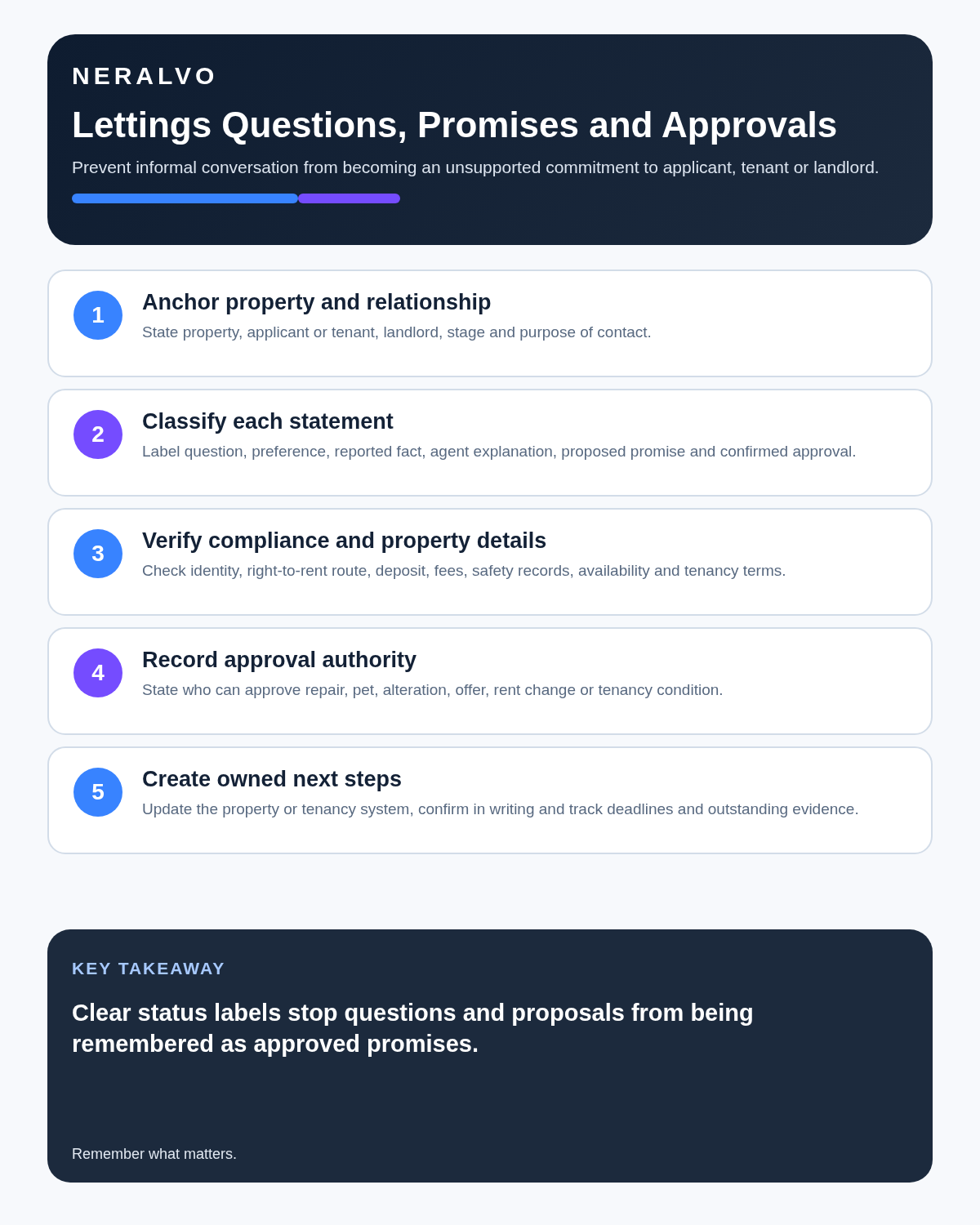
Applicants ask about pets, decoration, move-in dates, furniture, repairs and price. An agent may agree only to ask the landlord, while a summary turns the request into permission. That creates avoidable disputes.
Use five clear lettings statuses
| Status | Example | Correct action |
|---|---|---|
| Question | “Will the landlord allow a cat?” | Seek the authorised answer |
| Preference | “We would like to move on the 12th.” | Record the requirement, not a confirmed date |
| Proposal | “The landlord may repaint first.” | Confirm scope, authority and timing |
| Approval | “The landlord has agreed the repair and cost.” | Update the official record and communicate accurately |
| Condition | “Approval depends on references and contract.” | Preserve the condition in every follow-up |
Formal agreement is a further controlled stage. An approved request does not automatically amend a tenancy, listing or contract.
The property → question → source → verification → authority → agreement workflow
| Stage | Question | Output |
|---|---|---|
| Property | Which address, unit and listing? | Stable reference |
| Question | What exactly is being asked? | Clear issue |
| Source | Who supplied the information? | Attribution |
| Verification | What document or inspection supports it? | Reliable fact |
| Authority | Who can approve the request? | Decision owner |
| Agreement | What is formally confirmed and recorded? | Controlled outcome |
Anchor every property conversation
State the full property reference, appointment type, participant, date, room or area, current listing version and relevant tenancy stage. Repeat the address after moving to another property.
Post-viewing notes are often better than recording the whole viewing
A full viewing may capture unnecessary conversation inside somebody’s home. A short private note afterwards can preserve property and viewing time, applicant reference, stated interest, questions requiring confirmation, condition concerns, preferred move date, documents promised, approval needed and the next action, owner and deadline.
Move useful details into the CRM promptly rather than keeping a long audio diary.
Verify material property information
- Rent, deposit and included charges.
- Availability and move-in date.
- Furnishing and inventory.
- Utilities, parking and access.
- Restrictions and permissions.
- Safety or compliance information.
- Repair status.
- Licence, building or tenure requirements where relevant.
A landlord or tenant statement may be useful, but advertising and formal records should use appropriate evidence.
Control applicant requests
For pets, alterations, decoration, accessibility, early access, break clauses or furniture changes, capture the exact request, reason where relevant, decision authority, conditions, deadline and written-confirmation route. Do not promise approval while waiting for the landlord.
Confirm material landlord instructions
For rent, availability, repairs, furnishings, pets, applicant selection or other material instructions, record which property and tenancy stage are affected, what was asked, what the landlord approved, rejected or left open, conditions, cost or timing implications, documents requiring update and who needs written confirmation.
A voice transcript should not be the only evidence of a material landlord instruction.
Handle repair information carefully
| Status | Meaning |
|---|---|
| Reported | Issue described by tenant or applicant |
| Inspected | Condition observed by an authorised person |
| Contractor finding | Technical account from contractor |
| Approved work | Scope and cost authorised |
| Scheduled | Appointment confirmed |
| Completed | Contractor says work finished |
| Verified closed | Outcome checked and tenant updated |
Urgent safety and essential-service issues should enter the emergency process immediately. Recording must not delay action.
Keep one controlled record
- CRM: applicant requirements and next communication.
- Property record: verified facts and landlord instructions.
- Maintenance system: repair scope, access, status and updates.
- Tenancy file: approved documents, conditions and confirmed decisions.
- Inventory or inspection system: evidence-based property condition.
Do not paste the complete transcript into every system. Route each verified output to the record that owns it.
Protect applicant and tenant information
Do not record passwords, payment data, identity-document numbers, unnecessary health details or broad financial documents. Route affordability, identity, complaint, safeguarding and vulnerability information through approved restricted systems.
Do not use voice, accent or communication style to infer personality, reliability or suitability. Apply the agency’s lawful, fair and non-discriminatory process.
Use a post-viewing CRM card
- Property and viewing reference.
- Applicant requirements and constraints.
- Specific positive and negative feedback.
- Questions requiring verification.
- Requests awaiting approval.
- Current answer and conditions.
- Next action, owner and deadline.
- Communication preference and permission.
How NERALVO Halo fits letting agents
NERALVO Halo includes NOTE mode, supported CALL mode, 64GB local storage, up to 35 hours of recording and Bluetooth sync with DOWAY. CALL mode is not universal, so test the exact phone, case and route.
DOWAY provides transcripts, summaries, speaker-separated notes, templates, translations, mind maps and exports, with one year of DOWAY Max included. The agent remains responsible for checking every property, applicant and landlord detail.
Cloud software, a dedicated recorder or manual notes?
For Letting Agents, the right answer changes with the setting. This matrix deliberately gives each method a situation where it can be the strongest choice.
| Situation | Best starting point | Reason |
|---|---|---|
| scheduled remote meetings | Cloud meeting software | Auto-join and central collaboration can remove routine admin. |
| in-person or mobile work | Dedicated recorder | Dedicated hardware suits movement, variable rooms and offline source capture. |
| recording is refused or prohibited | Manual notes or an approved alternative | A clear alternative respects policy and participant choice. |
| mixed online and offline work | Governed hybrid | One governed process prevents gaps between desk and field work. |
Frequently asked questions
Can an agent approve a pet request during a viewing?
Only if the agent has explicit authority. Otherwise record it as awaiting landlord approval.
Can a tenant report become an advertised fact?
No. Verify material property information through the appropriate source.
Should full transcripts enter the CRM?
Usually no. Save the concise verified property and applicant record.
Does landlord approval automatically change the tenancy?
No. Any required formal document or agreement must still be completed.
Final lettings checklist
- Property and tenancy stage identified.
- Question, preference, proposal, approval and condition separated.
- Source of each material statement clear.
- Compliance and listing facts verified.
- Landlord instructions confirmed through the authorised route.
- Repairs have status, owner and verified closure.
- Personal information minimised.
- CRM, property, maintenance and tenancy systems updated correctly.
Bottom line: a strong lettings note prevents questions and preferences from becoming unauthorised promises by making evidence, conditions and decision authority visible.
Related guides
See the guides for estate agents, property managers and building surveyors.
On this page
Related guides
See whether Halo fits this workflow
Review the NERALVO Halo specifications, included services, delivery information and current offer only after completing the guide.
Found an error or an out-of-date claim? Email support@neralvo.com with the article address and a supporting source.