The 60-second verdict
Quick answer: logistics coordinators can use an AI voice recorder to preserve carrier updates, customs issues, warehouse handoffs and customer commitments, but every note must identify the shipment, source and timestamp. The transport-management, order and carrier systems remain the authoritative status.
Best fit: Logistics Coordinators who need recoverable audio and human-verified notes in an authorised workflow. Use another method when: recording is prohibited, a participant declines or the approved process requires manual notes.
Evidence basis and limits
- Decision factors covered: Why shipment notes become unreliable; Begin every note with shipment anchors; Use a controlled status vocabulary.
- Evidence rule: A claim earns weight only when the source, date, configuration and limitation are clear enough for a reader to check.
- Boundary: Examples and workflow recommendations must be tested with representative recordings, the intended users and the actual approval process before rollout.

Assess Halo against the logistics coordinators workflow matrix can support approved calls and post-call notes. It cannot confirm carrier movement, customs clearance or delivery.
Why shipment notes become unreliable
A single shipment can generate updates from the carrier, driver, warehouse, customs broker, supplier, customer and internal teams. Those statements may describe different moments. A polished summary can combine them into a status that nobody actually verified.
“Delivered today” is incomplete without the shipment reference, source, event time, destination, proof of delivery and any exception.
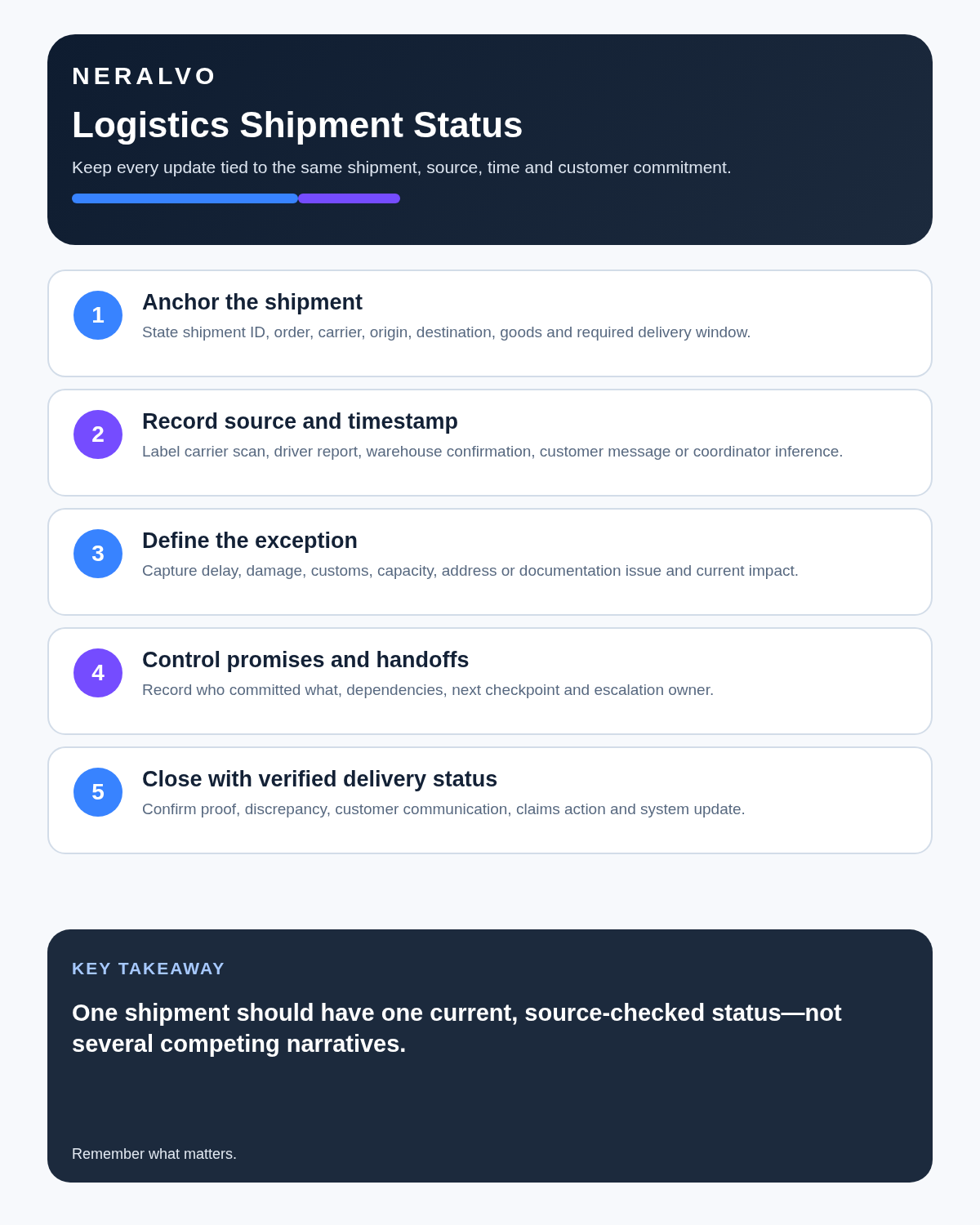
The shipment → source → timestamp → status → exception → closure workflow
| Stage | Question | Controlled output |
|---|---|---|
| Shipment | Which order, consignment, container or pallet? | Stable reference |
| Source | Who or which system supplied the update? | Attribution |
| Timestamp | When did the event happen and when was it reported? | Current chronology |
| Status | What has been verified? | Single current state |
| Exception | What prevents the planned movement? | Impact and recovery |
| Closure | What evidence proves completion? | Accepted delivery record |
Begin every note with shipment anchors
- Order, booking, consignment or container number.
- Origin and destination.
- Carrier, service and route.
- Planned collection and delivery windows.
- Goods description and handling requirement where relevant.
- Customer, supplier or project reference.
- Source of the update and local time zone.
Repeat the reference when moving between shipments during the same call.
Use a controlled status vocabulary
| Status | Minimum evidence |
|---|---|
| Booked | Carrier acceptance or booking reference |
| Collected | Driver, scan or collection document |
| In transit | Current carrier event or verified driver update |
| Held | Location, authority and reason |
| Delayed | Cause, revised estimate and source |
| Out for delivery | Current final-mile event |
| Delivered | Proof, recipient or accepted scan |
| Exception closed | Recovery completed and system reconciled |
Do not use “sorted” or “on its way” as operational statuses.
Separate reported from verified information
- Carrier reported: statement from carrier contact.
- Driver reported: direct operational account.
- System event: scan or tracking update.
- Customer reported: recipient account.
- Verified: corroborated in the authorised system or evidence.
- Estimated: forecast rather than confirmed event.
Keep event time separate from the time the team learned about it.
Build a useful exception record
For customs, damage, temperature, capacity, missed connection, incorrect documentation or security issues, capture:
- Exact shipment and affected quantity.
- Current physical location.
- Verified exception and source.
- Safety, quality, cost and customer impact.
- Immediate control.
- Required document, decision or resource.
- Recovery options and trade-offs.
- One accountable owner.
- Next update deadline.
- Escalation trigger.
Protect customer promises
A carrier estimate is not automatically a customer commitment. Record whether the time is planned, estimated, carrier-confirmed or contractually guaranteed. Name the person authorised to communicate a revised promise.
When the outcome remains uncertain, promise the next update rather than a delivery time the team cannot control.
Control handoffs
Every handoff should state what is transferred, from whom, to whom, at which location, under what condition and with which evidence. Include customs documents, temperature records, seals, packaging condition and acceptance exceptions where relevant.
Close delivery with evidence
- Proof of delivery checked.
- Correct destination and quantity confirmed.
- Damage or shortage recorded.
- Temperature or special-condition evidence accepted.
- Customer informed where required.
- Carrier and order systems reconciled.
- Claims or corrective actions opened separately.
Protect commercial and personal information
Do not dictate payment-card data, passwords, access codes or unnecessary personal details. Restrict customer addresses, high-value cargo and security-sensitive routes. Apply the organisation’s recording and retention rules.
How NERALVO Halo fits logistics coordination
NERALVO Halo includes NOTE mode, supported CALL mode, 64GB local storage, up to 35 hours of recording and Bluetooth sync with DOWAY. CALL mode is not universal, so test the exact phone, case and call route. DOWAY can create transcripts, summaries, speaker-separated notes, templates, translations, mind maps and exports, with one year of DOWAY Max included from activation.
These outputs can organise carrier conversations but cannot verify physical movement or replace transport systems.
Cloud software, a dedicated recorder or manual notes?
For Logistics Coordinators, the right answer changes with the setting. This matrix deliberately gives each method a situation where it can be the strongest choice.
| Situation | Best starting point | Reason |
|---|---|---|
| scheduled remote meetings | Cloud meeting software | Auto-join and central collaboration can remove routine admin. |
| in-person or mobile work | Dedicated recorder | Dedicated hardware suits movement, variable rooms and offline source capture. |
| recording is refused or prohibited | Manual notes or an approved alternative | A clear alternative respects policy and participant choice. |
| mixed online and offline work | Governed hybrid | One governed process prevents gaps between desk and field work. |
Frequently asked questions
Can an AI summary become the shipment status?
No. Verify the source event and update the authorised system.
Can a carrier estimate be promised to the customer?
Only with the appropriate qualification and authority. State whether it is estimated or confirmed.
Should every logistics call be retained?
No. Keep the minimum source needed for the defined operational and retention purpose.
Final logistics checklist
- Shipment reference and time zone clear.
- Source and event time recorded.
- Reported and verified states separated.
- Exception impact and recovery owned.
- Customer wording accurately qualified.
- Handoff evidence linked.
- Delivery closure verified.
- Authoritative systems updated.
Bottom line: a strong logistics voice note creates one traceable shipment timeline and one accountable recovery path—not another competing status.
Related guides
See the guides for warehouse managers, fleet managers and operations managers.
On this page
Related guides
See whether Halo fits this workflow
Review the NERALVO Halo specifications, included services, delivery information and current offer only after completing the guide.
Found an error or an out-of-date claim? Email support@neralvo.com with the article address and a supporting source.