The 60-second verdict
Martial arts instructors assess more than whether a movement looks correct. They watch control, distance, timing, partner care, decision-making and the student’s ability to perform safely under increasing pressure. A useful record should preserve those distinctions without distracting the instructor during live practice.
Best fit: Martial Arts Instructors who need recoverable audio and human-verified notes in an authorised workflow. Use another method when: recording is prohibited, a participant declines or the approved process requires manual notes.
Evidence basis and limits
- Decision factors covered: The control → technique → criteria → progression framework; Control comes before technical praise; Describe technique without diagnosing the person.
- Evidence rule: A claim earns weight only when the source, date, configuration and limitation are clear enough for a reader to check.
- Boundary: Examples and workflow recommendations must be tested with representative recordings, the intended users and the actual approval process before rollout.
An AI voice recorder for martial arts instructors can support private post-class debriefs, permitted student reviews and grading preparation. It cannot supervise contact, diagnose injury, interpret safeguarding concerns or decide whether a student has earned a grade.
The control → technique → criteria → progression framework
| Layer | Question | Record |
|---|---|---|
| Control | Was the activity performed safely and with appropriate restraint? | Observable safety behaviour |
| Technique | What movement, timing or tactical choice was demonstrated? | Specific performance evidence |
| Criteria | Which published or consistently applied standard is relevant? | Fair assessment reference |
| Progression | What is the next suitable drill, intensity or responsibility? | Action and review point |
This structure prevents a technically strong performance from hiding poor control, and it prevents personal impressions from replacing grading evidence.
Control comes before technical praise
Contact, throws, locks, takedowns, sparring, breakfalls and weapons practice require active supervision. During live work, the instructor should watch pairing, intensity, spacing, fatigue and whether students stop immediately when directed.
A useful control note describes behaviour:
- Maintained the agreed contact level.
- Released immediately on the stop command.
- Protected the partner during the throw.
- Adjusted distance after repeated warnings.
- Stopped because control deteriorated under fatigue.
Do not operate a recorder while active intervention may be needed. Create the note during a safe administrative period or after the class area and equipment are secured.
Describe technique without diagnosing the person
Record the movement and context rather than character. “Rear heel lifted during three slow repetitions of the stance transition” is useful. “Careless” or “lacks discipline” is not enough.
Keep separate:
- Technique: position, timing, balance, sequence and accuracy.
- Application: distance, choice, reaction and adaptability.
- Control: restraint, partner protection and response to instruction.
- Student report: confidence, pain, fear or confusion.
- Instructor decision: repeat, regress, progress, pause or refer.
An AI summary should not infer motive, mental-health status or medical diagnosis from hesitation or performance.
Make grading evidence criterion-based
AI can organise observations, but the authorised instructor or examiner must make the decision. Use the school’s published or consistently applied standard and record the evidence against it.
| Weak grading note | Stronger grading note |
|---|---|
| “Ready for next belt” | “Demonstrated the required sequence independently in two classes, maintained partner control and corrected the identified foot position.” |
| “Not focused enough” | “Missed the stop command twice during paired practice; repeat controlled drill before assessment.” |
| “Good fighter” | “Maintained distance, selected appropriate counters and controlled contact during the assessed rounds.” |
Where reasonable adjustments are needed, record how the required outcome was assessed fairly without adding unnecessary personal information.
Use a progression ladder instead of a vague next step
A clear progression might move through:
- Solo movement.
- Cooperative partner rehearsal.
- Variable but controlled response.
- Limited-pressure application.
- Appropriate live practice.
- Independent demonstration or grading assessment.
State the current rung, the evidence required to move forward and the stop condition. This creates a safer plan than an AI-generated instruction to “increase intensity.”
Record partner context
Performance in martial arts is relational. The partner’s size, experience, pace and cooperation affect what can be observed. Note the relevant context and avoid judging a student from one unsuitable pairing.
Before progressing, ask whether the student can demonstrate control with more than one appropriate partner and whether the environment supports the next level safely.
Use a head-injury stop rule
UK grassroots concussion guidance uses the precautionary message “if in doubt, sit them out.” A participant with suspected concussion should be removed from activity and managed through current first-aid, medical and governing-body procedures. The recorder cannot interpret symptoms or approve a return.
See the official UK grassroots concussion guidance.
Complete immediate care first, then document factual circumstances through the school’s incident process. Keep health detail restricted to those who need it.
Move safeguarding information out of general class notes
UK Coaching treats participant welfare and safeguarding as a priority. Follow the school, association or governing body process for communication, one-to-one instruction, changing areas, transport, photography and reporting concerns.
Never record changing rooms, toilets, overnight accommodation or private disclosures secretly. A concern about a child or adult at risk should be reported through the authorised safeguarding route immediately—not stored in a grading transcript. See the UK Coaching safeguarding statement.
A two-minute post-class debrief
- Class objective: state the technique, tactical idea or behaviour taught.
- Control: identify any material safety or supervision issue.
- Understanding: note where students succeeded or became confused.
- Individual evidence: record only the students who need a specific follow-up.
- Criteria: link grading observations to the correct standard.
- Progression: define the next drill, intensity and stop condition.
- Restricted action: move injury or safeguarding information to the correct record.
Review the transcript for names, techniques, sides, grades and dates before updating the official class or student record.
How NERALVO Halo can support martial arts instruction
Assess Halo against the martial arts instructors workflow matrix can support private post-class notes, permitted student reviews and instructor meetings. It includes NOTE mode, supported CALL capture, 64GB local storage, up to 35 hours of recording and Bluetooth sync with DOWAY. DOWAY can create transcripts, summaries, speaker-separated notes, templates, translations, mind maps and exportable files, with one year of DOWAY Max included from activation.
Halo is not protective equipment, a medical device, grading system or safeguarding platform. The school remains responsible for supervision, consent, access and retention.
Grading-note quality check
- Was the recorder kept away from live contact and weapons supervision?
- Does the note separate control, technique and student report?
- Are labels replaced with observable behaviour?
- Is every grading comment linked to a relevant criterion?
- Does the progression have a clear rung and stop condition?
- Was partner and class context considered?
- Were suspected head injury and safeguarding matters moved immediately to authorised routes?
- Is the final grading decision human and traceable?
- Has temporary audio been managed under school policy?
A strong martial-arts record shows not only what a student can perform, but whether they can perform it with control, understanding and readiness for the next safe progression.
Cloud software, a dedicated recorder or manual notes?
For Martial Arts Instructors, the right answer changes with the setting. This matrix deliberately gives each method a situation where it can be the strongest choice.
| Situation | Best starting point | Reason |
|---|---|---|
| scheduled remote meetings | Cloud meeting software | Auto-join and central collaboration can remove routine admin. |
| in-person or mobile work | Dedicated recorder | Dedicated hardware suits movement, variable rooms and offline source capture. |
| recording is refused or prohibited | Manual notes or an approved alternative | A clear alternative respects policy and participant choice. |
| mixed online and offline work | Governed hybrid | One governed process prevents gaps between desk and field work. |
Related AI voice recorder guides
See the guides for sports coaches, personal trainers and private tutors.
Related guides
Profession workflow
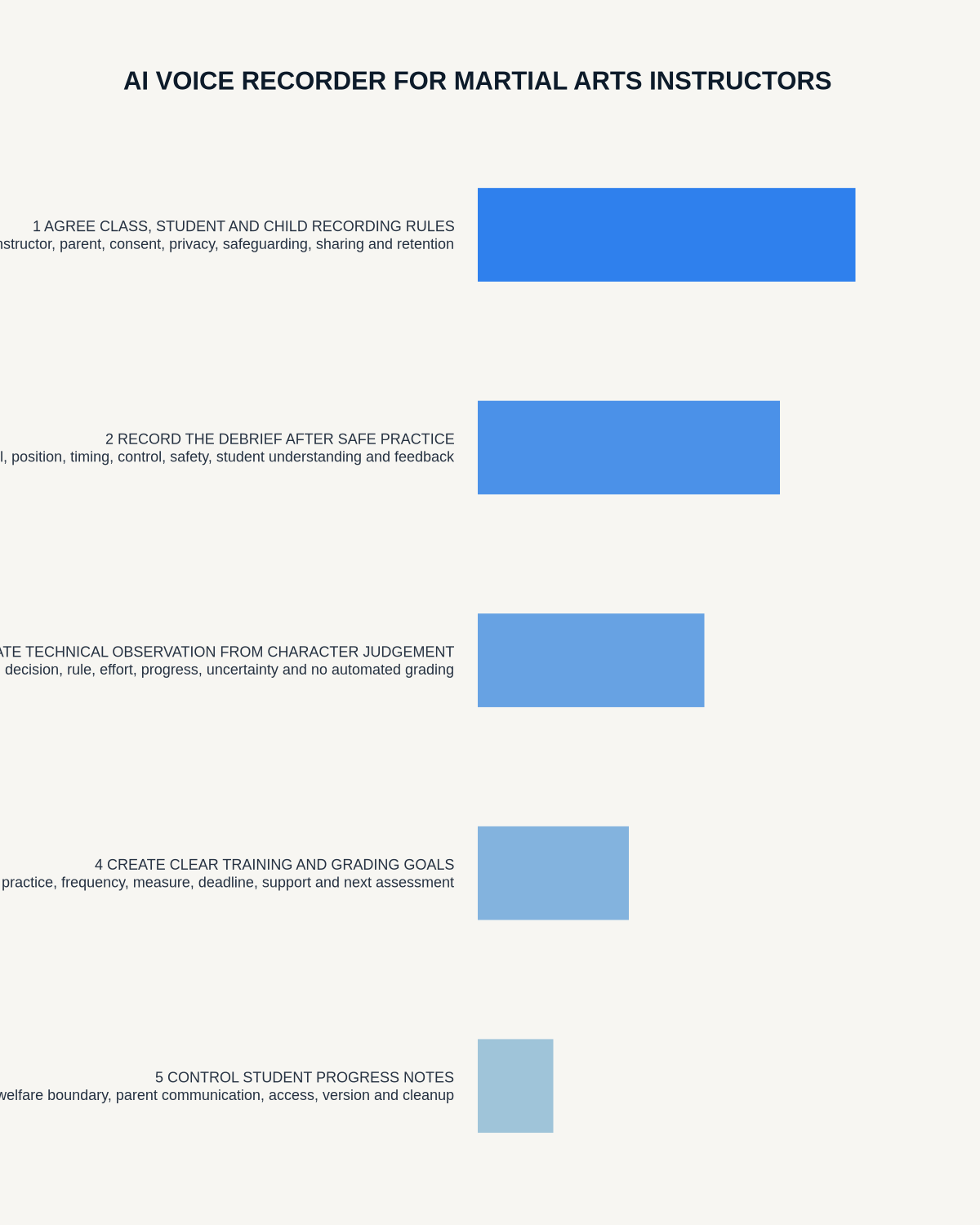
Visual map for AI Voice Recorder for Martial Arts Instructors: Class Debriefs, Student Goals and Grading Notes
- Prepare the approved useDefine purpose, safe position, permission and the required formal record.
- Capture context firstState the case, asset, person, location or event identifier before detail.
- Human-verify evidenceCheck technical terms, units, names, dates, decisions and uncertainty.
- Complete the formal recordTransfer only verified information and apply access and retention controls.
On this page
Related guides
See whether Halo fits long-form study capture
After checking permission and your institution’s rules, compare Halo’s stated battery, storage and export workflow with the way you actually study.
Found an error or an out-of-date claim? Email support@neralvo.com with the article address and a supporting source.