The 60-second verdict
Personal training depends on accurate details: what the client wants to achieve, what happened during the session, how the client responded and what should change next. Trying to type all of that while coaching can distract from movement quality and safety.
Best fit: Personal Trainers who need recoverable audio and human-verified notes in an authorised workflow. Use another method when: recording is prohibited, a participant declines or the approved process requires manual notes.
Evidence basis and limits
- Decision factors covered: The screen–coach–review system; 1. Screen before you programme; 2. Keep active coaching device-free.
- Evidence rule: The decision is based on the complete capture-to-action workflow, not a single feature or marketing accuracy percentage.
- Boundary: Examples and workflow recommendations must be tested with representative recordings, the intended users and the actual approval process before rollout.
An AI voice recorder for personal trainers can help by turning permitted consultations and private post-session reflections into searchable drafts. The strongest workflow is not to record everything. It is to use a clear screen–coach–review system that protects attention during exercise and keeps the final client record concise.
The recorder does not assess medical risk, diagnose pain, choose exercises or replace professional judgement. The trainer remains responsible for screening, supervision, referral, programme design and record accuracy.
The screen–coach–review system
| Stage | What to capture | What must remain human-led |
|---|---|---|
| Screen | Goals, relevant history, preferences, barriers and questions | Risk decisions, scope, referral and programme suitability |
| Coach | Short private notes after sets or at the end of the session | Observation, spotting, technique correction and immediate safety |
| Review | Progress themes, client feedback, agreed changes and next steps | Interpretation, progression and client-centred decision-making |
1. Screen before you programme
The initial conversation should establish what the client wants, what may affect participation and whether the trainer needs clarification or referral before progressing.
A useful consultation draft can include:
- Primary goal and why it matters to the client.
- Previous exercise experience and current activity.
- Relevant health information disclosed through the approved screening process.
- Current pain, symptoms or recent changes that may affect training.
- Preferences, confidence, schedule and practical barriers.
- Agreed measures of progress.
- Questions that need follow-up before programme design.
The approved screening form and client record remain authoritative. A transcript of an informal conversation should not replace the business's formal process.
2. Keep active coaching device-free
During free weights, loaded movement, unfamiliar equipment, balance work or intense conditioning, the trainer's attention should stay on the client. Handling a recorder while spotting or assessing technique creates unnecessary distraction.
The safer method is to make a short private note immediately after the set or session. A 30-second reflection can preserve the important detail without reducing supervision.
A useful post-session prompt
State the exercise, load or setting, what you observed, what the client reported, what you changed and the response. End with the next action.
Example structure:
- Exercise: goblet squat.
- Observation: depth reduced as fatigue increased.
- Client report: no pain; confidence lower on final set.
- Adjustment: load reduced and rest extended.
- Result: control improved.
- Next step: repeat at current load before progressing.
3. Separate facts from interpretation
AI summaries can merge several kinds of information into one sentence. The final note should keep them distinct:
- Client report: what the client said or described.
- Trainer observation: what was directly seen.
- Coaching action: the cue, regression or progression used.
- Outcome: what changed after the action.
- Referral or pause: why training was modified or stopped.
Do not allow a generated summary to turn a pain report into a diagnosis or a temporary movement pattern into a clinical conclusion.
4. Verify numbers and exercise details
Speech recognition can confuse exercise names, sides, loads and units. Before transferring a draft into the client record, check:
- Exercise and variation.
- Weight and unit.
- Sets, repetitions, time or distance.
- Left, right or bilateral work.
- Machine setting or equipment used.
- Tempo and rest period.
- Reported discomfort and exact timing.
- Agreed home activity and review date.
The programme should only be updated from verified information.
5. Build progress reviews around the client's goal
A useful review is broader than a list of numbers. It should connect measurable change with the client's experience and the original reason for training.
Review:
- What has improved.
- What has stayed difficult.
- Which sessions or habits were completed.
- How recovery, confidence and enjoyment changed.
- Whether the original goal is still relevant.
- What the client wants to prioritise next.
AI can organise these points into a draft, but the client and trainer should agree the final interpretation and next plan together.
6. Use a minimum-necessary client record
Fitness notes can contain sensitive health, body-composition, lifestyle and financial information. Record only what is needed to deliver the service safely and effectively.
A concise final note may include:
- Date and session type.
- Client goal or current phase.
- Relevant update before training.
- Exercises and verified training values.
- Important observation or client feedback.
- Modification, progression or referral.
- Agreed next action.
Raw audio should not become the permanent record by default. Set a clear purpose, access rule and deletion point before creating it.
7. Handle pain and concerning symptoms correctly
An AI tool cannot decide whether a client is safe to continue. If the client reports concerning pain, dizziness, chest symptoms, unusual breathlessness, collapse, neurological symptoms or another significant change, stop or modify the activity and follow the appropriate emergency or referral process.
Document the factual sequence after immediate safety action. Record what the client reported, what was observed, what action was taken and what follow-up was advised.
8. Protect privacy in the training environment
Do not record changing rooms, toilets, treatment areas or unrelated conversations. In a shared gym, a private post-session note is often safer than capturing live audio that includes other members.
Before recording a consultation or review, explain the purpose, how the audio is processed, who can access it and when it will be deleted. Provide a reasonable alternative for clients who do not want audio used.
9. Use referrals without overstepping scope
When a client's needs exceed the trainer's competence, a referral should be factual and proportionate. With the client's agreement, summarise the relevant goal, reported issue, observed response to exercise and any training changes.
Avoid diagnostic language. The purpose is to support an appropriate professional assessment, not to present the trainer's interpretation as a medical conclusion.
10. Create a reusable personal-training note
- Client and date
- Session goal
- Readiness and relevant update
- Exercises and verified values
- Client-reported response
- Trainer observation
- Adjustment and result
- Scope, safety or referral issue
- Agreed action before the next session
- Next-session focus
How NERALVO Halo fits the workflow
View Halo specifications for personal trainers use can support permitted consultations, private post-session reflections and structured progress reviews. It includes NOTE recording, supported CALL capture, 64GB local storage, up to 35 hours of recording and Bluetooth sync with DOWAY.
DOWAY can create transcripts, summaries, speaker-separated notes, templates, translations, mind maps and exports. One year of DOWAY Max is included from activation.
Halo is not a medical device, exercise-safety monitor or substitute for a qualified trainer. Use depends on the business's privacy, consent, retention and record policies.
Cloud software, a dedicated recorder or manual notes?
For Personal Trainers, the right answer changes with the setting. This matrix deliberately gives each method a situation where it can be the strongest choice.
| Situation | Best starting point | Reason |
|---|---|---|
| scheduled remote meetings | Cloud meeting software | Native remote-meeting workflows can be more efficient here. |
| in-person or mobile work | Dedicated recorder | A separate battery and recoverable local source improve resilience. |
| recording is refused or prohibited | Manual notes or an approved alternative | Manual notes are the correct control when recording is unavailable. |
| mixed online and offline work | Governed hybrid | A hybrid can combine automation with reliable physical capture. |
Related guides
Final quality check
- Was the client clearly informed before any recording?
- Did the trainer maintain full attention during active exercise?
- Are client report and trainer observation separated?
- Were all loads, units, sides and repetitions verified?
- Does the note avoid diagnosis and unsupported conclusions?
- Is the final record concise and relevant?
- Were safety and referral actions handled outside the AI workflow?
- Has temporary audio been retained or deleted according to policy?
The best use of an AI voice recorder in personal training is not continuous capture. It is a disciplined system that preserves the client's goals and the trainer's verified decisions without weakening supervision.
More role-specific recording workflows
See the guides for sports coaches, nutrition coaches and physiotherapists.
Profession workflow
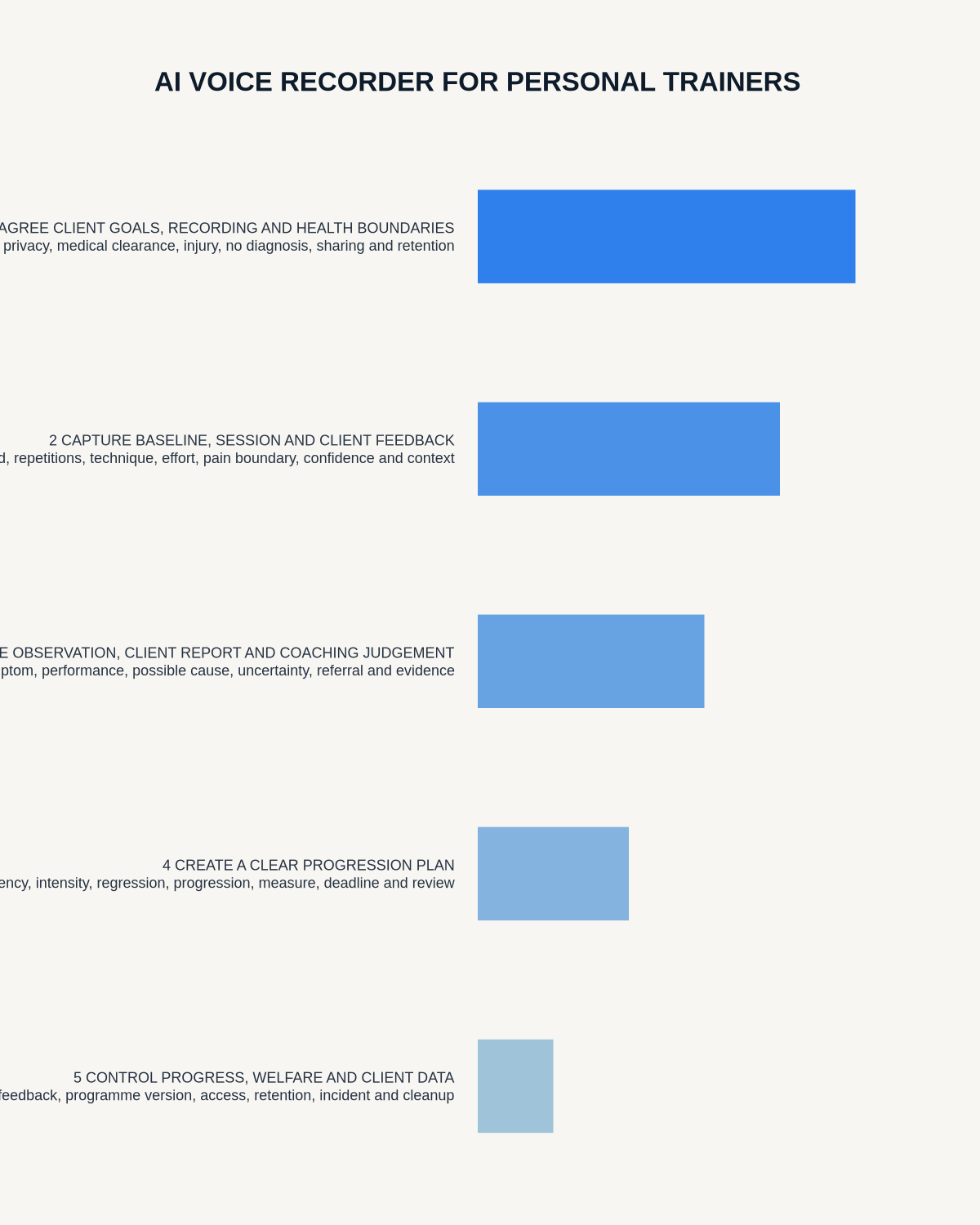
Visual map for AI Voice Recorder for Personal Trainers: Client Goals, Session Notes and Progress Reviews
- Prepare the approved useDefine purpose, safe position, permission and the required formal record.
- Capture context firstState the case, asset, person, location or event identifier before detail.
- Human-verify evidenceCheck technical terms, units, names, dates, decisions and uncertainty.
- Complete the formal recordTransfer only verified information and apply access and retention controls.
On this page
Related guides
See whether Halo fits this workflow
Review the NERALVO Halo specifications, included services, delivery information and current offer only after completing the guide.
Found an error or an out-of-date claim? Email support@neralvo.com with the article address and a supporting source.