The 60-second verdict
Quick answer: use an AI voice recorder in one-to-one meetings only through an approved, transparent and proportionate process. Create a concise checked follow-up note that preserves both perspectives, support commitments, actions and the next review date without turning every personal comment into a permanent HR record.
Best fit: One-to-One Meetings who need recoverable audio and human-verified notes in an authorised workflow. Use another method when: recording is prohibited, a participant declines or the approved process requires manual notes.
Evidence basis and limits
- Decision factors covered: First decide what kind of meeting this is; Ask whether recording is necessary; Explain the complete process.
- Evidence rule: The decision is based on the complete capture-to-action workflow, not a single feature or marketing accuracy percentage.
- Boundary: Examples and workflow recommendations must be tested with representative recordings, the intended users and the actual approval process before rollout.

One-to-one meetings may cover priorities, development, workload, wellbeing and performance. Recording can improve accuracy, but it can also change how openly an employee speaks. View Halo specifications for one-to-one meetings use should never be introduced casually, secretly or as default surveillance.
First decide what kind of meeting this is
| Meeting type | Possible record | Main caution |
|---|---|---|
| Routine development | Priorities, support and actions | Keep the record proportionate |
| Performance discussion | Specific evidence, expectations and support | Follow formal policy where applicable |
| Health or wellbeing | Only necessary agreed workplace information | Special-category data and restricted access |
| Grievance or disciplinary | Formal authorised record | Use the prescribed process |
| Safeguarding or serious risk | Immediate formal escalation | Do not wait for AI processing |
A routine coaching workflow must not be stretched to cover a formal HR, safeguarding or emergency matter.
Ask whether recording is necessary
A shared written agenda and short agreed action note may be enough. Recording should serve a specific purpose such as an agreed accessibility adjustment, preserving complex evidence or supporting an approved remote process. It should not be used merely because the device is available.
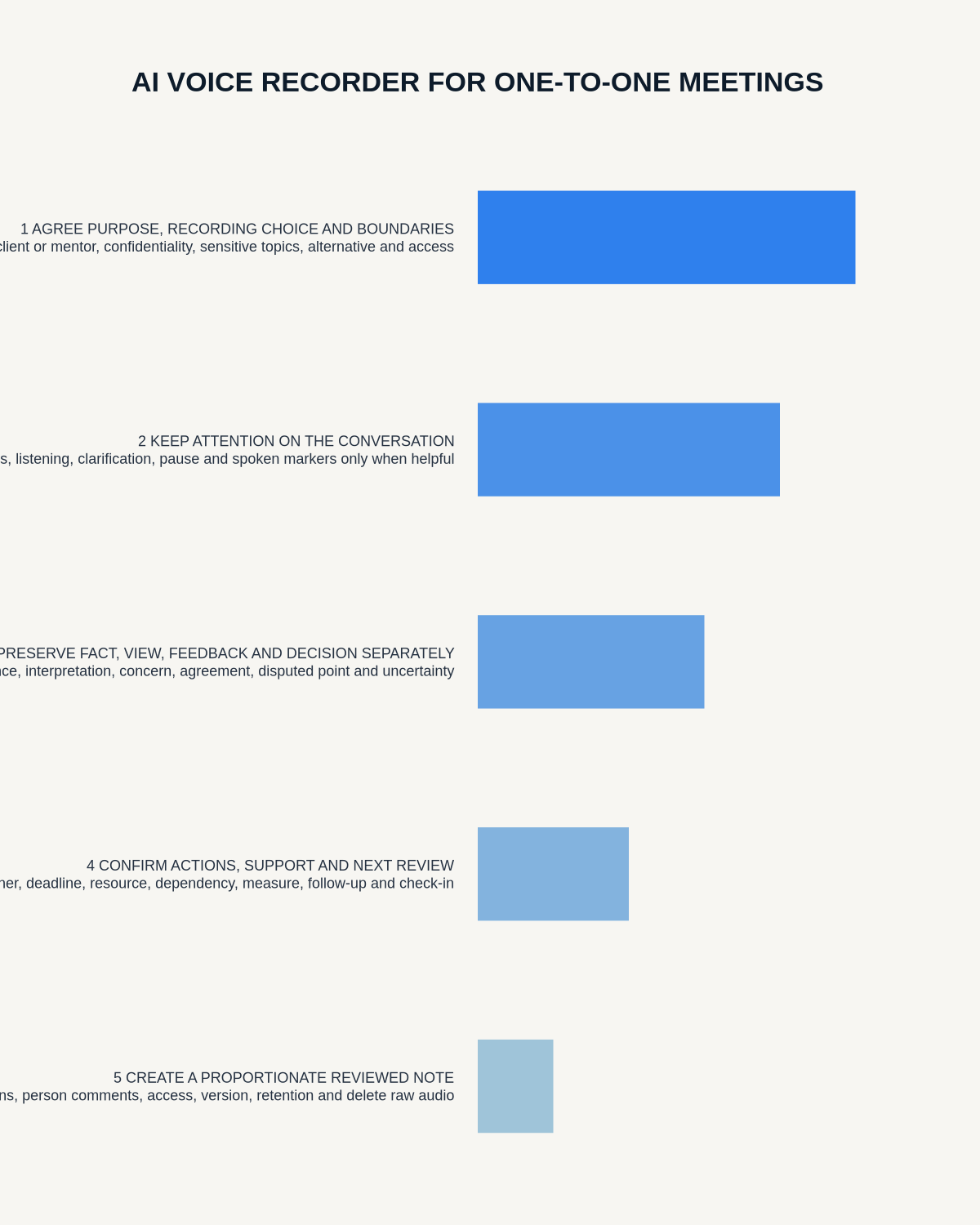
Before recording, confirm:
- The purpose and organisational process.
- What both participants will be told.
- Whether a non-recorded alternative is appropriate.
- Who can access audio, transcript and final note.
- Whether sensitive information needs a separate restricted record.
- How inaccuracies or disagreements can be recorded.
- When source audio and drafts will be deleted.
Explain the complete process
A clear opening should cover:
- Why the meeting is being recorded.
- Whether the purpose is notes, accessibility, coaching or another stated use.
- Which AI processing will occur.
- Who receives the resulting note.
- How either person can raise a concern or correct factual detail.
- What happens to the audio after approval.
Trust is weakened when an ordinary developmental conversation is later used for a broader monitoring or performance purpose.
Use a balanced agenda
- Check-in: immediate priorities and context.
- Progress: evidence, outcomes and learning since the last meeting.
- Blockers: resources, decisions or support required.
- Feedback: specific examples and the employee’s perspective.
- Development: skills, opportunities and agreed support.
- Decisions: what has actually been agreed.
- Actions: employee and manager commitments, owners and deadlines.
- Review: next meeting or trigger.
Separate information states
- Employee account: their experience or explanation.
- Manager observation: a clearly attributed view.
- Verified fact: evidence supported by records.
- Feedback: specific, work-relevant interpretation based on evidence.
- Support commitment: action the manager or employer agrees to provide.
- Employee action: task, owner and date.
- Unresolved point: issue requiring further evidence or discussion.
Do not let an AI summary rewrite different perspectives as consensus.
During the conversation
- Listen rather than relying on the recorder.
- Use specific evidence and distinguish fact from opinion.
- Do not push for unnecessary medical, family or personal detail.
- Clarify whether a statement is a request, concern, decision or possibility.
- Repeat deadlines and commitments.
- Pause recording if the discussion moves outside the agreed purpose.
- Follow urgent organisational procedures immediately where required.
Use a balanced record
| Note area | Required distinction |
|---|---|
| Progress | Evidence and employee perspective |
| Workload | Current demand, impact and agreed response |
| Development | Goal, opportunity, support and review |
| Wellbeing or health | Minimum routine detail; use the confidential route where required |
| Performance | Observable expectations, evidence and the proper HR process |
| Actions | Employee and manager commitments separately owned |
What belongs in the final note
- Current priorities.
- Progress and evidence discussed.
- Blockers and support requested.
- Feedback and response.
- Decision or agreed expectation.
- Employee action, owner and deadline.
- Manager support commitment, owner and deadline.
- Development opportunity.
- Next review date.
- Record status and authorised location.
Personal context should appear only where necessary for the work purpose and should use the appropriate confidentiality and access controls.
Use a controlled review workflow
- Secure the recording through the approved route.
- Generate the transcript and label it as a draft.
- Correct attribution, names, dates, figures and important wording.
- Separate evidence, interpretation, feedback and agreed actions.
- Remove irrelevant private conversation from the final note.
- Give participants an appropriate opportunity to identify factual inaccuracies or disputed commitments.
- Store the approved note in the correct manager, HR or project system.
- Delete or retain audio and transcript according to policy.
Preserve disagreement without forcing consensus
Where the manager and employee disagree, record the material point, each perspective, evidence required and next process. Do not silently rewrite one account to make the note appear mutually agreed.
An AI summary is not automatically an HR record
AI can omit qualifications, merge speakers or turn tentative language into certainty. It may also give disproportionate weight to emotional or repeated words. No employment decision should rely on an unchecked automated summary. The responsible manager and required HR process must evaluate evidence, policy, context and the employee’s response.
Do not automate employee judgement
AI should not score emotion, confidence, motivation, credibility, personality or performance from voice. Such inferences can be unreliable, discriminatory and intrusive. Human managers must assess observable evidence through the correct process.
Protect sensitive information
Health, disability, family circumstances, grievances and other sensitive information may require a separate restricted record. Do not copy the full transcript into email, chat and shared folders. Use the minimum information needed for the one-to-one purpose.
Official workplace guidance
The ICO advises that worker monitoring should be necessary, proportionate and transparent. Workers should understand what is monitored, why it is used, who can access it and how long it is kept. Routine one-to-one recording for performance scoring may be more intrusive than an agreed action note.
How NERALVO Halo fits suitable one-to-ones
NERALVO Halo provides NOTE mode, supported CALL mode, 64GB local storage, up to 35 hours of recording and Bluetooth sync with DOWAY. DOWAY can create transcripts, summaries, speaker-separated notes, templates, translations, mind maps and exports, with one year of DOWAY Max included.
Halo can support draft notes. It does not determine whether a meeting should be recorded, whether information belongs in an HR file or whether an employment decision is fair.
Cloud software, a dedicated recorder or manual notes?
For One-to-One Meetings, the right answer changes with the setting. This matrix deliberately gives each method a situation where it can be the strongest choice.
| Situation | Best starting point | Reason |
|---|---|---|
| scheduled remote meetings | Cloud meeting software | Native remote-meeting workflows can be more efficient here. |
| in-person or mobile work | Dedicated recorder | A separate battery and recoverable local source improve resilience. |
| recording is refused or prohibited | Manual notes or an approved alternative | Manual notes are the correct control when recording is unavailable. |
| mixed online and offline work | Governed hybrid | A hybrid can combine automation with reliable physical capture. |
Frequently asked questions
Should every one-to-one be recorded?
No. Recording should serve a specific necessary and proportionate purpose. A concise shared note is often enough.
What if an employee does not want recording?
Follow organisational policy and use a suitable non-recorded process unless another formal authorised requirement applies.
Can the employee correct the note?
Provide the organisation’s correction or disagreement route. Preserve unresolved differences accurately.
Can managers analyse tone or sentiment automatically?
No. Automated interpretation should not replace evidence, fair process or human judgement.
Can a one-to-one recording be reused for training?
Not automatically. A new use requires its own purpose, transparency, access and retention assessment.
Final one-to-one checklist
- Meeting type and purpose identified.
- Necessity and alternatives considered.
- Recording process explained.
- Employee and manager perspectives separated.
- Evidence and opinion distinguished.
- Employee actions and manager commitments separately owned.
- Sensitive matters routed correctly.
- No automated trait or performance judgement used.
- Correction or disagreement route available.
- Final note stored and source retention controlled.
Bottom line: protect the conversation as carefully as the action list. Record selectively, explain the purpose and finish with a concise checked note both people can understand.
Related guides
See the guides for HR managers, coaches and mentors and performance reviews.
On this page
Related guides
See whether Halo fits this workflow
Review the NERALVO Halo specifications, included services, delivery information and current offer only after completing the guide.
Found an error or an out-of-date claim? Email support@neralvo.com with the article address and a supporting source.