
The 60-second verdict
Quick answer: use an AI voice recorder for a performance review only through an approved, transparent and proportionate HR process. Consider whether written notes are sufficient, preserve both perspectives, separate evidence from judgement, verify every material point and create a concise formal record rather than retaining the whole transcript by default.
Best fit: Performance Reviews who need recoverable audio and human-verified notes in an authorised workflow. Use another method when: recording is prohibited, a participant declines or the approved process requires manual notes.
Evidence basis and limits
- Decision factors covered: Start by asking whether audio is proportionate; Explain the process clearly; Use a balanced review structure.
- Evidence rule: A claim earns weight only when the source, date, configuration and limitation are clear enough for a reader to check.
- Boundary: Examples and workflow recommendations must be tested with representative recordings, the intended users and the actual approval process before rollout.
Start by asking whether audio is proportionate
A standard written appraisal form may be sufficient. Before proposing audio, consider:
- The reason a recording is needed.
- Whether accurate written notes could meet the same purpose.
- The sensitivity of likely discussion.
- Employee expectations and workplace policy.
- Whether an accessibility adjustment affects the method.
- Who will access the audio and transcript.
- Whether the processing tool is approved.
- How long each record will be kept.
Do not record merely because the device is available.
Explain the process clearly
Before the meeting, tell the employee:
- Why recording is proposed.
- Whether participation is optional or governed by a formal policy.
- Which parts of the meeting will be captured.
- Who can access the source and drafts.
- How automated transcription will be used.
- Which document becomes the official record.
- How factual corrections or comments can be submitted.
- When the source audio will be deleted or reviewed.
Do not use a compact device to make recording less noticeable. Workplace trust requires deliberate transparency.
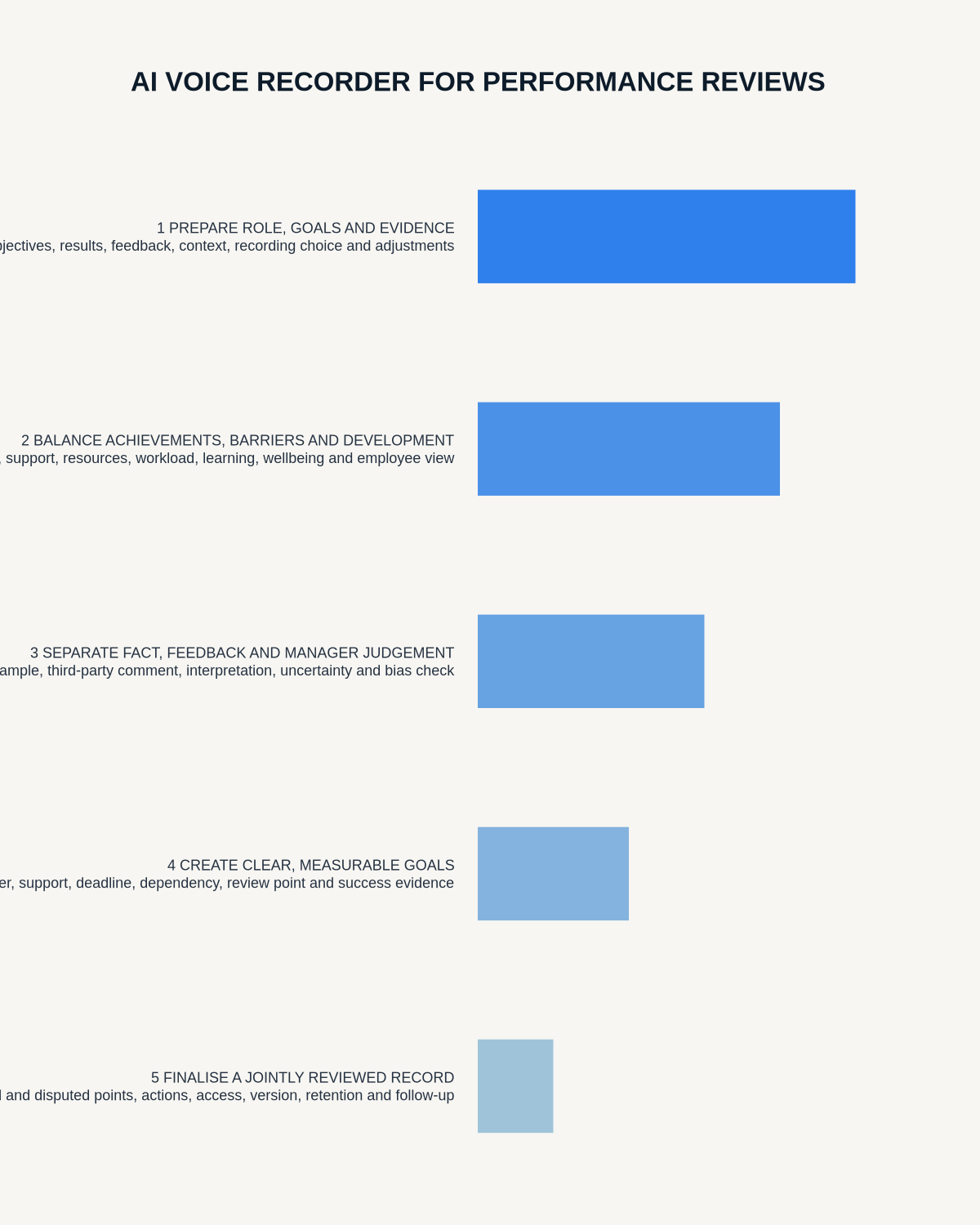
Use a balanced review structure
| Section | Questions to cover |
|---|---|
| Achievements | What went well, and what evidence supports it? |
| Role expectations | What objectives and behaviours were agreed? |
| Challenges | What affected the result, including workload or dependencies? |
| Employee perspective | How does the employee assess their own performance? |
| Support | What training, resources, coaching or adjustments are needed? |
| Development | What skills or responsibilities should be developed? |
| Objectives | What fair, measurable and realistic outcomes are agreed? |
| Review | When will progress and support be checked? |
Separate evidence from judgement
| Record type | Example |
|---|---|
| Objective evidence | Project delivered on 14 June against an agreed 15 June date |
| Employee explanation | Delay risk increased after access was withdrawn |
| Manager observation | Updates were not escalated early enough |
| Assessment | Improvement is required in risk communication |
| Agreed support | Weekly coaching and access to the project template |
| Objective | Submit a risk update by noon every Friday for eight weeks |
AI may merge these categories. The reviewer must restore the distinction before the note is used.
Preserve the employee’s perspective
The final record should not read as though the manager was the only source. Include:
- The employee’s self-assessment.
- Relevant context or constraints.
- Disagreement about evidence or interpretation.
- Requested support.
- Career aspirations.
- Any proposed correction to the draft record.
- Points that remain unresolved.
Use fair objectives
Objectives should be connected to the role and normal workload. A strong objective is:
- Specific about the expected outcome.
- Measurable through appropriate evidence.
- Achievable with the available time and resources.
- Relevant to the employee’s duties.
- Time-bound with a reasonable review point.
- Supported by training or resources where needed.
Do not use a generated summary to invent goals that nobody agreed.
Record support as clearly as expectations
A balanced performance record states what the employer will provide, such as:
- Training.
- Coaching or mentoring.
- Clearer priorities.
- Tools and access.
- Workload changes.
- Regular check-ins.
- Reasonable adjustments where applicable.
- Named support owners and dates.
Do not automate the rating or decision
A transcript or AI summary should not:
- Score tone or emotion.
- Infer motivation or honesty.
- Rank employees against one another without a fair approved process.
- Convert speaking confidence into performance.
- Remove disability, workload or resource context.
- Make a pay, promotion or capability decision.
Human decision-makers remain responsible for evidence, consistency, equality and procedural fairness.
Correct the transcript in layers
- Confirm attendees, date and review period.
- Correct names, projects, objectives and figures.
- Separate evidence, explanation and judgement.
- Verify achievements and concerns against supporting records.
- Capture the employee’s response.
- Confirm support and adjustments.
- Check objectives, owners and dates.
- Create the concise written record.
- Share it through the approved process.
- Apply retention and deletion controls.
Create a final written record
The authoritative note can include:
- Review period and participants.
- Achievements and evidence.
- Areas for development.
- Employee comments.
- Support and training.
- Agreed objectives.
- Review dates.
- Unresolved disagreements or submitted comments.
- Approval or acknowledgment status.
A full transcript is generally too long and contains more personal information than the final record requires.
Protect employee information
Performance discussions may include health, family, union, financial or other sensitive information. Restrict access, avoid uncontrolled email attachments and use separate retention rules for audio, transcript drafts and the final appraisal. Do not repurpose the recording for unrelated monitoring or analytics without a separately justified and transparent process.
Performance-review workflow
| Before | During | After |
|---|---|---|
| Assess necessity and policy | Use a balanced agenda | Secure the source |
| Explain recording and access | Preserve both perspectives | Verify evidence and context |
| Prepare evidence | Separate facts and judgement | Create written record |
| Consider support and adjustments | Agree fair objectives | Share through HR process |
| Set retention rules | Confirm next review | Delete redundant drafts |
How NERALVO Halo may fit an approved review workflow
Assess Halo against the performance reviews workflow matrix provides NOTE mode for suitable face-to-face meetings, supported CALL mode for lawful and disclosed compatible remote conversations, 64GB local storage, up to 35 hours of recording and Bluetooth sync with DOWAY. DOWAY can generate transcripts, summaries, templates, translations, mind maps and exports, with one year of DOWAY Max included.
Halo can help create a working draft where recording is approved. The authoritative performance record should remain in the organisation’s controlled HR system.
Cloud software, a dedicated recorder or manual notes?
For Performance Reviews, the right answer changes with the setting. This matrix deliberately gives each method a situation where it can be the strongest choice.
| Situation | Best starting point | Reason |
|---|---|---|
| scheduled remote meetings | Cloud meeting software | Auto-join and central collaboration can remove routine admin. |
| in-person or mobile work | Dedicated recorder | Dedicated hardware suits movement, variable rooms and offline source capture. |
| recording is refused or prohibited | Manual notes or an approved alternative | A clear alternative respects policy and participant choice. |
| mixed online and offline work | Governed hybrid | One governed process prevents gaps between desk and field work. |
Frequently asked questions
Can a manager record a performance review without telling the employee?
Do not conceal routine recording. Follow current law, data-protection requirements, workplace policy and the approved HR process.
Can AI decide the performance rating?
No. Ratings and employment decisions require accountable human judgement and fair evidence.
Should the employee receive the notes?
Follow the organisation’s process. A written record should normally be shared, with a route for factual comments or corrections.
Can the transcript replace the appraisal form?
Usually not. Create a concise controlled record matched to the organisation’s process.
What if manager and employee disagree?
Record the disagreement accurately, preserve relevant evidence and follow the organisation’s review or escalation process.
Final performance-review checklist
- Recording was necessary and policy-compliant.
- The employee understood purpose, access and retention.
- Evidence, explanation and judgement remain distinct.
- The employee’s perspective is visible.
- Support commitments are as clear as expectations.
- Objectives are fair, measurable and agreed.
- No automated trait, emotion or performance scoring was used.
- The final HR record was checked and shared through the approved process.
- Source audio and drafts follow the retention rule.
Bottom line: use technology to improve clarity, not the power imbalance. A responsible performance-review record preserves evidence, context, the employee’s voice and the employer’s support commitments.
Related guides
See the guides for HR managers, one-to-one meetings and disciplinary meetings.
On this page
Related guides
See whether Halo fits this workflow
Review the NERALVO Halo specifications, included services, delivery information and current offer only after completing the guide.
Found an error or an out-of-date claim? Email support@neralvo.com with the article address and a supporting source.