The 60-second verdict
Quick answer: HR managers should record only where the purpose is specific, proportionate, transparent and approved. Recording can support routine interviews, agreed note-taking and complex meetings, but it may be inappropriate in highly sensitive, adversarial or welfare-focused situations where it would inhibit participation or create unnecessary risk.
Best fit: HR Managers who need recoverable audio and human-verified notes in an authorised workflow. Use another method when: recording is prohibited, a participant declines or the approved process requires manual notes.
Evidence basis and limits
- Decision factors covered: Why HR recording needs a decision framework; The purpose → necessity → fairness → controls → review → record workflow; Potentially suitable use cases.
- Evidence rule: Claims are weighted by consequence: capture failure, changed meaning, access and recovery matter more than polished wording.
- Boundary: Examples and workflow recommendations must be tested with representative recordings, the intended users and the actual approval process before rollout.

Check whether NERALVO Halo fits hr managers work can support approved HR use cases. It does not establish consent, procedural fairness, employee truthfulness or legal compliance.
Why HR recording needs a decision framework
Employment meetings can involve power imbalance, health, disability, performance, allegations, witnesses and legal rights. A transcript may improve detail while increasing anxiety, over-collection and the chance that provisional discussion is treated as evidence.
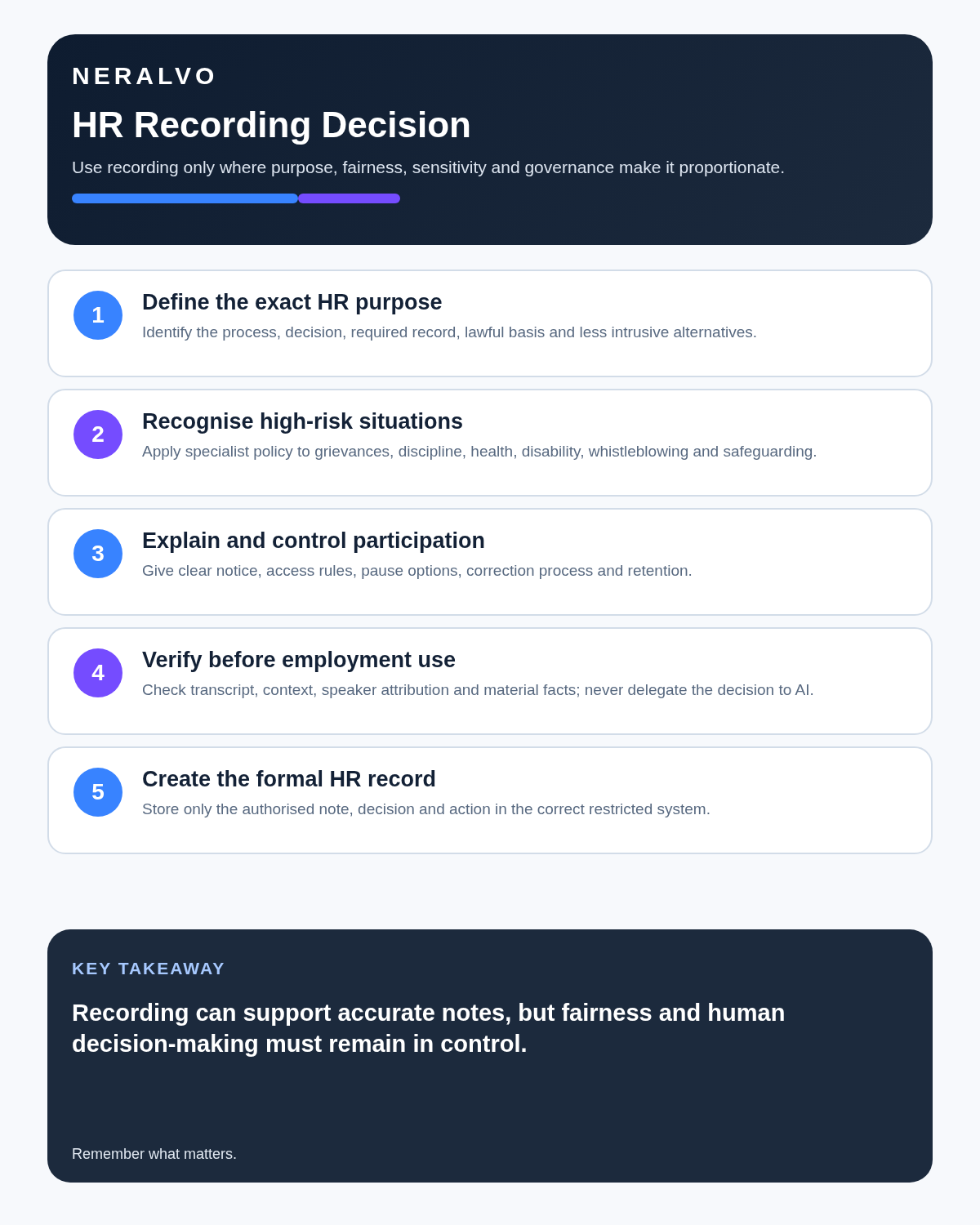
The purpose → necessity → fairness → controls → review → record workflow
| Stage | Question | Output |
|---|---|---|
| Purpose | What exact HR outcome requires recording? | Defined use |
| Necessity | Why are written notes insufficient? | Proportionate justification |
| Fairness | Can the employee understand and choose appropriately? | Transparent process |
| Controls | Who accesses, reviews, retains and deletes? | Governed workflow |
| Review | Which statements and evidence require checking? | Verified draft |
| Record | What is the formal HR outcome? | Restricted authoritative file |
Potentially suitable use cases
- Structured recruitment interviews where policy permits.
- Agreed note support for a participant adjustment.
- Routine consultation or policy meetings.
- Complex factual meetings where all parties understand the process.
- Private HR post-meeting dictation without employee audio.
High-risk or unsuitable situations
- Safeguarding or immediate welfare response.
- Highly distressed participants.
- Medical or occupational-health detail beyond the purpose.
- Informal support conversations expected to be confidential.
- Witness discussions where recording may contaminate evidence.
- Meetings where policy, representation or procedural rights are unresolved.
Provide participant controls
Explain the purpose, who receives the file, AI processing, access, retention, correction and alternative. Allow pause or stop where appropriate. Arrange representation, adjustments, interpreting and accessibility independently.
Separate evidence states
| Status | Meaning |
|---|---|
| Employee statement | Attributed account |
| Manager statement | Attributed account |
| Documentary evidence | Verified source |
| HR observation | Direct professional observation |
| Allegation | Unproven claim requiring fair process |
| Finding | Authorised conclusion after review |
| Outcome | Formal decision and appeal route |
Do not infer traits from voice
Accent, hesitation, emotion, speaking style and disability-related communication do not reliably show honesty, competence or commitment. Do not use sentiment or emotion analysis for employment decisions.
Verify the formal record
Check names, dates, quotations, allegations, evidence references, decisions, conditions, actions, review dates and procedural rights. Provide correction or challenge routes consistent with the process.
Keep one restricted HR record
Do not copy full transcripts into email, chat and shared drives. Create the minimum approved note, store it in the HR system and apply separate retention to raw audio and drafts.
Official UK workplace guidance
Acas says an organisation can record an investigation meeting where policy allows it and the worker agrees, while warning that recording can feel intimidating and reduce openness. Its current guidance also explains that meeting notes or witness statements should be checked through the organisation’s process. See Acas guidance on investigation meetings and recording.
The ICO describes audio monitoring as particularly intrusive and says continuous audio monitoring is unlikely to be justified except in rare circumstances. A one-off meeting recording is different, but necessity, transparency, minimisation, security and proportionality still apply. See the ICO’s worker-monitoring guidance.
How NERALVO Halo fits HR managers
NERALVO Halo includes NOTE mode, supported CALL mode, 64GB local storage, up to 35 hours of recording and Bluetooth sync with DOWAY. DOWAY provides transcripts, summaries, speaker-separated notes, templates, translations, mind maps and exports, with one year of DOWAY Max included. Organisational policy and accountable HR judgement govern use.
Cloud software, a dedicated recorder or manual notes?
For HR Managers, the right answer changes with the setting. This matrix deliberately gives each method a situation where it can be the strongest choice.
| Situation | Best starting point | Reason |
|---|---|---|
| scheduled remote client meetings | Cloud meeting software | Calendar automation and shared integrations are usually the strongest advantage. |
| in-person visits and travel | Dedicated recorder | Independent capture reduces reliance on an active phone or laptop. |
| a client declines or policy requires manual notes | Manual notes or an approved alternative | The boundary takes priority over convenience. |
| mixed CRM and field work | Governed hybrid | Use each method only in the setting it actually fits. |
Frequently asked questions
Should every HR meeting be recorded?
No. Use a purpose, necessity and fairness test.
Can AI analyse employee emotion or honesty?
No. Such inferences are unreliable and inappropriate for decisions.
Does a transcript become the formal HR record?
Not automatically. Create and approve the required restricted note through the process.
Final HR checklist
- Specific purpose documented.
- Less intrusive alternatives considered.
- Policy and procedure permit recording.
- Participant controls and adjustments provided.
- Evidence states separated.
- No voice-trait inference used.
- Formal record verified and restricted.
- Source retention and deletion controlled.
Bottom line: HR recording is justified only when it improves fairness and accuracy more than it increases pressure, sensitivity and lifecycle risk.
Related guides
See the guides for recruiters, coaches and school leaders.
On this page
Related guides
See whether Halo fits this workflow
Review the NERALVO Halo specifications, included services, delivery information and current offer only after completing the guide.
Found an error or an out-of-date claim? Email support@neralvo.com with the article address and a supporting source.