The 60-second verdict
Quick answer: coaches and mentors can use an AI voice recorder for approved session summaries, client reflections and action planning, but the client must understand the purpose, outputs, access, AI processing, sponsor boundaries, retention and non-recorded alternative before recording begins.
Best fit: Coaches who need recoverable audio and human-verified notes in an authorised workflow. Use another method when: recording is prohibited, a participant declines or the approved process requires manual notes.
Evidence basis and limits
- Decision factors covered: Why recording changes the coaching relationship; The four possible session records; The agreement → goal → reflection → challenge → action → review workflow.
- Evidence rule: The decision is based on the complete capture-to-action workflow, not a single feature or marketing accuracy percentage.
- Boundary: Examples and workflow recommendations must be tested with representative recordings, the intended users and the actual approval process before rollout.

View Halo specifications for coaches use can support approved sessions and private post-session drafting. It does not assess mental health, competence, honesty or readiness.
Why recording changes the coaching relationship
Clients may become guarded when every experiment, doubt or emotional statement becomes searchable. A small device can intensify the imbalance if the client feels unable to refuse. Recording should solve a defined note-taking problem, not become the default.
The four possible session records
| Record | Possible purpose | Main risk |
|---|---|---|
| Audio | Replay, supervision or credential evidence | Captures the complete sensitive conversation |
| Transcript | Search and drafting | Errors, excessive detail and third-party information |
| Session summary | Continuity and agreed themes | AI interpretation may replace the client’s meaning |
| Action note | Client-owned goal and next step | Can become prescriptive if the coach writes the goal for the client |
A client may agree to an action note without wanting the full audio retained. Treat each output separately.
The agreement → goal → reflection → challenge → action → review workflow
| Stage | Question | Output |
|---|---|---|
| Agreement | What is recorded, why and under which boundaries? | Informed choice |
| Goal | What does the client want to change or understand? | Client-owned outcome |
| Reflection | What does the client notice, believe or experience? | Attributed account |
| Challenge | What question or perspective does the coach introduce? | Coach intervention |
| Action | What will the client try, by when? | Measurable experiment |
| Review | What happened and what was learned? | Evidence of progress |
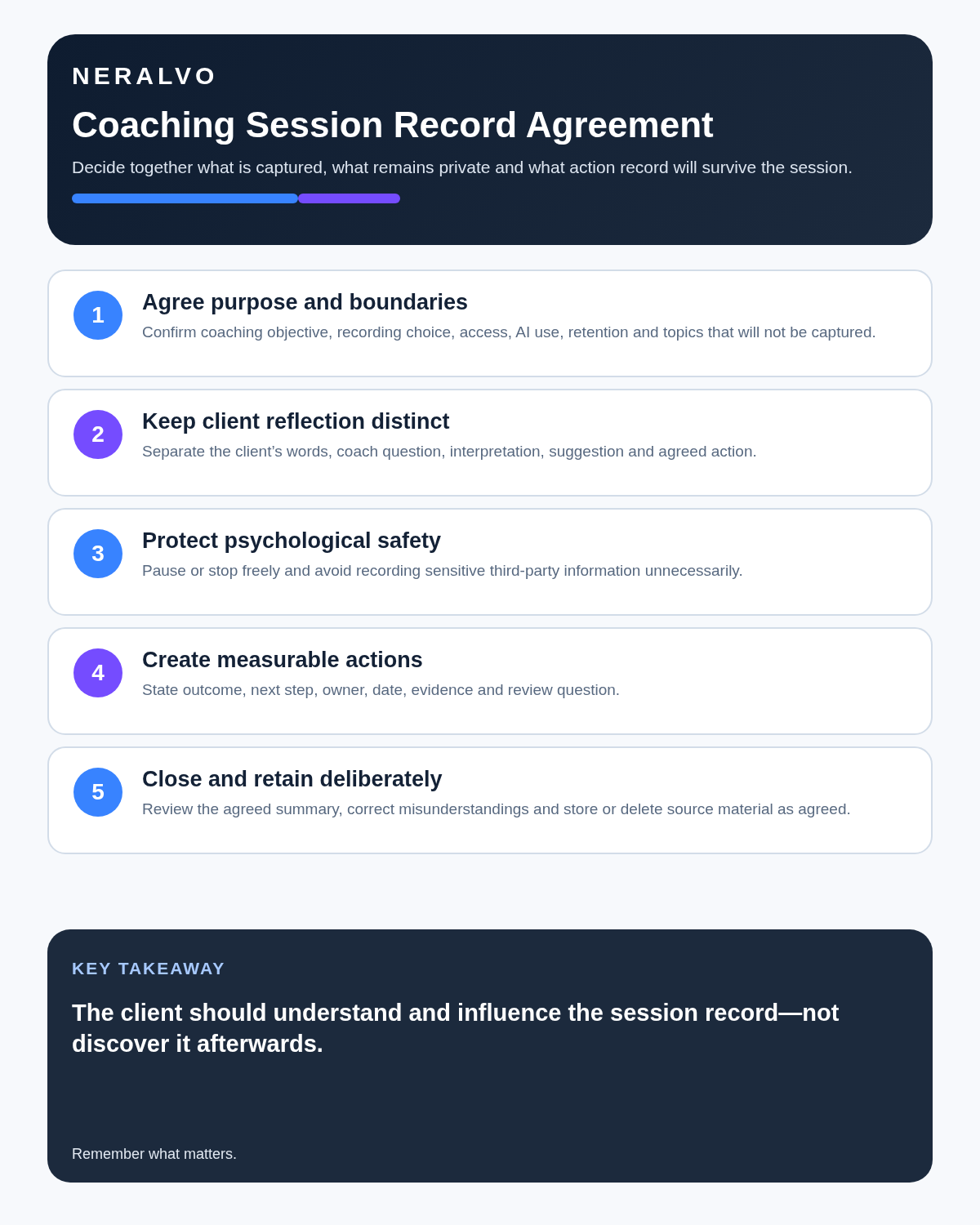
Create a complete recording agreement
Before the first recorded session, agree:
- purpose and session types covered;
- device and processing service;
- who controls the account;
- who can access audio, transcript, summary and action note;
- whether an employer, sponsor, supervisor or assessor receives anything;
- what will not be recorded;
- how the client can pause or stop;
- the non-recorded alternative;
- retention period for each output;
- deletion process and backup limitations;
- what happens if the client changes their mind;
- limits of confidentiality.
Confirm again at the start of each recorded session rather than relying on an agreement made months earlier.
Separate the client’s voice from coach interpretation
| Layer | Example |
|---|---|
| Client reflection | “I avoid giving feedback because I expect conflict.” |
| Coach observation | Client became less specific when discussing one relationship |
| Coach hypothesis | Possible fear of status loss; requires exploration |
| Agreed action | Prepare and deliver one feedback conversation using the agreed structure |
An AI summary should not turn a tentative hypothesis into a fact about the client.
Build client-owned action notes
| Field | Record |
|---|---|
| Focus | What the client wanted to explore |
| Insight | Meaning expressed in the client’s language |
| Options | Alternatives considered |
| Choice | Action selected by the client |
| Measure | How the client will recognise progress |
| Support | Resource or accountability requested |
| Review | Date or situation for revisiting the action |
Avoid unnecessary personal history, speculative labels and private details about third parties.
Protect psychological safety
Do not use sentiment, emotion or voice analysis to infer motivation, truthfulness, readiness or personality. Speech patterns can be affected by culture, disability, neurodiversity, stress, language and the coaching relationship.
Ask the client what the experience means to them. Keep coaching within the practitioner’s competence and use the appropriate referral or safeguarding process when needs move outside the coaching agreement.
Use a concise final session note
- session purpose;
- client-defined goal;
- key reflection in the client’s language;
- coach challenge or tool used;
- agreed action and review date;
- boundary, referral or support issue;
- what source material will be retained or deleted.
The full transcript is rarely the best coaching record.
Handle employer-sponsored coaching carefully
A three-way agreement should define what the sponsor receives. Appropriate reporting may include:
- attendance or engagement status;
- high-level goals agreed with the client;
- milestones the client has authorised for sharing;
- programme completion;
- anonymised themes across a wider programme.
It should not automatically include complete transcripts, personal disclosures, health information or AI-generated psychological interpretations.
Supervision and credential assessment are new purposes
Using a recording for supervision, training or credential assessment requires specific permission and a clear explanation of who will receive the file, the transcript format and retention.
The current International Coaching Federation Code of Ethics requires clear agreements, confidentiality, secure records and ethical responsibility for technology systems including AI. Coaches should also follow the requirements of their own professional body and jurisdiction.
Group coaching needs a separate agreement
Group recording creates additional risk because every participant’s contribution is captured. Agree:
- whether recording occurs at all;
- who receives it;
- whether a transcript is shared;
- how speakers are identified;
- whether extracts can be reused;
- what happens when one participant objects or withdraws.
The coach can control their own handling of the file but cannot guarantee that every group member will maintain confidentiality outside the session.
The post-session workflow
- Generate the transcript through the approved account.
- Correct names, dates, actions and speaker attribution.
- Separate the client’s words from coach interpretation.
- Create the proportionate action note.
- Share only the output agreed with the client.
- Move administrative actions into the practice system.
- Delete or retain audio and transcript according to the agreement.
Coaching is not therapy or emergency support
A recording does not qualify a coach to diagnose or treat mental-health conditions. Do not rely on an AI summary to determine whether somebody is at risk.
Maintain the professional boundaries and escalation process required by the coach’s training, professional body and jurisdiction.
Data-protection checks
Coaching conversations can include health, employment, family and financial information. Review where audio is processed, model-training terms, subprocessors, workspace access, client rights, deletion and the data-processing arrangement.
Make recording genuinely optional. A pressured agreement may not provide a fair basis for collecting an unusually detailed record of private conversation.
How NERALVO Halo fits coaching and mentoring
NERALVO Halo includes NOTE mode, supported CALL mode, 64GB local storage, up to 35 hours of recording and Bluetooth sync with DOWAY. DOWAY provides transcripts, summaries, speaker-separated notes, templates, translations, mind maps and exports, with one year of DOWAY Max included. These functions must sit inside the coach’s ethical, contractual and privacy controls.
Cloud software, a dedicated recorder or manual notes?
For Coaches, the right answer changes with the setting. This matrix deliberately gives each method a situation where it can be the strongest choice.
| Situation | Best starting point | Reason |
|---|---|---|
| scheduled remote meetings | Cloud meeting software | Native remote-meeting workflows can be more efficient here. |
| in-person or mobile work | Dedicated recorder | A separate battery and recoverable local source improve resilience. |
| recording is refused or prohibited | Manual notes or an approved alternative | Manual notes are the correct control when recording is unavailable. |
| mixed online and offline work | Governed hybrid | A hybrid can combine automation with reliable physical capture. |
Frequently asked questions
Should every coaching session be recorded?
No. Use recording only where it is proportionate, clearly agreed and useful.
Can AI identify the client’s real emotion?
No. Automated inference is unreliable and should not drive coaching judgement.
Can the sponsor receive the transcript?
Not unless the client agreement explicitly and appropriately permits it.
Can a session recording be reused for supervision?
Only with specific permission for that new purpose and controlled access.
Final coaching checklist
- Recording agreement clear.
- Each output has a defined purpose and retention period.
- Client can stop or choose an alternative.
- Client reflection is separated from coach interpretation.
- No automated personality or emotion judgement.
- Actions are client-owned and measurable.
- Clinical and safeguarding boundaries are respected.
- Sponsor reporting is limited.
- Group, supervision and credential uses have separate permission.
- Retention and deletion are deliberate.
Bottom line: coaching recording should strengthen memory and accountability without weakening candour, client ownership or confidentiality.
Related guides
On this page
Related guides
See whether Halo fits this workflow
Review the NERALVO Halo specifications, included services, delivery information and current offer only after completing the guide.
Found an error or an out-of-date claim? Email support@neralvo.com with the article address and a supporting source.