The 60-second verdict
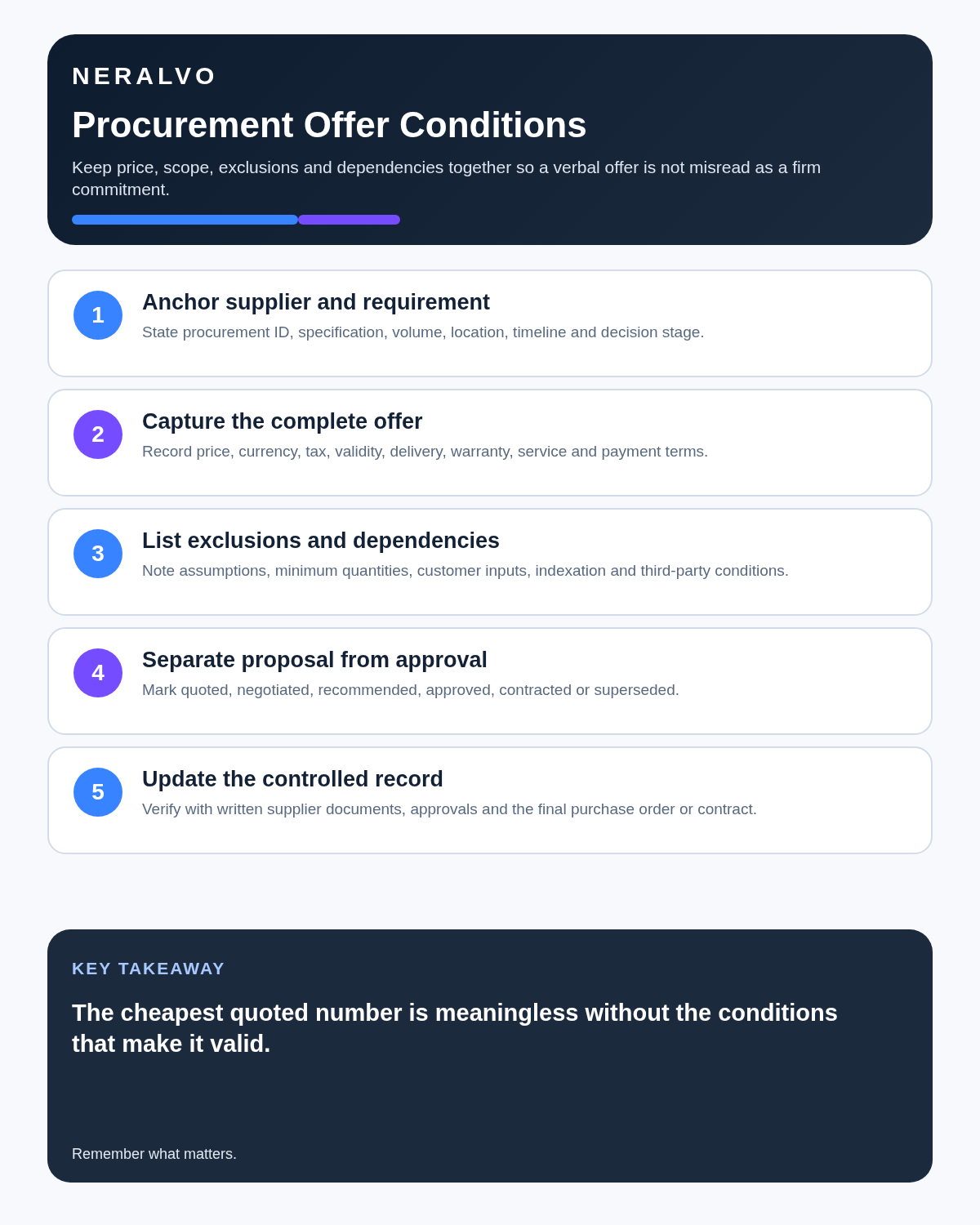
“We can hold that price” is meaningless until the volume, term, scope, deadline and authority behind the offer are recorded.
Best fit: Procurement Managers who need recoverable audio and human-verified notes in an authorised workflow. Use another method when: recording is prohibited, a participant declines or the approved process requires manual notes.
Evidence basis and limits
- Decision factors covered: The six commercial statuses; The TERMS ledger; Before the supplier meeting.
- Evidence rule: A claim earns weight only when the source, date, configuration and limitation are clear enough for a reader to check.
- Boundary: Examples and workflow recommendations must be tested with representative recordings, the intended users and the actual approval process before rollout.
This workflow creates a conditional-offer ledger from approved supplier conversations without bypassing tender, evaluation, approval or contract controls.
The six commercial statuses
| Status | Meaning | Treatment |
|---|---|---|
| Supplier statement | Claim made during discussion | Verify against evidence |
| Proposal | Possible commercial or technical offer | Record as unapproved |
| Clarification | Explanation of an existing submission | Keep within process rules |
| Conditional concession | Movement dependent on another term | Record every dependency |
| Approved position | Internal stance authorised for negotiation | Keep restricted |
| Contractual term | Incorporated through the formal legal process | Contract remains controlling |
The TERMS ledger
- T — Topic: requirement, lot or contract area.
- E — Evidence: submission, demonstration, certificate or reference.
- R — Restriction: condition, exclusion, dependency or expiry.
- M — Money and measure: price, volume, service level and calculation basis.
- S — Status: proposal, clarification, concession, approved position or contract term.
Example: “Lot 2 migration. Supplier proposed £84,000 based on 12 source systems and completion by 31 March. Training, data cleansing and weekend cutover excluded. Price indicative pending discovery and expires 30 July. Revised written breakdown due 24 July. No commercial term agreed.”
Before the supplier meeting
Define agenda, permitted discussion, evaluation boundaries, authority and confidential information. A recorder should not create an informal route around the procurement procedure.
After the meeting
- Generate and correct the transcript.
- Check prices, percentages, dates, volumes and legal entities.
- Enter every material point into the TERMS ledger.
- Separate supplier claims from verified evidence.
- Request written clarification or confirmation.
- Apply approved evaluation criteria independently.
- Record conflicts and approvals.
- Incorporate agreed terms only through the contract process.
- Restrict negotiation strategy and competitor information.
- Delete temporary audio under policy.
AI must not score suppliers secretly
AI can organise submitted information, but it may favour fluent language, miss exclusions or invent comparison criteria. Formal evaluation must use verified submissions, approved criteria and accountable human review.
Due diligence
Verify material claims about financial standing, security, certifications, subcontractors, resilience, environmental claims, implementation capacity and service measurement. A repeated statement in a transcript is still only a claim.
Commercial confidentiality
Use role-based access. Do not upload confidential tenders or negotiation strategy to an unapproved AI service, and never disclose one supplier’s information to another.
Where NERALVO Halo fits
NERALVO Halo includes 64GB local storage, NOTE and CALL modes, up to 35 hours of recording and DOWAY processing. The current package includes one year of DOWAY Max.
NOTE mode may support approved supplier meetings, clarification sessions and mobilisation. CALL mode may support compatible supplier calls. Halo does not provide evaluation governance, delegated authority or contract formation.
Review the current NERALVO Halo details.
Cloud software, a dedicated recorder or manual notes?
For Procurement Managers, the right answer changes with the setting. This matrix deliberately gives each method a situation where it can be the strongest choice.
| Situation | Best starting point | Reason |
|---|---|---|
| scheduled remote client meetings | Cloud meeting software | Auto-join and central collaboration can remove routine admin. |
| in-person visits and travel | Dedicated recorder | Dedicated hardware suits movement, variable rooms and offline source capture. |
| a client declines or policy requires manual notes | Manual notes or an approved alternative | A clear alternative respects policy and participant choice. |
| mixed CRM and field work | Governed hybrid | One governed process prevents gaps between desk and field work. |
Related guides
Bottom line
An AI recorder can improve procurement records only when every offer retains its conditions and status. Verify evidence, apply the approved method and place binding terms in the formal contract—not the transcript.
Profession workflow
Visual map for AI Voice Recorder for Procurement Managers: Record Every Offer Condition
- Prepare the approved useDefine purpose, safe position, permission and the required formal record.
- Capture context firstState the case, asset, person, location or event identifier before detail.
- Human-verify evidenceCheck technical terms, units, names, dates, decisions and uncertainty.
- Complete the formal recordTransfer only verified information and apply access and retention controls.
On this page
Related guides
See whether Halo fits this workflow
Review the NERALVO Halo specifications, included services, delivery information and current offer only after completing the guide.
Found an error or an out-of-date claim? Email support@neralvo.com with the article address and a supporting source.