The 60-second verdict
Quick answer: software developers can use an AI voice recorder for approved design discussions, debugging hypotheses, incident debriefs and implementation notes, but the transcript must not replace source control, issue tracking, tests, observability or secure technical documentation.
Best fit: Software Developers who need recoverable audio and human-verified notes in an authorised workflow. Use another method when: recording is prohibited, a participant declines or the approved process requires manual notes.
Evidence basis and limits
- Decision factors covered: Use the hypothesis chain; Use the DEBUG note; Never dictate secrets.
- Evidence rule: A claim earns weight only when the source, date, configuration and limitation are clear enough for a reader to check.
- Boundary: Examples and workflow recommendations must be tested with representative recordings, the intended users and the actual approval process before rollout.

Assess Halo against the software developers workflow matrix can support rapid approved capture while code, configuration, telemetry and controlled records remain authoritative.
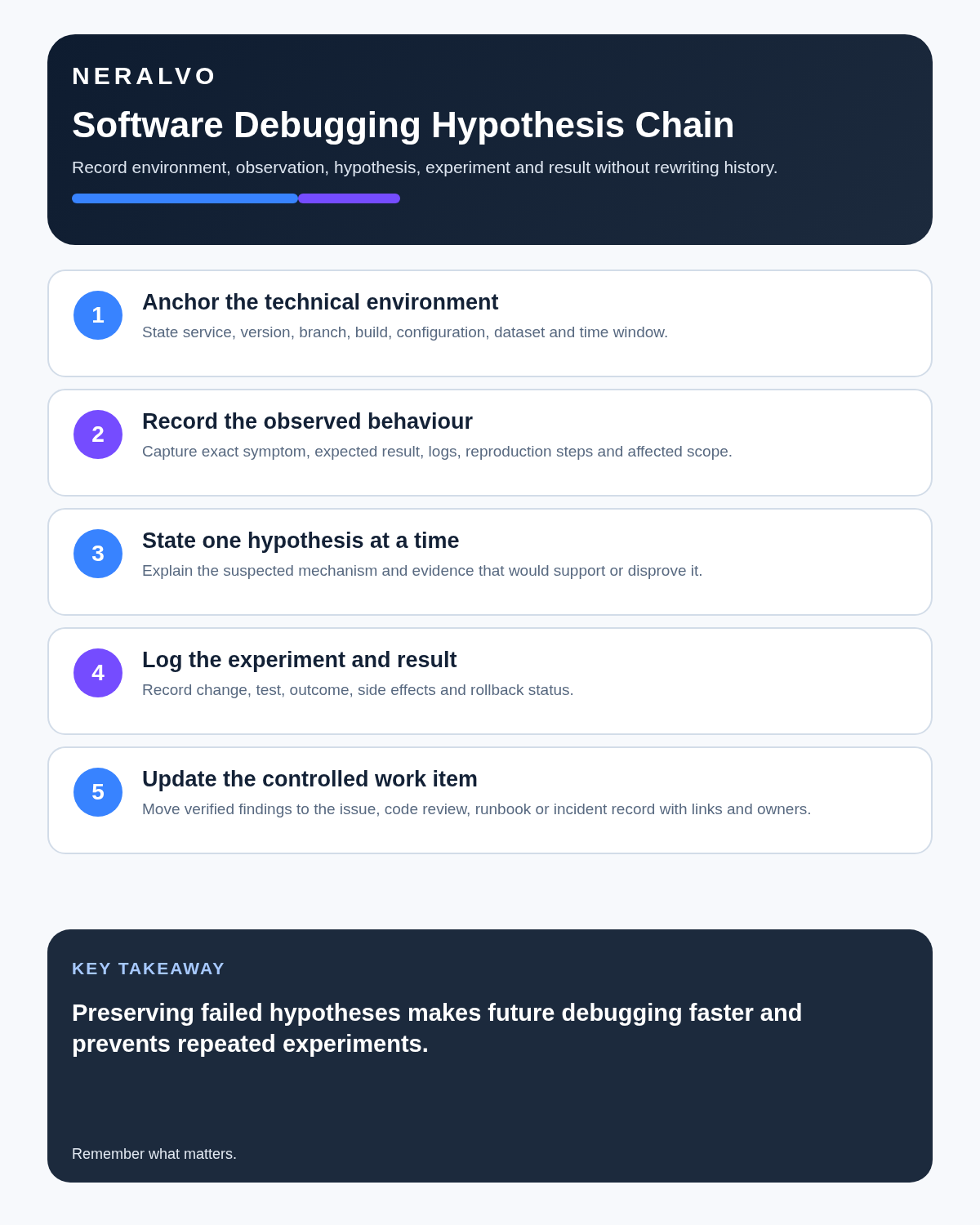
Use the hypothesis chain
| Stage | Example | Required evidence |
|---|---|---|
| Observation | Requests return 502 after 30 seconds | Service, environment, version and timestamp |
| Signal | Gateway log shows upstream timeout | Log query, correlation ID and timezone |
| Hypothesis | Connection pool may be exhausted | Reason it fits and evidence that may disprove it |
| Experiment | Pool limit changed in staging | Authorisation, test scope and rollback |
| Result | Failure remains | Measured outcome and comparison |
| Confirmed cause | Unused clients leak connections | Reproduction, code path and test |
| Decision | Adopt bounded client lifecycle | Issue, ADR, code review, owner and release plan |
Keep failed hypotheses. They show what was tested and prevent the same investigation from restarting later.
Use the DEBUG note
- D — Deployment: service, environment, version, feature flag and recent change.
- E — Evidence: exact symptom, logs, metrics, traces and timestamps.
- B — Belief: current hypothesis, confidence and alternatives.
- U — Undertaking: test or change, expected result, authority and rollback.
- G — Ground truth: actual result, confirmed cause, fix and follow-up.
Never dictate secrets
Do not record passwords, API keys, tokens, certificates, private keys, recovery codes, live connection strings or security answers. Avoid proprietary source code, sensitive architecture and customer data unless the approved process explicitly permits the exact content and processing route.
Use placeholders such as “production database credential” and store the real value only in the authorised secrets system.
Separate technical evidence states
- User report: attributed description of impact.
- Observed symptom: behaviour directly reproduced or measured.
- Telemetry evidence: linked log, trace, metric or alert.
- Hypothesis: possible explanation awaiting a discriminating test.
- Experiment result: measured outcome under stated conditions.
- Confirmed cause: explanation supported by reproduction and evidence.
- Verified fix: reviewed change that passes defined tests and monitoring.
A neat AI summary must not turn correlation into cause or a proposed patch into a verified fix.
Use a controlled technical-record workflow
- Define the technical question and user impact.
- Confirm participant agreement and company approval for recording.
- Remove secrets and unnecessary sensitive data.
- Anchor the service, environment, version and recent changes.
- Capture constraints, observations, alternatives and evidence references.
- Correct versions, commands, identifiers, timestamps and technical terms.
- Build the hypothesis chain and preserve failed experiments.
- Create the correct controlled record: issue, ADR, runbook, change, incident or handover.
- Link code, tests, logs, traces, dashboards and pull requests.
- Review through normal engineering, security and change control.
- Delete unnecessary audio and duplicate exports.
Create an architecture-decision record
An ADR should state the context, decision drivers, requirements, constraints, credible alternatives, trade-offs, selected option, consequences, decision authority, implementation implications and revisit trigger. A transcript showing that somebody suggested an option does not prove approval.
Review generated commands and code before use
For any command, script, migration or code suggested from the transcript, verify:
- the exact target environment and resource;
- permissions and blast radius;
- data loss, privacy and security impact;
- dependency and licence implications;
- tests, peer review and static analysis;
- deployment sequence and monitoring;
- rollback or recovery path; and
- the authorised change or release route.
AI-generated code receives the same scrutiny as any other change. Never run a destructive command merely because it appears in a confident summary.
Close incidents with evidence
Preserve timeline, customer impact, detection, response, mitigations, known configuration, competing hypotheses, confirmed cause, contributing conditions, corrective actions and effectiveness checks. Keep learning focused on systems and controls rather than unsupported blame.
Build an engineering handover
Include repository and service, environment, deployed version, current state, user impact, evidence, changes already attempted, results, remaining hypotheses, risks, temporary controls, next action, owner, deadline, rollback and the decision required.
The receiving developer should not need to replay an entire meeting to understand the problem.
How NERALVO Halo fits software development
NERALVO Halo includes NOTE mode, supported CALL mode, 64GB local storage, up to 35 hours of recording and Bluetooth sync with DOWAY. DOWAY can create transcripts, summaries, speaker-separated notes, templates, translations, mind maps and exports, with one year of DOWAY Max included.
It may support approved technical meetings, private debugging notes and handovers. It is not source control, observability, a secrets manager or an approval system.
Cloud software, a dedicated recorder or manual notes?
For Software Developers, the right answer changes with the setting. This matrix deliberately gives each method a situation where it can be the strongest choice.
| Situation | Best starting point | Reason |
|---|---|---|
| scheduled remote meetings | Cloud meeting software | Auto-join and central collaboration can remove routine admin. |
| in-person or mobile work | Dedicated recorder | Dedicated hardware suits movement, variable rooms and offline source capture. |
| recording is refused or prohibited | Manual notes or an approved alternative | A clear alternative respects policy and participant choice. |
| mixed online and offline work | Governed hybrid | One governed process prevents gaps between desk and field work. |
Frequently asked questions
Can AI confirm a root cause from repeated mentions?
No. A cause requires evidence and a discriminating test or reproduction.
Can a generated shell command be run directly?
No. Verify target, effect, permissions, test and rollback before execution.
Should failed experiments be deleted?
No. Preserve useful failed tests in the issue or incident record so the team does not repeat them.
Final developer-note checklist
- Service, environment and version identified.
- No secrets or unnecessary customer data recorded.
- Observation separated from hypothesis.
- Evidence and timestamps linked.
- Experiments have expected results and rollback.
- Cause supported by reproduction or equivalent evidence.
- Change linked to issue, code review and tests.
- Incident actions have owners and effectiveness checks.
- ADR, runbook and handover updated where required.
- Temporary audio and duplicate exports controlled.
Bottom line: a strong developer voice note preserves engineering reasoning and quickly transfers verified facts into code, tests, issues, ADRs and durable documentation.
Related guides
On this page
Related guides
See whether Halo fits this workflow
Review the NERALVO Halo specifications, included services, delivery information and current offer only after completing the guide.
Found an error or an out-of-date claim? Email support@neralvo.com with the article address and a supporting source.