The 60-second verdict
Quick answer: use an AI voice recorder for seminars only with the required permission, then organise the checked transcript around questions, arguments, evidence, counterarguments, examples and unresolved points before converting it into active-recall revision.
Best fit: Seminars who need recoverable audio and human-verified notes in an authorised workflow. Use another method when: recording is prohibited, a participant declines or the approved process requires manual notes.
Evidence basis and limits
- Decision factors covered: Ask before recording; Define the learning purpose; Prepare a seminar note structure.
- Evidence rule: Claims are weighted by consequence: capture failure, changed meaning, access and recovery matter more than polished wording.
- Boundary: Examples and workflow recommendations must be tested with representative recordings, the intended users and the actual approval process before rollout.

Seminars differ from lectures because understanding develops through questions, examples, disagreement and discussion of readings. Check whether NERALVO Halo fits seminars work can preserve an approved source while students focus on participation, but a transcript is not automatically accurate study material.
Ask before recording
Seminars may include personal experiences, assessed work, unpublished research or sensitive debate. Check:
- Institution and course policy.
- Tutor approval.
- Participant expectations.
- Any accessibility arrangement.
- Whether the recording is strictly for personal study.
- Whether an approved institutional transcript already exists.
- How files must be stored and deleted.
Personal-study permission does not automatically allow sharing, public uploading or processing through every AI service. Do not use hardware to avoid a tutor’s decision.
Define the learning purpose
Recording may be useful when the goal is to preserve exact definitions, how an argument developed, questions raised by the group, examples that clarify a theory, references to pages or sources, points of disagreement and follow-up reading. It is less useful where recording would inhibit discussion or the student has no realistic review plan.
Prepare a seminar note structure
| Field | What to capture |
|---|---|
| Seminar topic | The central question or problem |
| Required reading | Author, title, page or section |
| Key concepts | Definitions requiring verification |
| Arguments | Claim, reasoning and evidence |
| Counterarguments | Objections, limits and alternatives |
| Examples | Cases that apply or challenge the theory |
| Open questions | Issues not resolved in the session |
| Revision output | Questions, flashcards or essay plan |
Set up the room for discussion
- Place the recorder near the active centre, not behind laptops or books.
- Test the quietest important position.
- Reduce fan, keyboard and corridor noise.
- Use names or agreed participant labels where appropriate.
- Ask one person to speak at a time during complex debate.
- Repeat distant questions before answering.
- Record changes in attendance if attribution matters.
Large or highly interactive seminars may require an approved room system rather than one compact recorder.
Preserve the question-and-response structure
During review, organise discussion under the tutor’s questions rather than strict chronology. For each question, identify:
- The initial claim.
- The reasoning offered.
- The evidence or reading cited.
- The strongest counterargument.
- An example or case.
- The tutor’s clarification.
- What remained unresolved.
Record visual and textual references
Audio may not explain a diagram, board note or highlighted passage. Add page and paragraph numbers, case or article names, board headings, diagram labels, slide titles and links to the official reading list.
Do not rely on a transcript to reconstruct a visual argument it never captured.
Separate participant ideas from authoritative course content
| Content | Suggested label |
|---|---|
| Tutor explanation | Tutor clarification |
| Student interpretation | Participant view |
| Textual evidence | Reading or source reference |
| Unresolved debate | Open question |
| Assessment guidance | Verify against official module information |
Do not convert a confident class comment into a fact without checking the reading or official source.
Correct the transcript before studying from it
- Confirm the topic and date.
- Add question and reading headings.
- Correct names, authors, cases and technical terms.
- Check numbers, quotations and page references.
- Correct speaker labels where attribution matters.
- Mark overlap and inaudible passages honestly.
- Remove unrelated administration.
- Build the concise revision record.
Turn the transcript into active revision
- Write the central argument from memory.
- Create one question for each major concept.
- Explain the strongest argument and counterargument aloud.
- Build a comparison table or concept map.
- Draft an essay or problem-solving plan without the transcript.
- Check against official course material.
- Schedule spaced review.
Possessing a transcript can create familiarity, but familiarity is not the same as recall or understanding.
Use a seminar-to-revision workflow
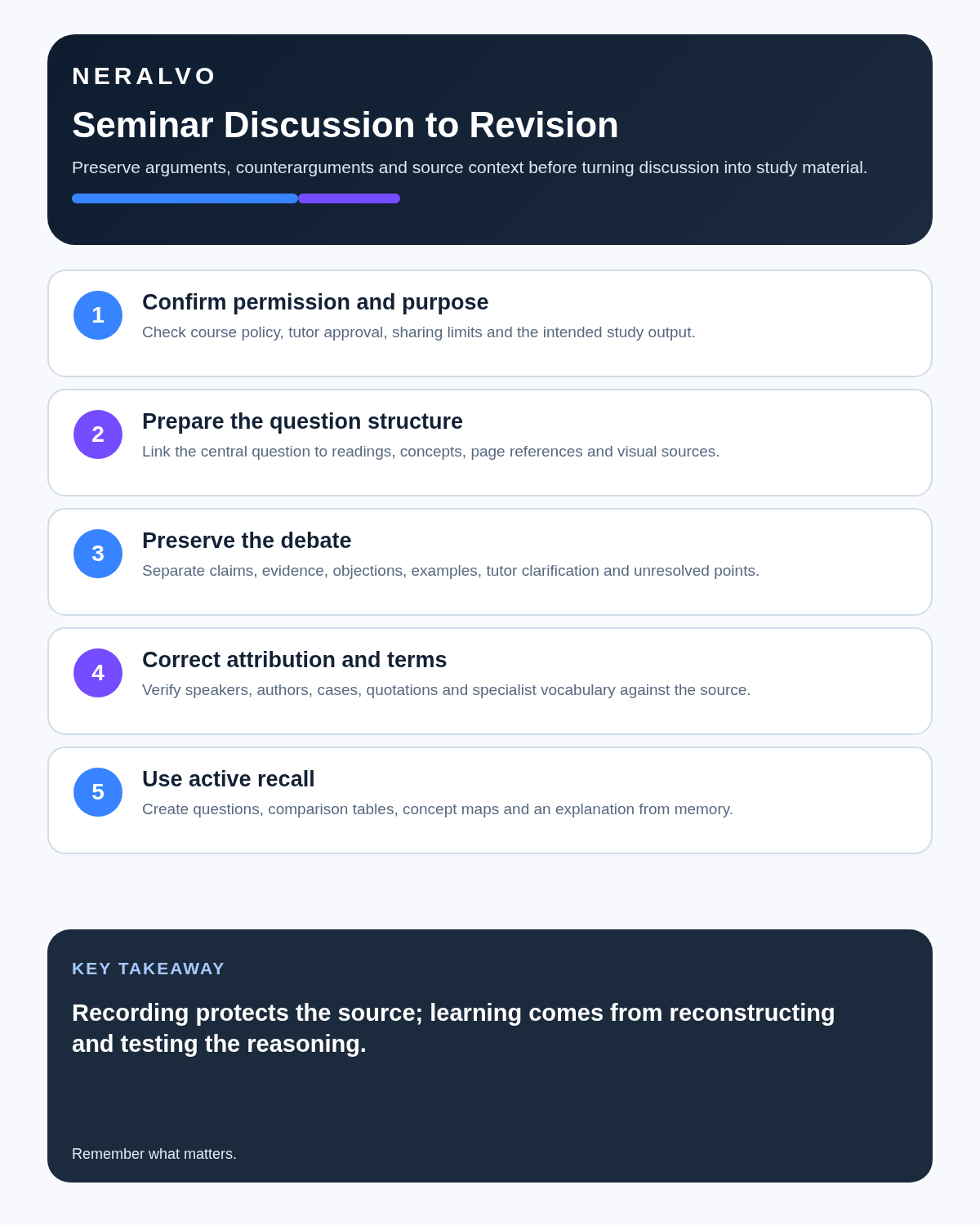
- Check permission and purpose.
- Prepare the seminar question and reading list.
- Record a short audio test.
- Write brief anchors and visual references during discussion.
- Generate the transcript.
- Correct high-risk terms and structure.
- Write a summary from memory.
- Create questions and an essay or problem-solving plan.
- Compare against official course material.
- Delete or retain files under the approved policy.
Protect participants
Seminars may reveal political views, health information, personal experience or unpublished academic work. Restrict access, remove unnecessary names from study notes and never distribute recordings simply because everyone was present. Where the subject is especially sensitive, use authorised written notes instead.
Accessibility and alternatives
Some students may require recording, captioning or note-taking support as a reasonable adjustment. Follow the institution’s approved process. Alternatives may include tutor notes, an approved transcript, a note-taker or accessible course materials.
How NERALVO Halo fits seminars
NERALVO Halo provides NOTE mode, 64GB local storage, up to 35 hours of recording and Bluetooth sync with DOWAY. DOWAY can generate transcripts, summaries, templates, translations, mind maps and exports, with one year of DOWAY Max included.
Use it within the approved learning process and verify technical content before revision.
Cloud software, a dedicated recorder or manual notes?
For Seminars, the right answer changes with the setting. This matrix deliberately gives each method a situation where it can be the strongest choice.
| Situation | Best starting point | Reason |
|---|---|---|
| scheduled remote meetings | Cloud meeting software | Calendar automation and shared integrations are usually the strongest advantage. |
| in-person or mobile work | Dedicated recorder | Independent capture reduces reliance on an active phone or laptop. |
| recording is refused or prohibited | Manual notes or an approved alternative | The boundary takes priority over convenience. |
| mixed online and offline work | Governed hybrid | Use each method only in the setting it actually fits. |
Frequently asked questions
Can every seminar be recorded?
No. Permission and course rules vary.
Can AI identify every speaker?
No. Similar voices and overlap require human review or neutral labels.
Can the summary replace the reading?
No. Official course sources remain authoritative.
Should recordings be shared with classmates?
Not without the required permission. Personal study approval does not automatically permit distribution.
Final seminar checklist
- Permission and learning purpose confirmed.
- Question and readings prepared.
- Room and quietest position tested.
- Arguments and counterarguments preserved.
- Visual and source references added.
- Participant and tutor content labelled correctly.
- Terminology and quotations checked.
- Active-recall materials created.
- Participants and source retention protected.
Bottom line: effective seminar notes show how claims were supported, challenged and refined. Recording can protect the source, but learning comes from organising, questioning and recalling it.
Related guides
See the guides for training sessions, panel discussions and choosing an AI voice recorder.
On this page
Related guides
See whether Halo fits long-form study capture
After checking permission and your institution’s rules, compare Halo’s stated battery, storage and export workflow with the way you actually study.
Found an error or an out-of-date claim? Email support@neralvo.com with the article address and a supporting source.