The 60-second verdict
SENCO meetings bring together different types of evidence: the pupil’s own experience, family priorities, classroom observation, progress information, specialist advice and provision records. A useful note must keep those sources separate before deciding what changes next.
Best fit: SENCOs who need recoverable audio and human-verified notes in an authorised workflow. Use another method when: recording is prohibited, a participant declines or the approved process requires manual notes.
Evidence basis and limits
- Decision factors covered: The voice → evidence → provision → review cycle; Start with accessible pupil voice; Keep family views distinct.
- Evidence rule: The decision is based on the complete capture-to-action workflow, not a single feature or marketing accuracy percentage.
- Boundary: Examples and workflow recommendations must be tested with representative recordings, the intended users and the actual approval process before rollout.
An AI voice recorder for SENCOs can support approved review drafts and private post-meeting notes. It cannot identify SEND, assess statutory entitlement, determine suitable provision, replace an EHC plan or make safeguarding decisions.
The voice → evidence → provision → review cycle
| Stage | Key question | Output |
|---|---|---|
| Voice | What matters to the child or young person and their family? | Accessible priorities |
| Evidence | What do observation, progress and professional advice show? | Verified picture of need and strengths |
| Provision | What support has actually been delivered and by whom? | Specific action |
| Review | What changed, what did not and what happens next? | Updated plan and review date |
This cycle supports the assess–plan–do–review approach without allowing the transcript to become the assessment.
Start with accessible pupil voice
Pupil voice may be expressed through speech, symbols, assistive technology, drawing, behaviour, supported conversation or observation. A spoken recording alone can exclude important evidence.
Capture:
- Strengths and interests.
- What feels difficult.
- What support helps.
- What the pupil wants to achieve.
- What they want adults to understand.
- How they prefer to communicate and participate.
Check meaning with the pupil and the people who know their communication best. Do not replace their words with a generic AI summary such as “wants more confidence.”
Keep family views distinct
Parents and carers may describe changes at home, previous support, health information, attendance patterns and priorities. Attribute the source rather than merging family, pupil and school perspectives.
A useful review note can show:
- Pupil view.
- Parent or carer view.
- Teacher observation.
- Specialist advice.
- Current provision.
- The SENCO’s coordination decision.
Disagreement should remain visible. An AI summary must not create false consensus.
Verify evidence before changing support
Check the source, date and relevance of:
- Attendance and progress information.
- Classroom and unstructured-time observation.
- Work samples and assessment.
- Behaviour or regulation patterns.
- Speech, language, sensory or physical information.
- Health and professional reports.
- Previous outcomes and provision records.
AI cannot decide that a child has a diagnosis or that one explanation accounts for every difficulty. Preserve uncertainty and identify evidence still required.
Record provision as delivered—not merely planned
A support plan should identify what happens in practice:
| Provision field | Required detail |
|---|---|
| Support | What is provided |
| Frequency and duration | How often and for how long |
| Deliverer | Role responsible |
| Setting | Where and under what conditions |
| Outcome | What change is expected |
| Evidence | How response will be reviewed |
Distinguish provision that was proposed, agreed, started, interrupted or completed. A transcript should not imply delivery when the support has not occurred.
Use the current statutory framework
In England, the SEND Code of Practice: 0 to 25 years remains the statutory guidance for the bodies it names. SENCOs should also follow current school, trust and local-authority procedures.
AI can organise evidence but cannot decide whether an EHC needs assessment is required, what statutory provision must be made or whether legal duties have been met.
Create an immediate safeguarding route
A disclosure or concern must be handled through the school’s safeguarding procedure immediately. Do not wait for the recording to upload, transcribe or identify speakers.
Move safeguarding information out of the general SEND meeting draft and into the restricted authorised record. Keep the routine support note proportionate.
Make parent meetings genuinely accessible
Explain recording in clear language, including purpose, access, retention and alternatives. Consider:
- Interpreter or translation needs.
- Easy-read or visual information.
- Communication aids.
- Processing time and breaks.
- Advocacy.
- Whether recording increases anxiety.
Automated translation may support a rough draft, but it should not replace approved language support where accurate participation or statutory decisions depend on meaning.
Review outcome, implementation and experience
At the next review, ask three separate questions:
- Outcome: what changed in the intended area?
- Implementation: was the agreed provision delivered consistently?
- Experience: how did the pupil and family experience the support?
A poor outcome may reflect an unsuitable plan, incomplete delivery, changing need or an inappropriate measure. Do not ask AI to choose the explanation.
A concise SENCO review-note script
- Voice: record pupil and family priorities separately.
- Strengths: identify what is working.
- Evidence: state the source and date of material information.
- Provision: record what was actually delivered.
- Response: describe outcome, implementation and experience.
- Decision: state the next adjustment and authority.
- Action: give owner, deadline and official destination.
- Review: define the next date and evidence required.
How NERALVO Halo can support approved SENCO administration
View Halo specifications for sencos use can support private post-review notes, approved meetings and structured action drafting. It includes NOTE mode, supported CALL capture, 64GB local storage, up to 35 hours of recording and Bluetooth sync with DOWAY. DOWAY can create transcripts, summaries, speaker-separated notes, templates, translations, mind maps and exportable files, with one year of DOWAY Max included from activation.
Halo is not automatically approved for pupil information. The school or trust remains responsible for data protection, cyber security, safeguarding, accessibility, procurement and retention.
SEND-record quality check
- Is pupil voice captured through a suitable communication method?
- Are pupil, family, teacher and specialist views attributed separately?
- Is every important evidence source verified?
- Does the note distinguish planned from delivered provision?
- Were safeguarding concerns acted on immediately?
- Are statutory and professional decisions made by authorised people?
- Are language and accessibility needs properly supported?
- Does the review separate outcome, implementation and experience?
- Has source audio been handled under school or trust policy?
A strong SENCO record preserves the individual child or young person, verifies the evidence, describes provision precisely and creates a clear next review.
Cloud software, a dedicated recorder or manual notes?
For SENCOs, the right answer changes with the setting. This matrix deliberately gives each method a situation where it can be the strongest choice.
| Situation | Best starting point | Reason |
|---|---|---|
| scheduled remote meetings | Cloud meeting software | Native remote-meeting workflows can be more efficient here. |
| in-person or mobile work | Dedicated recorder | A separate battery and recoverable local source improve resilience. |
| recording is refused or prohibited | Manual notes or an approved alternative | Manual notes are the correct control when recording is unavailable. |
| mixed online and offline work | Governed hybrid | A hybrid can combine automation with reliable physical capture. |
Related AI voice recorder guides
See the guides for school leaders, teachers and private tutors.
Related guides
Profession workflow
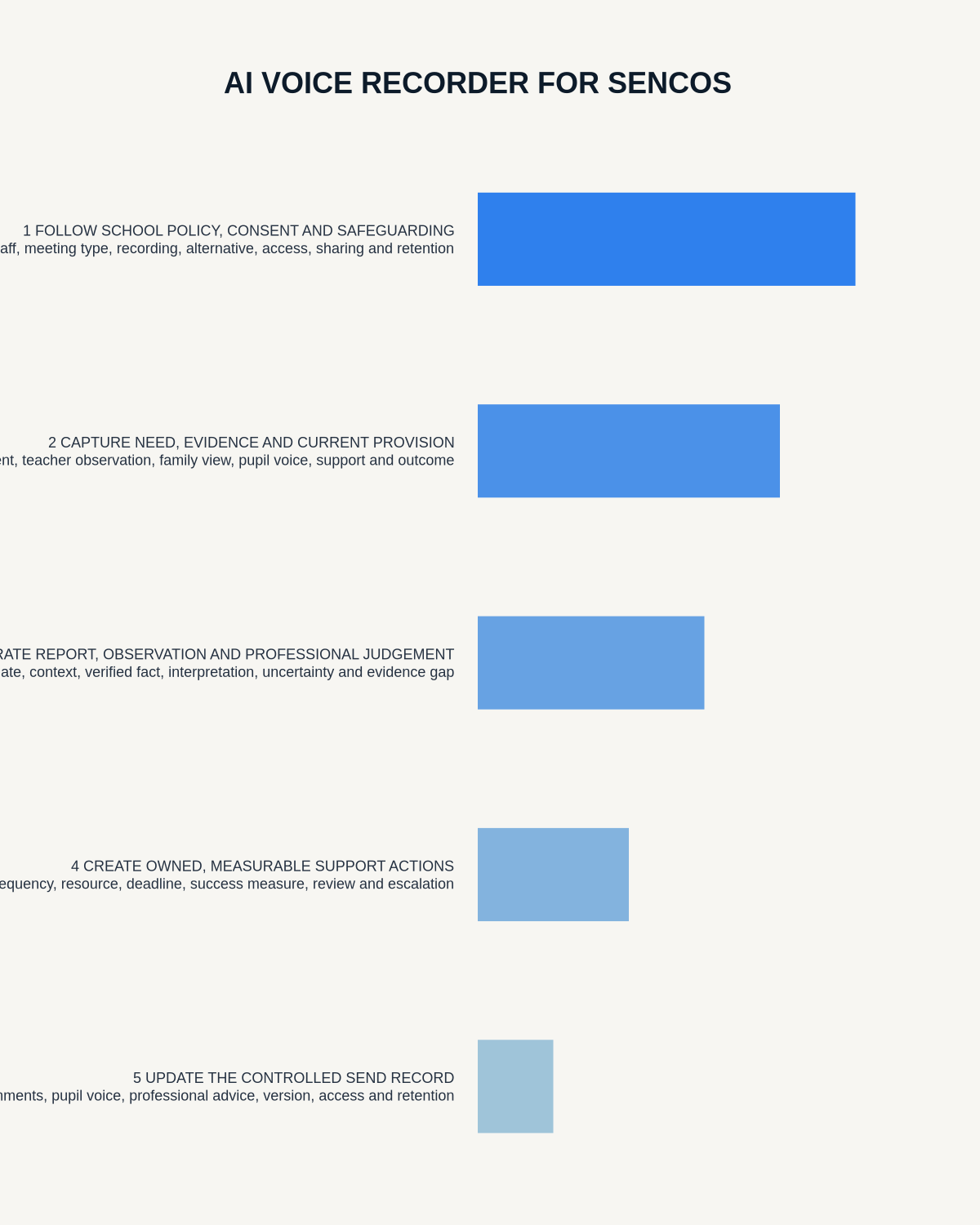
Visual map for AI Voice Recorder for SENCOs: Parent Meetings, Support Reviews and Provision Notes
- Prepare the approved useDefine purpose, safe position, permission and the required formal record.
- Capture context firstState the case, asset, person, location or event identifier before detail.
- Human-verify evidenceCheck technical terms, units, names, dates, decisions and uncertainty.
- Complete the formal recordTransfer only verified information and apply access and retention controls.
On this page
Related guides
See whether Halo fits this workflow
Review the NERALVO Halo specifications, included services, delivery information and current offer only after completing the guide.
Found an error or an out-of-date claim? Email support@neralvo.com with the article address and a supporting source.