The 60-second verdict
Social work students need to understand what a person says, what the evidence shows, how power shapes the interaction and what action is required. A recording can support approved teaching and simulation, but it must not create an unofficial copy of a person’s life, a placement case or a safeguarding concern.
Best fit: Social Work Students who need recoverable audio and human-verified notes in an authorised workflow. Use another method when: recording is prohibited, a participant declines or the approved process requires manual notes.
Evidence basis and limits
- Decision factors covered: The voice → evidence → power → action → reflection workflow; Use a hard placement boundary; Stage 1: Preserve voice without rewriting it.
- Evidence rule: Claims are weighted by consequence: capture failure, changed meaning, access and recovery matter more than polished wording.
- Boundary: Examples and workflow recommendations must be tested with representative recordings, the intended users and the actual approval process before rollout.
An AI voice recorder for social work students can support permitted lectures, fictional skills practice and private anonymised reflection. It cannot assess risk, capacity or eligibility, decide an intervention or replace supervision and authorised records.
The voice → evidence → power → action → reflection workflow
| Stage | Social-work question | Useful output |
|---|---|---|
| Voice | What does the person say matters, in their own terms? | Attributed perspective |
| Evidence | What is observed, documented, reported or still uncertain? | Source-aware account |
| Power | How do authority, identity, rights and inequality affect the situation? | Ethical analysis |
| Action | What must happen now, through which authorised route? | Accountable next step |
| Reflection | What did the student learn about their reasoning and practice? | Authentic development action |
This workflow keeps a person’s voice separate from the student’s interpretation and puts urgent action before retrospective reflection.
Use a hard placement boundary
Do not record home visits, service-user meetings, supervision, case discussions, telephone calls or placement records on a personal consumer device unless the course and placement provider have expressly approved the complete arrangement.
Social Work England explains that students should not act against the professional standards or the policies and procedures of their course or placement provider. See its information for students and graduates.
Permission to record a university lecture or fictional role-play does not extend to placement activity.
Stage 1: Preserve voice without rewriting it
In a fictional scenario or approved simulation, distinguish:
- What the person says happened.
- What they want to change.
- What they fear or disagree with.
- How they describe their strengths and support.
- What communication method they prefer.
- What remains difficult to express or understand.
AI summaries may soften anger, remove uncertainty or turn a complex account into a neat service request. Keep attribution and disagreement visible.
Stage 2: Separate the evidence sources
| Information type | Correct treatment |
|---|---|
| Person’s account | Attribute clearly and preserve meaning |
| Family or carer account | Record separately |
| Student observation | Describe observable behaviour or context |
| Documented evidence | Identify source and date |
| Professional opinion | Attribute the person and role |
| Student interpretation | Label as provisional and discuss in supervision |
| Decision | Record the authorised decision-maker and route |
A transcript does not prove that an allegation, memory or interpretation is accurate. It records speech that still requires professional evaluation.
Use a safeguarding fast lane
A safeguarding or immediate-safety concern must be reported through the placement procedure without delay. Do not wait for audio to upload, transcribe or identify speakers.
Complete the authorised factual record and contact the appropriate supervisor or safeguarding route. Reflection can occur later. A private voice note is not an adequate safeguarding report.
Stage 3: Examine power, rights and inequality
Social work involves statutory authority, resource decisions and unequal relationships. A learning note should consider:
- What formal power is being used.
- Whether the person understands the process and choices.
- How race, disability, class, gender, age, sexuality, migration status or another factor may shape experience.
- What reasonable communication or accessibility support is needed.
- Whether the student is privileging one professional account over the person’s own evidence.
- What legal or ethical right requires verification.
AI cannot decide whether practice is anti-oppressive, proportionate or lawful. These judgements require current law, policy, supervision and critical reflection.
Make recording consent realistic
A person may feel unable to refuse a recording proposed by someone connected to a service. For approved simulation or research, explain:
- The exact purpose.
- Whether participation or recording is optional.
- The alternative available.
- Who can access the audio and transcript.
- Where processing occurs.
- When the material will be deleted.
- How withdrawal works and any limits.
Silence or attendance is not meaningful agreement. Placement recording should follow the organisation’s authorised consent and governance process.
Stage 4: Route action into the correct system
For every material issue, identify:
- Immediate safety or safeguarding action.
- Authorised decision-maker.
- Law, policy or procedure to verify.
- Official record to update.
- Person who must be informed.
- Action, owner and deadline.
- Review or escalation point.
The AI output is working material. The placement or university system remains the source of truth.
Use supervision preparation rather than supervision recording
Students can often prepare more safely by creating a private, anonymised question sheet before supervision:
- What am I uncertain about?
- Which fact and interpretation have I merged?
- What power or ethical tension is present?
- Which legal or policy point needs checking?
- What emotional response may be affecting my judgement?
- What decision or support do I need from supervision?
Do not record the supervision conversation or identifiable case detail unless the provider has expressly authorised it.
Practise interviews with fictional information
With informed peers or actors, a recording can help review whether the student:
- Introduced their role and purpose clearly.
- Used open and focused questions appropriately.
- Listened without rushing to a service solution.
- Explained authority and confidentiality honestly.
- Recognised strength, risk and uncertainty.
- Checked understanding.
- Ended with an agreed next step.
AI can organise the transcript but should not score empathy, honesty or risk. Educators and approved criteria remain responsible for feedback.
Anonymisation requires more than removing a name
A person or family may remain identifiable through age, location, household structure, service history, occupation, rare circumstances or chronology. Use the minimum detail needed to examine the student’s learning.
A safe reflection focuses on the student’s reasoning, communication and action rather than retelling a recognisable case.
Use technology lawfully and ethically
Social Work England’s professional standards require technology and electronic communication to be used lawfully and ethically. Its current online communication guidance also emphasises privacy, confidentiality and dignity.
Students should use provider-approved accounts, keep access restricted and avoid open links, personal messaging groups and unnecessary copies of sensitive material.
Stage 5: Create authentic reflection
A useful reflection separates:
- What was known or observed.
- What the student assumed.
- How power and identity affected the interaction.
- What feedback was received and from whom.
- What law, ethics or evidence needs checking.
- What the student would do differently.
- How the change will be demonstrated in future practice.
AI may help organise a permitted draft, but it must not invent insight, experience, service-user statements or feedback.
How NERALVO Halo can support social-work study
Check whether NERALVO Halo fits social work students work can support permitted lectures, fictional skills simulations and private anonymised learning notes. It includes NOTE mode, supported CALL capture, 64GB local storage, up to 35 hours of recording and Bluetooth sync with DOWAY.
DOWAY can create transcripts, summaries, speaker-separated notes, templates, translations, mind maps and exports. One year of DOWAY Max is included from activation.
These features do not make Halo or DOWAY approved for service-user information, placement calls, home visits or case records. The course and placement provider control the permitted devices, accounts and processing route.
Social-work-study quality check
- Was recording limited to approved teaching, fictional simulation or private anonymised reflection?
- Was all identifiable placement information excluded?
- Are person, family, professional and student accounts attributed separately?
- Were safety and safeguarding actions completed immediately?
- Were power, rights and inequality considered?
- Was recording consent genuine and specific?
- Was each decision routed into the authorised system?
- Does reflection focus on the student’s own reasoning and development?
- Is technology being used under course and placement policy?
A strong social-work-student recording workflow protects the people behind the work, preserves different evidence sources and turns supervised learning into accountable future practice.
Cloud software, a dedicated recorder or manual notes?
For Social Work Students, the right answer changes with the setting. This matrix deliberately gives each method a situation where it can be the strongest choice.
| Situation | Best starting point | Reason |
|---|---|---|
| scheduled remote consultations | Cloud meeting software | Calendar automation and shared integrations are usually the strongest advantage. |
| in-person consultations or ward handovers | Dedicated recorder | Independent capture reduces reliance on an active phone or laptop. |
| a patient declines or policy prohibits recording | Manual notes or an approved alternative | The boundary takes priority over convenience. |
| mixed remote and clinical work | Governed hybrid | Use each method only in the setting it actually fits. |
Related AI voice recorder guides
See the guides for social workers, SENCOs, nursing students and counsellors.
Related guides
Profession workflow
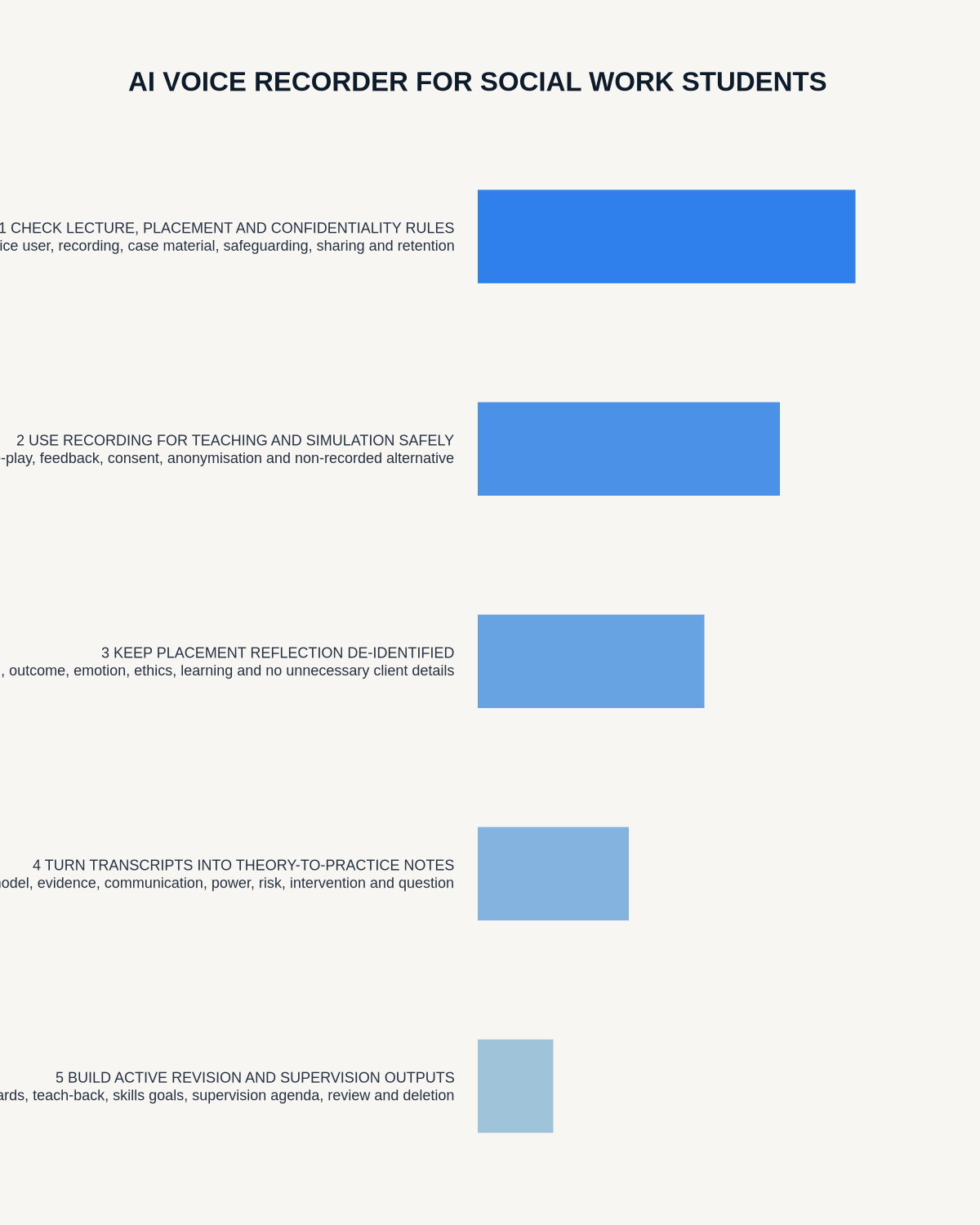
Visual map for AI Voice Recorder for Social Work Students: Lectures, Placement Reflection and Skills Practice
- Prepare the approved useDefine purpose, safe position, permission and the required formal record.
- Capture context firstState the case, asset, person, location or event identifier before detail.
- Human-verify evidenceCheck technical terms, units, names, dates, decisions and uncertainty.
- Complete the formal recordTransfer only verified information and apply access and retention controls.
On this page
Related guides
See whether Halo fits long-form study capture
After checking permission and your institution’s rules, compare Halo’s stated battery, storage and export workflow with the way you actually study.
Found an error or an out-of-date claim? Email support@neralvo.com with the article address and a supporting source.