
Reviewed and fact-checked: 21 July 2026.
The 60-second verdict
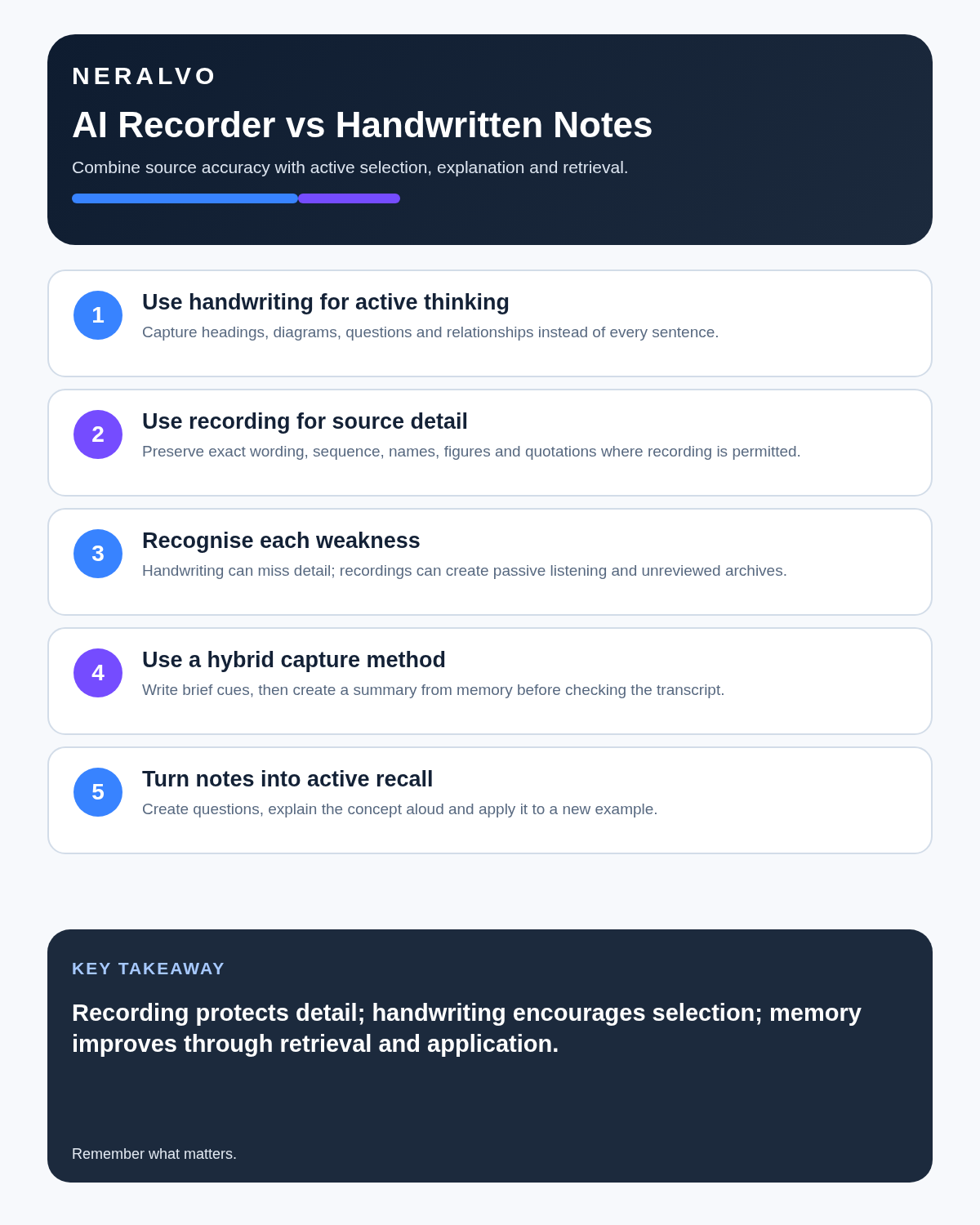
Handwritten notes and AI voice recordings solve different problems. Writing by hand can encourage selection, compression and personal organisation. Recording can preserve exact wording, names, figures and context while allowing the listener to stay engaged. Neither method guarantees better memory or understanding by itself.
Best fit: choose the option that passes your capture, recovery, privacy and total-cost gates. Do not decide on: price or a single accuracy claim in isolation.
Quick verdict: use handwriting when active synthesis, diagrams or a non-recorded method matter; use permitted recording when exact detail and later verification matter; combine both when you need source accuracy and active learning.
Evidence basis and limits
- Decision factors covered: There is no universal winner; What handwritten notes do well; Where handwritten notes can fail.
- Evidence rule: A claim earns weight only when the source, date, configuration and limitation are clear enough for a reader to check.
- Boundary: Examples and workflow recommendations must be tested with representative recordings, the intended users and the actual approval process before rollout.
There is no universal winner
Research comparing note-taking methods does not justify a simple rule that one medium always produces better learning. Some studies report differences in cognitive processing between handwriting and typing, while other work finds no clear performance advantage across note-taking devices. Outcomes depend on the task, the learner, the quality of the notes, later review and whether the person actively retrieves the information.
A voice recording introduces another distinction: it preserves the source but does not require the same real-time selection as writing. That can protect detail, but passive possession of audio is not the same as remembering or understanding it.
What handwritten notes do well
- Encourage the writer to select and compress information.
- Support diagrams, arrows, equations and spatial layouts.
- Work without batteries, apps or internet access.
- Avoid capturing everyone’s voice.
- Provide a quiet option where recording is prohibited or inappropriate.
- Can support active review when the writer reorganises ideas in their own words.
Where handwritten notes can fail
- Important wording, names, figures or conditions may be missed.
- Fast writing can reduce eye contact and listening.
- Notes may be difficult for another person to interpret.
- The writer may record an assumption as though it were agreed.
- There is no audio source for checking a disputed quotation.
- Handwriting may be difficult or inaccessible for some people.
What an AI voice recorder does well
- Preserves a replayable source where recording is permitted.
- Reduces pressure to capture every sentence manually.
- Supports transcript search across long meetings or lectures.
- Makes names, figures, quotations and commitments easier to verify.
- Can create draft summaries, action lists and mind maps.
- Supports people who find prolonged handwriting difficult.
Where recording can fail
- Poor placement, noise or overlapping speech can make words unrecoverable.
- Automatic transcripts can mishear names, numbers and negatives.
- Speaker labels may be wrong.
- Recording can inhibit participants or create privacy concerns.
- Hours of audio can become an unprocessed backlog.
- Listening again without active recall may create familiarity rather than durable learning.
How NERALVO Halo may fit a combined workflow
Use the AI Voice Recorder vs Handwritten Notes criteria to assess NERALVO Halo is an ultra-slim, phone-mounted AI voice recorder with NOTE mode for suitable room meetings, lectures and private spoken notes; supported CALL mode for lawful and disclosed calls; 64GB local storage; up to 35 hours of recording; and Bluetooth sync with the DOWAY app. DOWAY can generate transcripts, summaries, templates, translations, mind maps and exports. One year of DOWAY Max is included.
Halo can preserve the source while the user writes only brief markers, questions or diagrams. Recording must still be permitted, transparent and appropriate for the setting.
A practical hybrid method
- Check whether recording is allowed and necessary.
- Write the session purpose and two or three questions before it begins.
- Start the permitted recording and note the time.
- Write brief anchors rather than a second transcript.
- Mark decisions, questions, confusion and important timestamps.
- Afterwards, correct the transcript’s names, figures and speaker labels.
- Close the recording and reconstruct the main ideas from memory.
- Compare your reconstruction with the checked source.
- Create concise final notes, actions or revision questions.
- Delete or retain source audio according to the approved policy.
Choose the method by purpose
Balanced comparison matrix
Balanced decision rule: a cloud tool should win where automation and collaboration matter most; a dedicated recorder should win where independent capture and mobility matter most; manual notes should win when recording is inappropriate.
| Situation | Likely starting method | Reason |
|---|---|---|
| Private idea | Voice note or handwriting | Choose the fastest accessible method |
| Lecture with permission | Brief notes plus recording | Preserves detail while supporting active processing |
| Confidential meeting where recording is not approved | Authorised written notes | Recording governance takes priority |
| Interview requiring exact quotations | Permitted recording plus observation notes | Exact wording can be checked later |
| Diagram-heavy subject | Handwriting or digital ink | Spatial relationships matter |
| Decision meeting | Recording plus concise decision log | Source verification and controlled follow-up |
| Accessibility need | Individual or assisted combination | The method should fit the person |
Use active review rather than passive replay
For learning, do not simply reread a transcript or replay the entire recording. Better review may include:
- Writing a summary before checking the source.
- Creating questions and answering them from memory.
- Explaining the topic aloud without notes.
- Drawing a concept map.
- Comparing your understanding with the transcript.
- Scheduling spaced review rather than one long replay.
- Turning decisions and actions into the correct system immediately.
Accuracy and privacy still apply to both
Handwritten notes can contain personal data and confidential information just as audio can. Protect notebooks, photographs, exports, transcripts and recordings. Keep only what the purpose requires, correct inaccurate information and avoid uncontrolled duplicates.
Is cloud software or a physical recorder right for this workflow?
- Choose the software-led option when automated remote-meeting capture and collaboration remove more work than they add.
- Choose the dedicated-recorder option when independent in-person capture, mobility and source recovery matter more.
- A governed hybrid can be best when the same team works both online and in person.
How community feedback is used
Public reviews can reveal recurring friction, but an anonymous anecdote is not treated as measured proof. A pull-quote should appear only when it links to the original post, identifies the relevant product version or date and is presented as one user’s experience—not as universal fact.
Frequently asked questions
Does recording improve memory automatically?
No. Recording preserves information. Learning still requires attention, organisation, retrieval and review.
Are handwritten notes always better for studying?
No. They may encourage active processing, but results vary by person, task, note quality and review method.
Can a transcript replace personal notes?
It can preserve detail, but it is usually too long to function as a useful final study or meeting record.
Are handwritten notes more private?
They avoid audio capture, but written notes still require secure storage and proportionate content.
Should every lecture or meeting be recorded?
No. Recording must be permitted, necessary and suitable for the purpose.
Preserve detail without outsourcing the thinking
Handwriting can help create meaning; recording can protect the source. A deliberate combination often provides stronger accuracy and follow-up than relying on either method passively.
Use the AI Voice Recorder vs Handwritten Notes criteria to assess NERALVO Halo for approved portable recording and structured AI notes.
Related guides
On this page
Related guides
See whether Halo fits this workflow
Review the NERALVO Halo specifications, included services, delivery information and current offer only after completing the guide.
Found an error or an out-of-date claim? Email support@neralvo.com with the article address and a supporting source.