Reviewed and strengthened: 5 August 2026.
The 60-second verdict
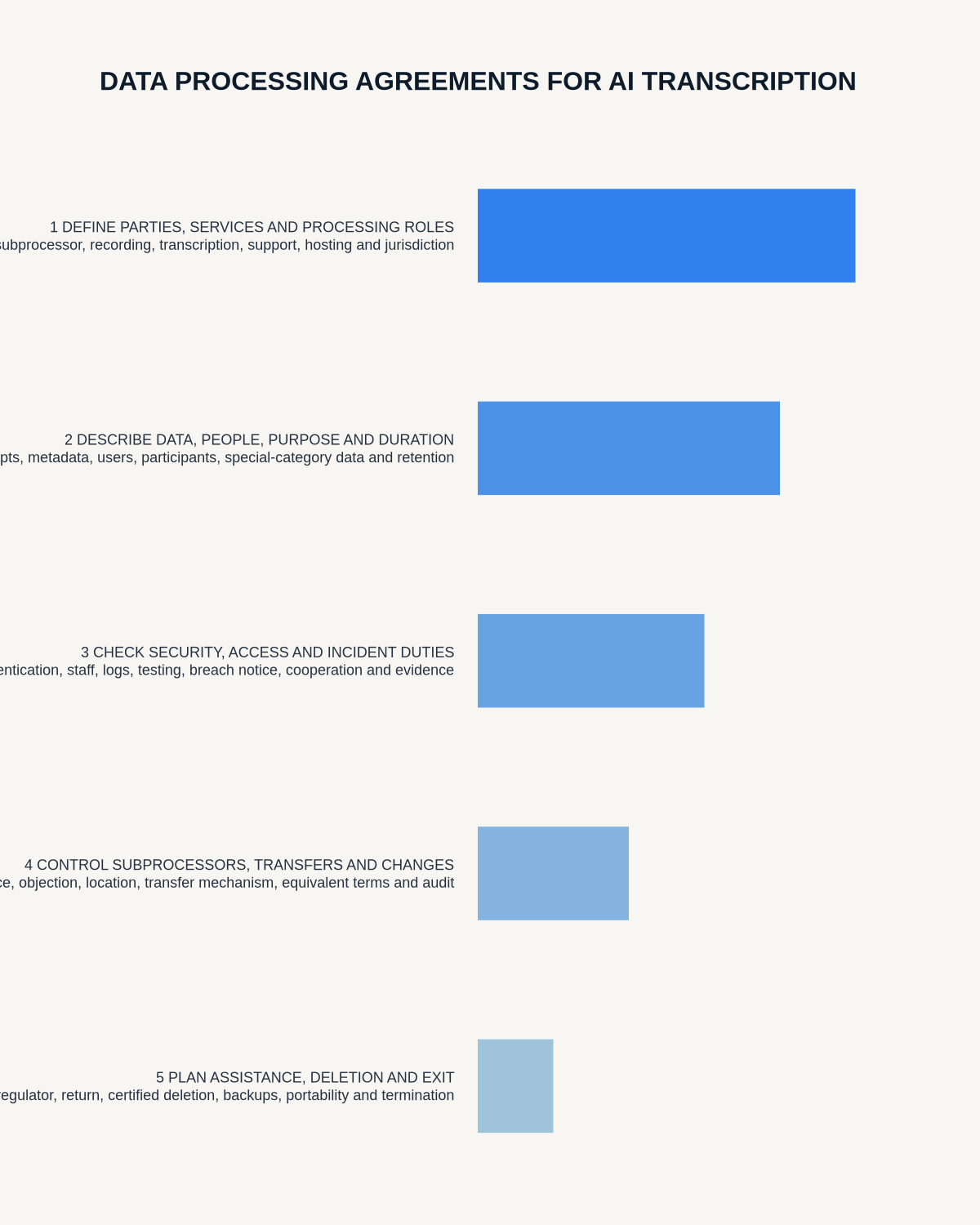
Quick answer: an AI-transcription data processing agreement should describe the real service from recording to deletion. It should define the parties’ roles, permitted instructions, data types, security, support access, subprocessors, international transfers, AI-model use, breach response, rights assistance, retention, deletion, audit evidence, change control and supplier exit.
Decision focus: use the method below only where it produces a recoverable source, a verifiable output and a clear next action. If one of those fails, change the workflow rather than trusting a polished summary.

Quick verdict: a privacy policy, product page or consumer subscription agreement is not a substitute for a usable processor contract. The written terms, technical evidence and actual product configuration must all describe the same processing.
Evidence basis and limits
- Decision factors covered: Start with the real processing, not the supplier’s label; Map the complete AI-transcription data flow; Core processor terms to review.
- Evidence rule: A claim earns weight only when the source, date, configuration and limitation are clear enough for a reader to check.
- Boundary: Examples and workflow recommendations must be tested with representative recordings, the intended users and the actual approval process before rollout.
This article provides general information, not legal advice. Organisations should obtain appropriate advice and review current UK GDPR, sector, confidentiality and international-transfer requirements.
Start with the real processing, not the supplier’s label
An organisation deciding why employees, customers, clients or research participants are recorded will often be the controller. A transcription supplier processing those recordings only on documented instructions will commonly act as processor. Roles depend on the facts.
If the supplier independently reuses customer audio, transcripts, prompts, corrections or summaries to train a general model, create behavioural analytics or pursue another purpose of its own, it may have separate controller responsibilities for that activity. The contract should distinguish each purpose rather than calling the supplier a processor for everything.
Useful role questions include:
- Who decides why the recording exists?
- Who decides which people and data are captured?
- Who chooses retention and deletion periods?
- Can the supplier use content for a purpose beyond delivering the contracted service?
- Can the customer disable optional analytics, model improvement or human review?
- Who responds to individuals and regulators?
See the ICO’s controller–processor contract guidance.
Map the complete AI-transcription data flow
- Audio is captured on a recorder, phone or conferencing platform.
- The file may remain temporarily on hardware or a mobile device.
- Audio transfers to an app or supplier infrastructure.
- A speech-to-text model creates a transcript.
- Additional systems may create summaries, templates, translations, speaker labels, mind maps or action lists.
- Support, engineering, quality or security personnel may access content.
- Users edit, export, email, download or upload outputs elsewhere.
- Operational logs, analytics, caches and backups may retain additional copies.
- Content is deleted, returned or migrated when its purpose ends or the service is terminated.
The DPA should cover every material copy. A clause referring only to “uploaded documents” may not clearly cover raw audio, generated text, prompts, speaker labels, timestamps, device identifiers, correction history, support tickets or backup copies.
Core processor terms to review
| Contract area | What good wording should achieve | Evidence to request |
|---|---|---|
| Subject matter and duration | Identify the recording, transcription and AI services and when processing starts and ends. | Service description and data-flow diagram. |
| Nature and purpose | Limit processing to capture, transfer, transcription, approved AI outputs, support, storage and deletion. | Feature list and configuration guide. |
| Data and people | Cover audio, text, metadata and likely participants, including sensitive categories where relevant. | Data inventory. |
| Documented instructions | Require processing only on customer instructions, subject to any legally required exception. | Admin controls and instruction mechanism. |
| Confidentiality | Restrict access to authorised people under confidentiality obligations. | Access policy, training and support-access process. |
| Security | Commit to appropriate technical and organisational measures and controlled material changes. | Security schedule, assurance reports and test summaries. |
| Subprocessors | Provide authorisation, notice, objection and equivalent downstream duties. | Current list, locations and service descriptions. |
| International transfers | Identify restricted transfers, safeguards and responsibility for supporting assessments. | Transfer mechanism and assessment material. |
| Rights and compliance assistance | Support access, correction, restriction, deletion, DPIAs, breaches and regulator enquiries. | Response procedures and service levels. |
| Return, deletion and exit | Define export, return, deletion, backup expiry and final confirmation. | Deletion guide and tested export formats. |
| Audit and evidence | Provide enough information to demonstrate compliance and permit proportionate escalation. | Independent reports, policies and audit route. |
AI training, evaluation and product improvement
Do not accept one broad phrase such as “improve our services” without understanding the underlying activity. Ask whether customer content is used to:
- Train or fine-tune a general model.
- Evaluate model quality.
- Create benchmark datasets.
- Improve speaker identification, summarisation or translation.
- Develop new products.
- Perform human quality review.
- Create aggregate analytics.
For each activity, confirm:
- Whether it is necessary to provide the contracted service.
- Whether it is enabled by default.
- Whether an administrator can disable it technically and contractually.
- Whether the supplier acts as processor or separate controller.
- Which model providers or reviewers receive the data.
- What de-identification is applied and whether re-identification remains credible.
- Whether historical contributions can be removed after opt-out or termination.
“Anonymised” should not be accepted as a complete answer without evidence about the method, irreversible separation and residual risk.
Security schedule: convert promises into testable controls
“Industry-standard security” is too vague to assess. The schedule should provide enough detail for the organisation to understand the control environment without requiring the supplier to disclose exploitable secrets.
- Encryption in transit and at rest.
- Authentication, session controls and administrator permissions.
- Role-based access and least privilege.
- Support-access approval, logging and expiry.
- Secure firmware, app and infrastructure updates.
- Vulnerability reporting, testing and remediation targets.
- Tenant separation.
- Backup protection, resilience and recovery testing.
- Employee screening, confidentiality and training.
- Logging of access, export, deletion and account changes.
- Retention and secure deletion.
- Incident detection, investigation and customer notification.
Support access deserves its own clause
AI-transcription services may involve support staff viewing account metadata, audio or transcripts to diagnose failures. The agreement should state:
- Whether support can access customer content.
- Whether customer approval is required.
- How access is limited, logged and time-bound.
- Which countries support personnel work from.
- Whether screenshots, downloaded files or ticket attachments are created.
- How support copies are deleted after the issue is resolved.
Subprocessors and international transfers
The supplier should identify each material subprocessor, what it does and where it processes data. The customer needs a practical notice and objection route for changes—not a list that can change silently.
Review the current ICO international-transfer guidance. The contract should identify who is responsible for the transfer mechanism, supporting assessment, supplementary measures and reassessment after a material change.
Breach notification and incident cooperation
The processor should notify the controller without undue delay after becoming aware of a personal data breach. Avoid wording that allows notification only after the supplier decides an incident is “serious”, “material” or likely to cause harm.
The notice should provide, as information becomes available:
- Nature and timing of the incident.
- Systems, data and people affected.
- Likely consequences.
- Containment and remediation.
- Contact point.
- Updates and final root-cause information.
- Evidence required for regulatory and participant communications.
See the ICO’s personal data breach guidance.
Retention, deletion and backups
| Question | Acceptable outcome |
|---|---|
| Can administrators delete individual recordings? | Yes, through a documented process suitable for retention and rights requests. |
| Does deletion cover audio and AI outputs? | Audio, transcript, summary, prompts and derived copies are explicitly addressed. |
| How are backups handled? | Deleted data becomes inaccessible and expires through a defined backup cycle. |
| What happens at termination? | Usable export, transition period, account closure and final deletion confirmation. |
| Can deletion be evidenced? | Logs, reports, certificates or auditable confirmation are available. |
Clause-by-clause approval matrix
| Status | Meaning | Action |
|---|---|---|
| Green | Wording is clear, evidence exists and configuration supports it. | Approve and record the evidence. |
| Amber | A gap is manageable through clarification, configuration or a written addendum. | Assign owner and deadline before launch. |
| Red | The clause permits incompatible reuse, hides the processing chain or prevents required control. | Do not approve until resolved. |
Common red flags
- Unlimited product-improvement rights.
- Model-training use hidden in a privacy policy rather than the contract.
- Silent subprocessor changes.
- No processing locations.
- Security controls change entirely at supplier discretion.
- Breach notification only after confirmed harm.
- Deletion available only at account closure.
- No method to remove individual recordings.
- No support for rights requests or DPIAs.
- Audit rights limited to marketing statements.
- No usable export or exit assistance.
- Liability exclusions that make core confidentiality commitments meaningless.
Test the agreement operationally before approval
- Create a controlled test recording.
- Confirm where the source file and generated outputs appear.
- Disable any optional model-improvement setting.
- Export audio and editable text.
- Delete the recording and verify which copies remain.
- Remove a test user and confirm access ends.
- Submit a test support request and observe the access process.
- Review the current subprocessor list and change-notice route.
- Document the evidence against each contract clause.
NERALVO Halo and DOWAY
Apply this guide before assessing NERALVO Halo provides 64GB local storage, up to 35 hours of recording, NOTE mode, supported CALL mode, Bluetooth synchronisation with DOWAY and AI transcription, summaries, templates, translation, mind maps and exports. One year of DOWAY Max access is included.
Organisations should review the applicable DOWAY terms, privacy information, subprocessors, processing locations, security controls, retention, deletion, export and support-access arrangements. Halo is a general productivity tool and is not automatically approved for confidential, regulated or highly sensitive processing.
Turn the contract into operational controls
- Configure accounts and permissions to match the agreement.
- Disable optional processing that is not approved.
- Document approved and prohibited recording uses.
- Train users to verify AI output and avoid uncontrolled exports.
- Apply retention across device, app, exports and official systems.
- Maintain a current subprocessor and transfer record.
- Test rights-request, deletion, support-access and breach workflows.
- Review material changes to features, models, terms and locations.
- Assign a contract owner and annual reassessment date.
Workflow choice matrix for Data Processing Agreements for AI Transcription
Choose the method that protects the source and reduces downstream correction. The table makes the non-hardware options explicit.
| Condition | Preferred route | Why |
|---|---|---|
| High-risk or mixed work | Governed hybrid | Separate capture, review, approval and retention rather than trusting one tool. |
| Recording is refused, prohibited or unnecessary | Manual notes / no recording | Respecting the boundary is the correct workflow, not a product failure. |
| In-person, mobile or unreliable-connectivity work | Dedicated recorder | Independent capture and a recoverable local source are usually more resilient. |
| Repeatable remote work with approved integrations | Cloud software | Automation and central collaboration may outweigh device independence. |
Frequently asked questions
Is a privacy policy the same as a DPA?
No. A privacy policy explains practices. A DPA creates contractual processor obligations and allocates responsibilities between the parties.
Does every customer need a bespoke agreement?
No. Standard terms can be suitable where they contain the required provisions and accurately describe the service. The organisation still needs to assess whether those terms meet its use and risk level.
Can a contract replace technical due diligence?
No. Contract wording, security evidence, configuration and operational testing must support one another.
What should trigger reassessment?
New models, subprocessors, processing countries, support arrangements, retention periods, training uses, security changes, incidents or material changes to the intended use.
Related guides
- AI Recorder Supplier Due Diligence: A Buyer’s Checklist
- Voice Recording Retention Policy: A Practical Template Guide
- How to Exit an AI Transcription Supplier Without Losing Records
Final review checklist
- Controller, processor and any independent-controller roles are accurate.
- The agreement covers audio, text, metadata, AI outputs, support and backups.
- The complete device-to-app-to-AI data flow is documented.
- All required processor clauses are present.
- Subprocessor and transfer arrangements are understood.
- Model-training and product-improvement use is explicit and controllable.
- Security and support-access terms are evidence-backed.
- Breach notification is prompt and usable.
- Rights requests, retention, return, deletion and exit are workable.
- A controlled operational test has passed.
- Internal configuration and training match the contract.
- Change monitoring and reassessment ownership are recorded.
Bottom line: a strong AI-transcription DPA connects legal wording to the complete recording lifecycle and gives the customer practical control from first capture to verified deletion.
On this page
Related guides
See whether Halo fits this workflow
Review the NERALVO Halo specifications, included services, delivery information and current offer only after completing the guide.
Found an error or an out-of-date claim? Email support@neralvo.com with the article address and a supporting source.