The 60-second verdict
Quick answer: turn recorded interviews into blog posts by agreeing the intended use, correcting the transcript, choosing one reader question, mapping every quotation and material claim to evidence and editing for clarity without changing the speaker’s meaning.
Decision focus: use the method below only where it produces a recoverable source, a verifiable output and a clear next action. If one of those fails, change the workflow rather than trusting a polished summary.
Evidence basis and limits
- Decision factors covered: Confirm editorial permission before recording; Correct the transcript; Create an evidence map.
- Evidence rule: A claim earns weight only when the source, date, configuration and limitation are clear enough for a reader to check.
- Boundary: Examples and workflow recommendations must be tested with representative recordings, the intended users and the actual approval process before rollout.
A transcript is source material, not finished copy. The strongest interview-led article reorganises the conversation around a reader need while preserving uncertainty, context and the difference between experience, opinion and verified fact.

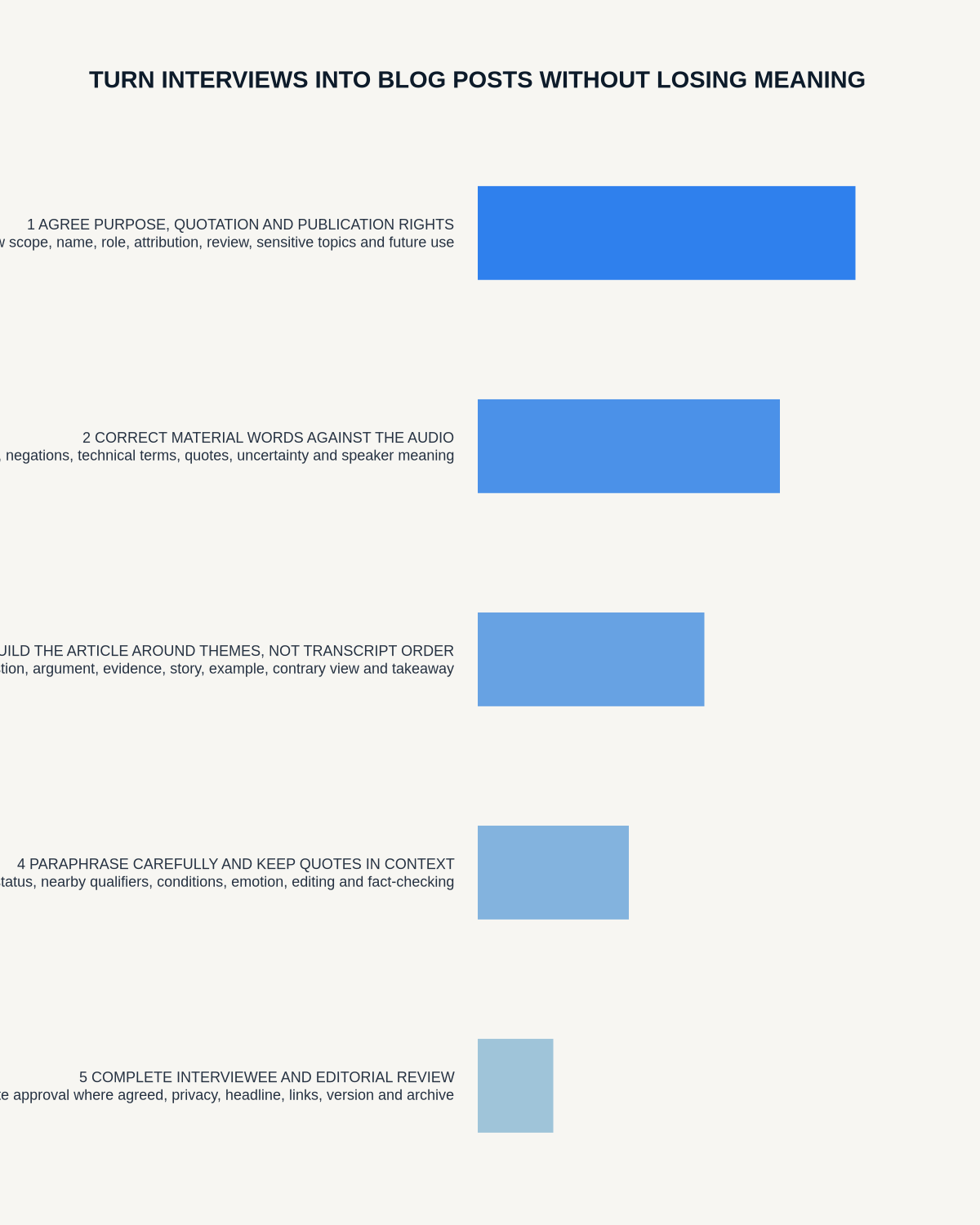
Confirm editorial permission before recording
Explain:
- The article purpose and audience
- Whether the interview is on or off the record
- How quotations may be edited
- Whether audio or clips may be published
- Whether the speaker can review quotations, factual details or the full draft
- Publication channels and future reuse
- Withdrawal limits
- Retention of audio and transcript
Record restrictions and promised review so later repurposing stays within the agreement.
Choose one central reader question
Examples include how a founder solved a specific operational problem, what buyers should know before choosing a product or why a professional workflow fails without accurate records. A wide-ranging interview may support several separate articles, but each page needs one coherent promise.
Correct the transcript
Check names, organisations, dates, figures, technical terms, negative wording, speaker attribution and material quotations against the audio. Mark unclear passages rather than guessing.
Create an evidence map
| Article claim | Source | Evidence status | Planned use |
|---|---|---|---|
| Manual notes delayed follow-up | Interview 12:40 | Speaker experience, confirmed | Direct quotation |
| Adoption improved response time | Interview plus CRM report | Verified fact with limitation | Paraphrase and data point |
Keep speaker experience, opinion, verified fact, third-party claim, estimate and editorial interpretation visibly separate.
Group by theme, not interview order
A useful structure may be:
- The reader’s problem
- Why previous approaches failed
- The turning point
- The practical method
- Evidence, results and limitations
- Advice or next steps
Reordering material is acceptable when the meaning remains faithful.
Use direct quotation, light editing and paraphrase correctly
- Direct quotation: substantially exact wording checked against audio.
- Lightly edited quotation: filler or repetition removed without changing meaning.
- Paraphrase: the editor’s concise summary, without quotation marks.
Do not combine words spoken at different times into a seamless quotation unless the method is transparent and approved.
Verify every important quotation
Check the exact wording, speaker, negative words, numbers, dates, pronoun references, surrounding context and whether the remark was on the record. Preserve qualifying phrases such as “in our case,” “I think” and “we have not measured this yet.”
Fact-check independently
Interviewees can be mistaken. Verify dates, product specifications, prices, legal or medical claims, market statistics, job titles, company history and named third parties through suitable sources. Clearly distinguish the speaker’s opinion from externally verified fact.
Do not let AI invent causation or certainty
An AI draft may turn two events into a causal claim or remove the speaker’s hesitation. Audit every “because,” “therefore,” “resulted in,” “proved” and “guaranteed.” Do not let an AI-generated transition create a cleaner or more confident position than the interview supports.
Add editorial value
The article should provide context, definitions, clear transitions, reliable source links, practical takeaways and balanced limitations. Avoid padding original insight with generic commentary.
Handle sensitive and third-party information
Remove personal data, confidential client details, allegations and off-record comments. Contact named third parties where fairness or editorial policy requires it, and route legal, safeguarding or reputational concerns through the appropriate review process.
Use a defined speaker-review process
Decide in advance whether the speaker reviews direct quotations, factual details, the complete draft or no pre-publication text. Set a deadline and clarify whether review is for accuracy or includes editorial control.
Build a reader-first outline
- Reader-focused headline
- Direct opening answer
- Problem-led introduction
- Speaker credibility and context
- Three to five thematic sections
- Verified quotations and examples
- Practical framework or checklist
- Limitations, disagreement and uncertainty
- Conclusion, FAQ and sources
Create multiple approved outputs carefully
With permission, one interview may support a long-form article, case study, FAQ, social clips, email quotation or sales-enablement material. Each use must remain within the agreed purpose and preserve the approved source meaning.
Retain source material deliberately
Keep the audio long enough for fact-checking, approval and complaints, then apply the agreed retention schedule. Protect the source recording more tightly than the published article.
Where NERALVO Halo fits
Apply this guide before assessing NERALVO Halo provides NOTE recording, supported CALL capture, 64GB local storage, up to 35 hours of recording and Bluetooth connection to DOWAY. DOWAY can create transcripts, summaries, speaker-separated notes, templates, translations, mind maps and exports. One year of DOWAY Max is included from activation.
Record with informed permission, use timestamps to verify quotations and move only approved content into the editorial system.
Apply a final accuracy audit
Read the draft once without the transcript, then audit it against the audio and evidence map. The accuracy principles in the IPSO Editors’ Code of Practice are a useful benchmark even where the publisher is not regulated by IPSO.
- Highlight every factual claim and verify it independently where possible.
- Match every quotation to its timestamp and approved wording.
- Label inference, opinion and uncertainty rather than presenting them as fact.
- Confirm that the title and introduction do not overstate the interview.
- Record who completed the final accuracy and sensitivity review.
Workflow choice matrix for How to Turn Interviews into Blog Posts Without Losing the Speaker’s Meaning
Choose the method that protects the source and reduces downstream correction. The table makes the non-hardware options explicit.
| Condition | Preferred route | Why |
|---|---|---|
| High-risk or mixed work | Governed hybrid | Separate capture, review, approval and retention rather than trusting one tool. |
| Recording is refused, prohibited or unnecessary | Manual notes / no recording | Respecting the boundary is the correct workflow, not a product failure. |
| In-person, mobile or unreliable-connectivity work | Dedicated recorder | Independent capture and a recoverable local source are usually more resilient. |
| Repeatable remote work with approved integrations | Cloud software | Automation and central collaboration may outweigh device independence. |
Frequently asked questions
Can filler words be removed?
Yes, where meaning, tone and emphasis remain faithful.
Can two answers be combined into one quote?
Use caution. Do not create wording or continuity the speaker did not express.
Should the interviewee approve the article?
Follow the agreed process, particularly for technical, sensitive or reputationally significant material.
Can the transcript be published as the post?
Usually not. Readers need structure, context, verification and purposeful editing.
Final editorial checklist
- Permission and review process agreed
- One reader question selected
- Transcript corrected
- Evidence map created
- Themes replace chronology
- Quotes checked against audio
- Paraphrases not presented as quotes
- Uncertainty preserved
- Facts independently verified
- Sensitive information removed
- AI causation checked
- Final accuracy audit recorded
- Source retention assigned
Related guides
On this page
Related guides
See whether Halo fits this workflow
Review the NERALVO Halo specifications, included services, delivery information and current offer only after completing the guide.
Found an error or an out-of-date claim? Email support@neralvo.com with the article address and a supporting source.