The 60-second verdict
Quick answer: turn a podcast recording into a searchable article by choosing one reader question, correcting the transcript, mapping themes and evidence, verifying quotations and claims, securing publication rights and writing an original reader-first page rather than publishing a raw transcript.
Decision focus: use the method below only where it produces a recoverable source, a verifiable output and a clear next action. If one of those fails, change the workflow rather than trusting a polished summary.
Evidence basis and limits
- Decision factors covered: Do not publish the raw transcript by default; Choose the article type and one search intent; Confirm rights and permissions.
- Evidence rule: Claims are weighted by consequence: capture failure, changed meaning, access and recovery matter more than polished wording.
- Boundary: Examples and workflow recommendations must be tested with representative recordings, the intended users and the actual approval process before rollout.
A podcast recording can preserve useful expertise, examples and distinctive language. The finished article should work without the audio, retain the speaker’s meaning and add enough structure, verification and practical value to justify its own page.

Do not publish the raw transcript by default
Unedited transcripts often contain long introductions, repeated ideas, false starts, unrelated topics, incorrect speaker labels, unsupported claims and spoken references that make little sense without the audio. Treat the transcript as source material, not finished editorial content.
Choose the article type and one search intent
An episode can become an edited transcript, summary, how-to guide, interview profile, research article, FAQ, case study, opinion piece or several distinct topic pages. For each page, define:
- The intended reader
- The specific question or problem
- The direct answer
- The episode evidence that supports it
- The additional value the article will add
- The useful next action
Do not create several lightly altered pages competing for the same search intent.
Confirm rights and permissions
Before drafting, confirm that guest, contributor and production agreements cover the intended use. Check permission for:
- Transcription and edited publication
- Direct quotations and attribution
- Promotional clips and social extracts
- Images, music or third-party material
- Future reuse and derivative content
- Any approval or fact-check process
Remove off-record discussion, confidential information and material outside the agreed scope.
Verify the source transcript
Prioritise guest and company names, quotations, dates, figures, product or technical terms, research claims, negative wording, speaker attribution and corrections made later in the episode. Never publish an AI-generated quotation without replaying the source.
Build a content map
| Element | Question |
|---|---|
| Search intent | What problem brought the reader here? |
| Primary answer | What should the article answer quickly? |
| Themes | Which sections support the answer? |
| Evidence | Which examples, facts or quotations support each section? |
| Gaps | What needs external verification or added explanation? |
| Action | What can the reader do next? |
Create a podcast article brief
- Primary topic and search question
- Reader problem and desired outcome
- Article type
- Episode timestamps
- Quotes to verify
- Claims to fact-check
- Rights or approval conditions
- Original examples, tables or templates to add
- Internal links and episode link
- Call to action
- Owner and review date
Write for reading, not listening
Remove greetings, housekeeping, repeated questions, filler, false starts, audio-only references, long diversions and promotional repetition. Add transitions, definitions, subheadings and context that listeners received from tone or earlier discussion.
Preserve the speaker’s meaning
- Replay the full answer.
- Confirm the speaker.
- Check whether removing words changes meaning.
- Retain qualifications and uncertainty.
- Use ellipses or paraphrase appropriately.
- Record the timestamp.
- Follow any approval or attribution agreement.
Use quotation marks only for words the person substantially said. Paraphrase routine detail without making a cautious statement sound certain.
Verify factual claims independently
Podcast guests may speak from memory. Check statistics, research findings, dates, legal or regulatory statements, product specifications, prices, company information and health or safety claims. Distinguish guest opinion from established fact and use authoritative sources where appropriate.
Use a reader-first structure
- Search-focused title
- Direct opening answer
- Why the topic matters
- Three to seven thematic sections
- Verified examples or quotations
- Practical steps, tables or templates
- Mistakes, limitations and uncertainty
- Frequently asked questions
- Episode and related-content links
Add original editorial value
A searchable article should add original synthesis, current sources, clearer definitions, step-by-step instructions, examples, tables, templates, pros and cons, limitations and useful internal links. It should remain valuable to someone who never listens to the episode.
Use AI drafting carefully
AI can group themes, propose headings and create a first draft. Check that it has not:
- Invented or blended quotations
- Combined answers from different parts of the episode
- Added false causation
- Removed limitations or uncertainty
- Changed the guest’s position
- Inserted generic filler
- Created unsupported facts, links or examples
Use internal links deliberately
Link to the original episode, relevant product or service information, supporting how-to guides, related privacy or legal content and any primary sources used for verification. Links should help the reader continue the task, not merely increase link count.
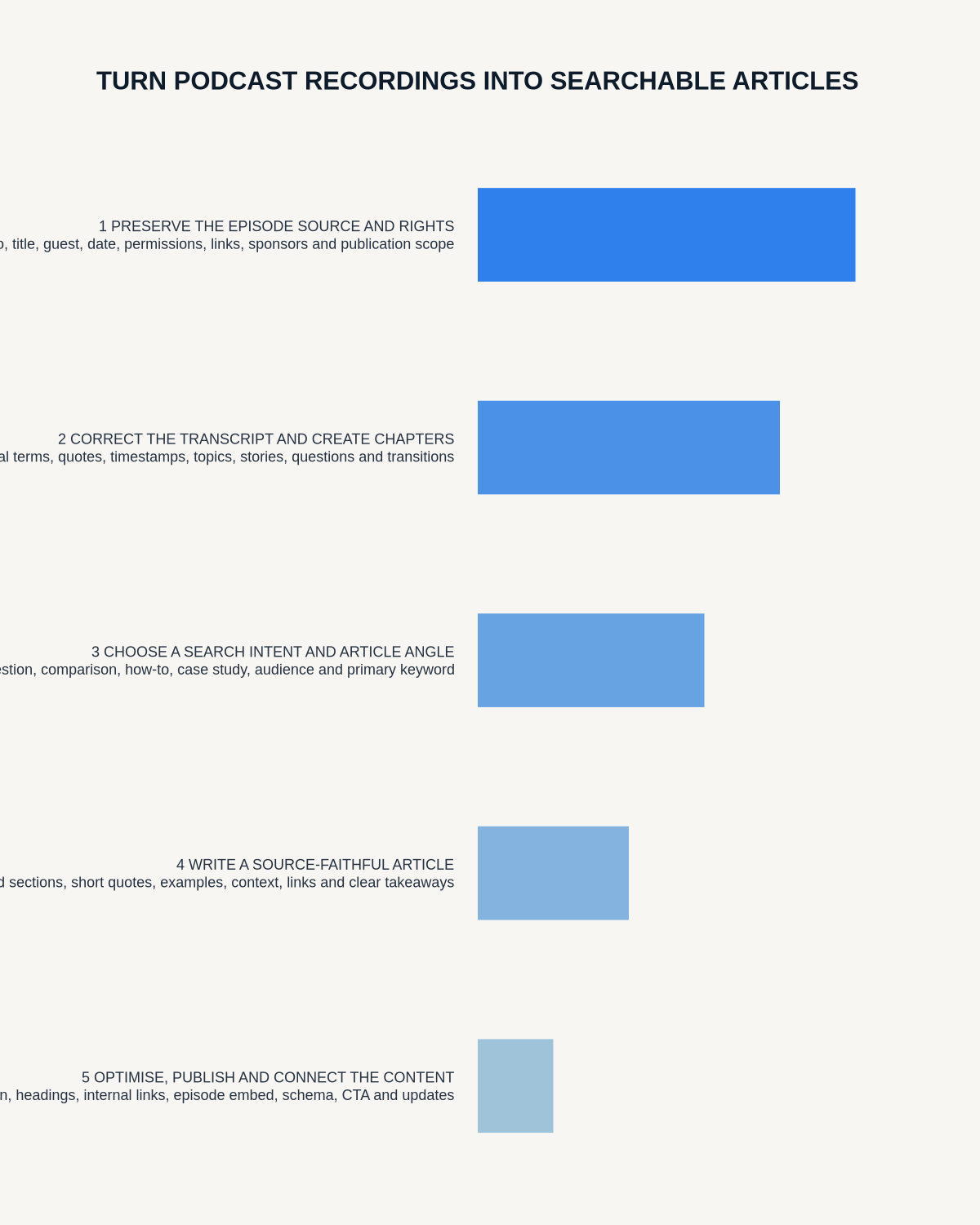
Workflow from episode to article
- Secure the source recording and confirm rights.
- Generate and correct the transcript.
- Choose the search question and article type.
- Build the content map and article brief.
- Verify claims and quotations.
- Draft in a reader-first structure.
- Add original context and practical value.
- Complete editorial, legal or subject review.
- Add metadata, internal links and accessible image text.
- Publish and connect the page to the episode.
- Apply source-retention rules.
Repurpose without duplication
With appropriate rights, one episode may support a main article, distinct FAQ pages, social posts, an email summary, quote graphics, short clips or internal knowledge notes. Each derivative should have a clear purpose and remain linked to the approved source so corrections can be applied consistently.
Measure article quality
- Factual corrections completed before publication
- Verified quotations
- Search impressions and clicks
- Reader engagement
- Internal-link use
- Episode plays from the article
- Duplicate-content overlap
- Time from episode to approved article
Where NERALVO Halo fits
Check whether NERALVO Halo fits this workflow provides NOTE recording, supported CALL capture, 64GB local storage, up to 35 hours of recording and Bluetooth connection to DOWAY. DOWAY can create transcripts, summaries, speaker-separated notes, templates, translations, mind maps and exports. One year of DOWAY Max is included from activation.
Use those outputs for source navigation and drafting, then complete full rights, editorial, quotation and factual review.
Workflow choice matrix for How to Turn Podcast Recordings into Searchable Articles
Choose the method that protects the source and reduces downstream correction. The table makes the non-hardware options explicit.
| Condition | Preferred route | Why |
|---|---|---|
| High-risk or mixed work | Governed hybrid | Separate capture, review, approval and retention rather than trusting one tool. |
| Recording is refused, prohibited or unnecessary | Manual notes / no recording | Respecting the boundary is the correct workflow, not a product failure. |
| In-person, mobile or unreliable-connectivity work | Dedicated recorder | Independent capture and a recoverable local source are usually more resilient. |
| Repeatable remote work with approved integrations | Cloud software | Automation and central collaboration may outweigh device independence. |
Frequently asked questions
Should the full transcript be published?
Only when readers genuinely need it and it has been carefully edited, verified and structured. Many episodes work better as an original article.
Can AI choose the SEO keyword?
It can suggest topics, but search intent and competition should be researched separately.
Can quotations be cleaned up?
Light editing may improve readability, but do not alter meaning. Verify against the audio and follow the speaker agreement.
Should every episode become several articles?
No. Create only assets with a distinct reader purpose and enough unique value.
Final checklist
- Rights and permissions confirmed
- Article type and search intent defined
- Transcript corrected
- Content map and brief built
- Quotations verified
- Claims fact-checked
- Spoken repetition removed
- Original reader value added
- Required review completed
- Metadata and links added
- Duplicate content controlled
- Source retention applied
Related AI voice recorder guides
On this page
Related guides
See whether Halo fits this workflow
Review the NERALVO Halo specifications, included services, delivery information and current offer only after completing the guide.
Found an error or an out-of-date claim? Email support@neralvo.com with the article address and a supporting source.