The 60-second verdict
Quick answer: turn voice notes into social media content by capturing one idea for one audience, extracting the strongest verified insight, checking claims and permissions, and adapting the structure, length and call to action for each platform without changing the speaker’s meaning.
Decision focus: use the method below only where it produces a recoverable source, a verifiable output and a clear next action. If one of those fails, change the workflow rather than trusting a polished summary.
Evidence basis and limits
- Decision factors covered: Use a 60-second capture structure; Example voice note; Start with the content brief.
- Evidence rule: Claims are weighted by consequence: capture failure, changed meaning, access and recovery matter more than polished wording.
- Boundary: Examples and workflow recommendations must be tested with representative recordings, the intended users and the actual approval process before rollout.

Speaking is often faster than typing, but a rambling voice note is not a finished post. The aim is to preserve the original perspective and distinctive wording while removing repetition, unsupported claims, confidential details and platform-inappropriate structure.
Check whether NERALVO Halo fits this workflow can support capture and transcription. Human editorial judgement decides what is accurate, appropriate and useful enough to publish.
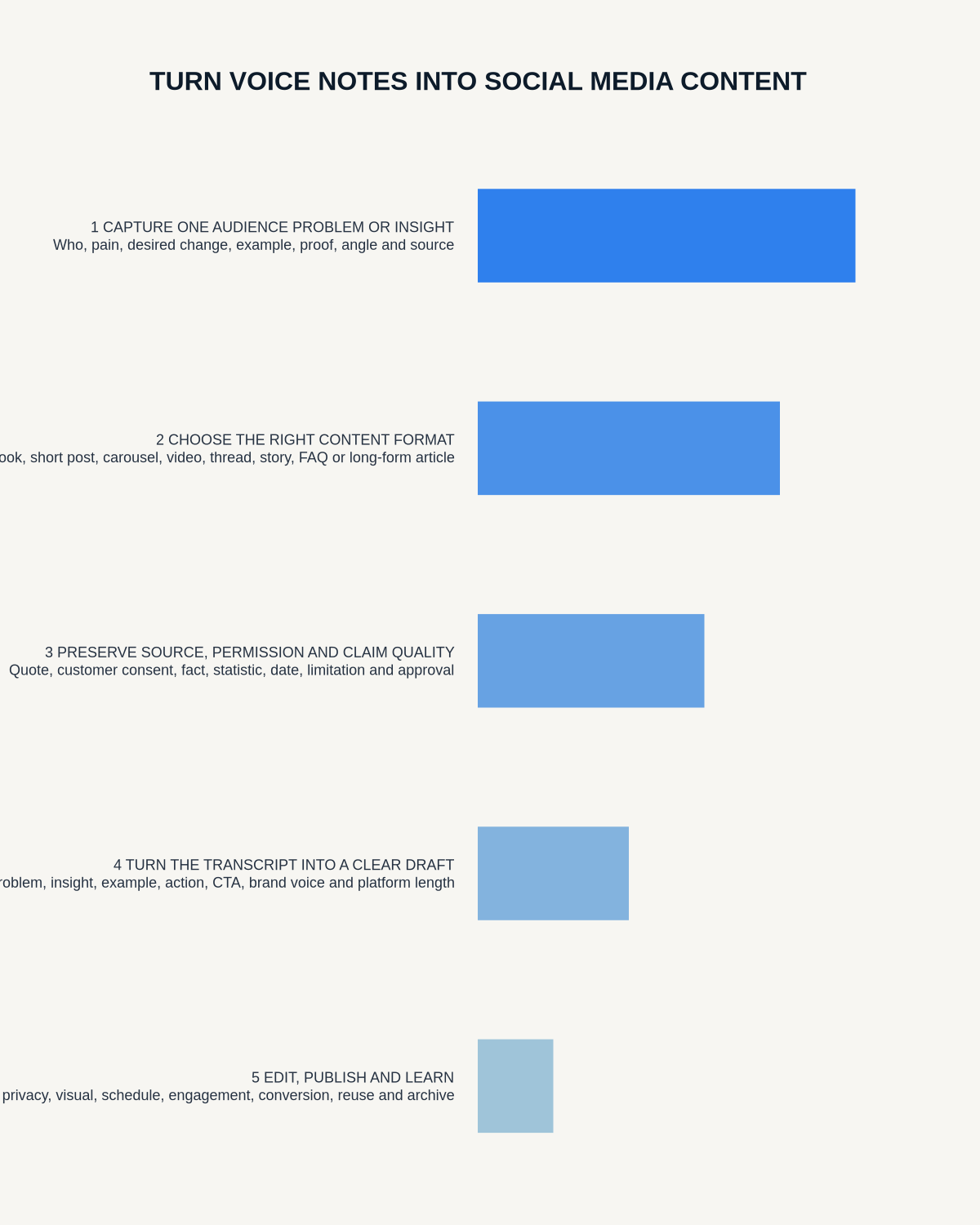
Use a 60-second capture structure
- Audience: who is this for?
- Problem: what are they struggling with?
- Insight: what do you believe or recommend?
- Proof: what example, observation or evidence supports it?
- Action: what should the audience try, consider or discuss?
Stop before introducing a second topic. A short focused note is easier to verify and repurpose than a long stream of unrelated thoughts.
Example voice note
“Audience: busy solicitors. Problem: client calls finish, but the attendance note takes another twenty minutes. Insight: the real benefit of an AI recorder is not transcription alone; it is starting the file note while the details are still fresh. Example: capture the call with permission, generate the draft and verify names, dates and instructions. Action: measure how long one week of notes currently takes.”
Start with the content brief
- Target audience.
- Problem or question.
- Single takeaway.
- Evidence or example.
- Platform and format.
- Desired next action.
- Claims requiring verification.
- Permissions or confidentiality restrictions.
Extract content units
Mark:
- Hooks.
- Explanations.
- Examples.
- Objections.
- Stories.
- Quotations.
- Lists.
- Calls to action.
One long note may produce several posts, but each post should communicate one clear idea and remain traceable to the approved source.
Choose the post type
- Short opinion.
- How-to post.
- Myth and correction.
- Customer lesson.
- Behind-the-scenes insight.
- Story.
- Checklist.
- Video script.
- Carousel outline.
- Question-led discussion.
Keep source status visible
| Source type | Required treatment |
|---|---|
| Verified fact | Link or retain the supporting source |
| Experience | Attribute appropriately and avoid presenting it as universal proof |
| Opinion | Present clearly as a view |
| Estimate | State assumptions and timeframe |
| Quotation | Check against audio and confirm permission |
| Customer outcome | Verify the result and any testimonial approval |
| Unknown | Research or remove rather than allowing AI to fill the gap |
Extract the strongest sentence
The hook should reflect the actual insight rather than merely sound dramatic. Examples:
- “Transcription is not the time-saver. The first usable draft is.”
- “A voice note is useful only if it leaves the recorder.”
- “More meeting data does not automatically mean better decisions.”
Do not create a stronger promise than the evidence supports.
Use a practical post structure
- Specific hook.
- Problem or tension.
- Useful explanation.
- Evidence or example.
- Practical takeaway.
- Clear call to action.
Keep the speaker’s language
Preserve distinctive phrases, examples and rhythm. Remove filler and repetition without replacing everything with generic corporate wording. Do not make a cautious idea sound like a guarantee or a personal experience sound like universal evidence.
Verify before publishing
Check:
- Product facts and current specifications.
- Numbers, percentages and dates.
- Customer outcomes and testimonials.
- Legal, medical or financial statements.
- Names and quotations.
- Whether an example can identify a client, employee or supplier.
- Whether the claim requires a source or qualification.
Remove confidential and restricted information
Do not publish client names, private meeting details, health information, employee issues, unreleased commercial plans, security information or third-party claims without the appropriate authority. Replace or generalise unnecessary identifiers and confirm that anonymisation is genuine rather than cosmetic.
Adapt to each platform
| Platform | Best adaptation |
|---|---|
| Professional insight, context, evidence and discussion | |
| Visual carousel, concise caption or Reel | |
| TikTok | Fast spoken hook, demonstration and payoff |
| X | One sharp idea or a short evidence-led thread |
| YouTube Shorts | Clear problem, visual proof and concise call to action |
| Email or newsletter | More context, practical detail and a direct next step |
Keep the core idea but change the opening, length, visual structure and call to action. Do not duplicate identical copy everywhere.
Create a content batch
One verified voice note can become:
- One LinkedIn post.
- One 30-second video script.
- One carousel.
- Three short hooks.
- One email paragraph.
- One article section.
Each derivative should remain linked to the approved source so later factual corrections can be applied consistently.
Use a human editing pass
Ask:
- Does this sound like the speaker?
- Is the point clear in the opening lines?
- Is the proof specific?
- Is anything exaggerated?
- Has uncertainty been preserved?
- Does the call to action match the content?
- Would the intended audience care?
- Is any private information still visible?
A copy-ready post template
Hook: [One accurate, specific sentence]
Problem: [What the audience experiences]
Insight: [The main point]
Example: [Specific evidence or scenario]
Action: [What to try, consider or answer]
Build a capture-to-publish board
- Captured.
- Transcribed.
- Needs proof.
- Needs permission.
- Drafted.
- Approved.
- Scheduled.
- Published.
- Repurpose.
- Correct or retire.
Delete raw notes when useful content has been safely processed and retention no longer serves a purpose.
Where NERALVO Halo fits
NERALVO Halo provides NOTE-mode capture, supported CALL capture, 64GB local storage, up to 35 hours of recording and Bluetooth connection to DOWAY. DOWAY supports transcripts, summaries, speaker-separated notes, templates, translations, mind maps and exports, with one year of DOWAY Max included from activation.
State the audience and topic aloud, keep each recording focused and use the transcript as source material rather than publish-ready copy.
Workflow choice matrix for How to Turn Voice Notes into Social Media Content
Choose the method that protects the source and reduces downstream correction. The table makes the non-hardware options explicit.
| Condition | Preferred route | Why |
|---|---|---|
| High-risk or mixed work | Governed hybrid | Separate capture, review, approval and retention rather than trusting one tool. |
| Recording is refused, prohibited or unnecessary | Manual notes / no recording | Respecting the boundary is the correct workflow, not a product failure. |
| In-person, mobile or unreliable-connectivity work | Dedicated recorder | Independent capture and a recoverable local source are usually more resilient. |
| Repeatable remote work with approved integrations | Cloud software | Automation and central collaboration may outweigh device independence. |
Frequently asked questions
How long should a voice note be?
Usually one to three minutes for a single post idea. Shorter structured notes are easier to process.
Can AI create the hook?
It can suggest options, but choose one that accurately reflects the insight and evidence.
Can AI publish directly from the transcript?
Not safely by default. Claims, privacy, rights, tone and platform fit require review.
Should the same post go everywhere?
No. Adapt the same core idea to the audience and format of each platform.
Should filler words remain?
Usually not, unless they are essential to the speaker’s voice or a direct quotation.
What should never be included?
Client secrets, personal data, unapproved testimonials and claims that cannot be supported.
Related guides
- How to Choose an AI Voice Recorder for Transcript Export
- How to Turn Podcast Recordings into Searchable Articles
- How to Turn Interviews into Blog Posts Without Losing the Speaker’s Meaning
Voice-to-social checklist
- One idea per note.
- Audience stated.
- Problem, insight and proof included.
- Source status visible.
- Hook matches the evidence.
- Claims verified.
- Confidential details removed.
- Permissions checked.
- Speaker’s language preserved.
- Platform adaptation completed.
- Human editing pass completed.
- Derivatives linked to the approved source.
- Useful output stored and raw note processed.
Bottom line: capture naturally, but publish deliberately. The strongest social content keeps the speaker’s real perspective while becoming specific, verified, platform-appropriate and safe to share.
On this page
Related guides
See whether Halo fits this workflow
Review the NERALVO Halo specifications, included services, delivery information and current offer only after completing the guide.
Found an error or an out-of-date claim? Email support@neralvo.com with the article address and a supporting source.