Reviewed and updated: 21 July 2026.
The 60-second verdict
Action-item extraction is valuable only when the system distinguishes a confirmed commitment from a suggestion, question or abandoned idea. The most serious failures are invented owners, invented deadlines and tasks created from rejected proposals.
Best fit: Action Items who need recoverable audio and human-verified notes in an authorised workflow. Use another method when: recording is prohibited, a participant declines or the approved process requires manual notes.
Quick verdict: test the recorder with known action edge cases, verify task, owner, deadline and status separately, and measure the complete handoff into the trusted task system before enabling automation.
Evidence basis and limits
- Decision factors covered: Create a ground-truth action meeting; Score every action field; Use clear meeting language.
- Evidence rule: The decision is based on the complete capture-to-action workflow, not a single feature or marketing accuracy percentage.
- Boundary: Examples and workflow recommendations must be tested with representative recordings, the intended users and the actual approval process before rollout.
Create a ground-truth action meeting
Record a short discussion containing:
- One explicit action with owner and date
- One action with owner but no deadline
- One suggestion that is rejected
- One unresolved question
- One action reassigned to another person
- One conditional task
- One duplicated action stated twice
- One action cancelled later
Write the answer key before processing the recording.
Score every action field
| Field | Pass condition | Failure |
|---|---|---|
| Task | Specific, observable outcome | Vague phrase copied from discussion |
| Owner | Final accountable person is correct | Original or implied owner retained after reassignment |
| Deadline | Only a stated date is included | Plausible date invented |
| Status | Confirmed, conditional, rejected or cancelled correctly | Rejected idea becomes task |
| Dependency | Condition remains attached | Task appears immediately due |
| Source | Relevant wording is replayable | No traceable evidence |
Use clear meeting language
Humans should close actions clearly:
“Priya will send the revised quote to Daniel by 4pm Thursday, subject to finance confirming the final margin.”
This is better for people and software than “we should probably send that soon.”
Review ambiguous action language
Check statements such as:
- “We need to…”
- “Someone should…”
- “Could you look at…”
- “Let’s think about…”
- “Maybe next week…”
- “I can do that.”
- “Subject to approval…”
These may describe a need or possibility rather than a confirmed assigned task.
Confirm actions before the meeting closes
- Read back each action.
- Name one accountable owner.
- State the task outcome.
- State the deadline or leave it explicitly open.
- Record dependencies.
- Invite correction.
- Separate unresolved questions.
Do not automate distribution too early
Before creating tasks, emailing participants or updating a CRM:
- Correct speaker labels
- Replay reassigned actions
- Remove rejected and cancelled items
- Merge duplicates
- Confirm missing deadlines
- Check high-risk commitments
- Remove inappropriate personal information
Measure the complete handoff
Time:
- Meeting ends
- Transcript and action draft become available
- Reviewer corrects the list
- Owners confirm disputed items
- Tasks enter the trusted system
- Participants receive the verified record
A strong extractor with poor export or duplicate handling may create more administration than a simpler workflow.
Test task-system export
Check whether:
- Task titles remain clear
- Owners map correctly
- Dates retain the right time zone
- Dependencies survive
- Source-note links are included
- Duplicates are prevented
- Corrections update rather than create another task
- Cancelled tasks are handled safely
Define high-risk approval
Legal, financial, safety, employment or client commitments may require a stricter reviewer or formal approval. Do not let ordinary task automation create an undertaking, payment, deadline or policy change without authority.
Measure extraction quality
- Precision: how many extracted tasks are real?
- Recall: how many real tasks were captured?
- Owner accuracy
- Deadline accuracy
- Rejected-item error rate
- Duplicate rate
- Human review time
- Successful export rate
- Action completion rate
Where NERALVO Halo fits
View Halo specifications for action items use provides NOTE mode, supported CALL mode, 64GB local storage, up to 35 hours of recording and Bluetooth synchronisation with DOWAY. DOWAY supports transcripts, summaries, templates, translations, mind maps and exports, with one year of DOWAY Max included.
DOWAY outputs can support action drafting, but owners, deadlines, conditions and commitments must be verified by a person before use.
Action-extraction buying checklist
- Ground-truth edge-case meeting created
- Task wording scored
- Final owner verified
- Unstated deadlines remain blank
- Rejected and cancelled items removed
- Conditional actions preserve dependencies
- Source replay tested
- Duplicates handled
- Task-system export completed
- High-risk approval defined
- Precision, recall and review time measured
- Automation follows human approval
Cloud software, a dedicated recorder or manual notes?
For Action Items, the right answer changes with the setting. This matrix deliberately gives each method a situation where it can be the strongest choice.
| Situation | Best starting point | Reason |
|---|---|---|
| scheduled remote meetings | Cloud meeting software | Native remote-meeting workflows can be more efficient here. |
| in-person or mobile work | Dedicated recorder | A separate battery and recoverable local source improve resilience. |
| recording is refused or prohibited | Manual notes or an approved alternative | Manual notes are the correct control when recording is unavailable. |
| mixed online and offline work | Governed hybrid | A hybrid can combine automation with reliable physical capture. |
Frequently asked questions
What should happen when no deadline was stated?
Leave it blank or add a clearly labelled review date after human agreement. Do not invent a commitment.
Can AI detect implied ownership?
It may infer an owner, but implication is exactly where verification is required.
Should every extracted item become a task?
No. Remove rejected ideas, duplicates, questions and items outside scope before export.
What matters more: precision or recall?
Both. Missing real tasks is harmful, but flooding the system with false tasks also destroys trust.
Choose accuracy at the handoff
The value of action extraction appears only when the correct work reaches the correct person with the real deadline and conditions intact.
Related guides
Profession workflow
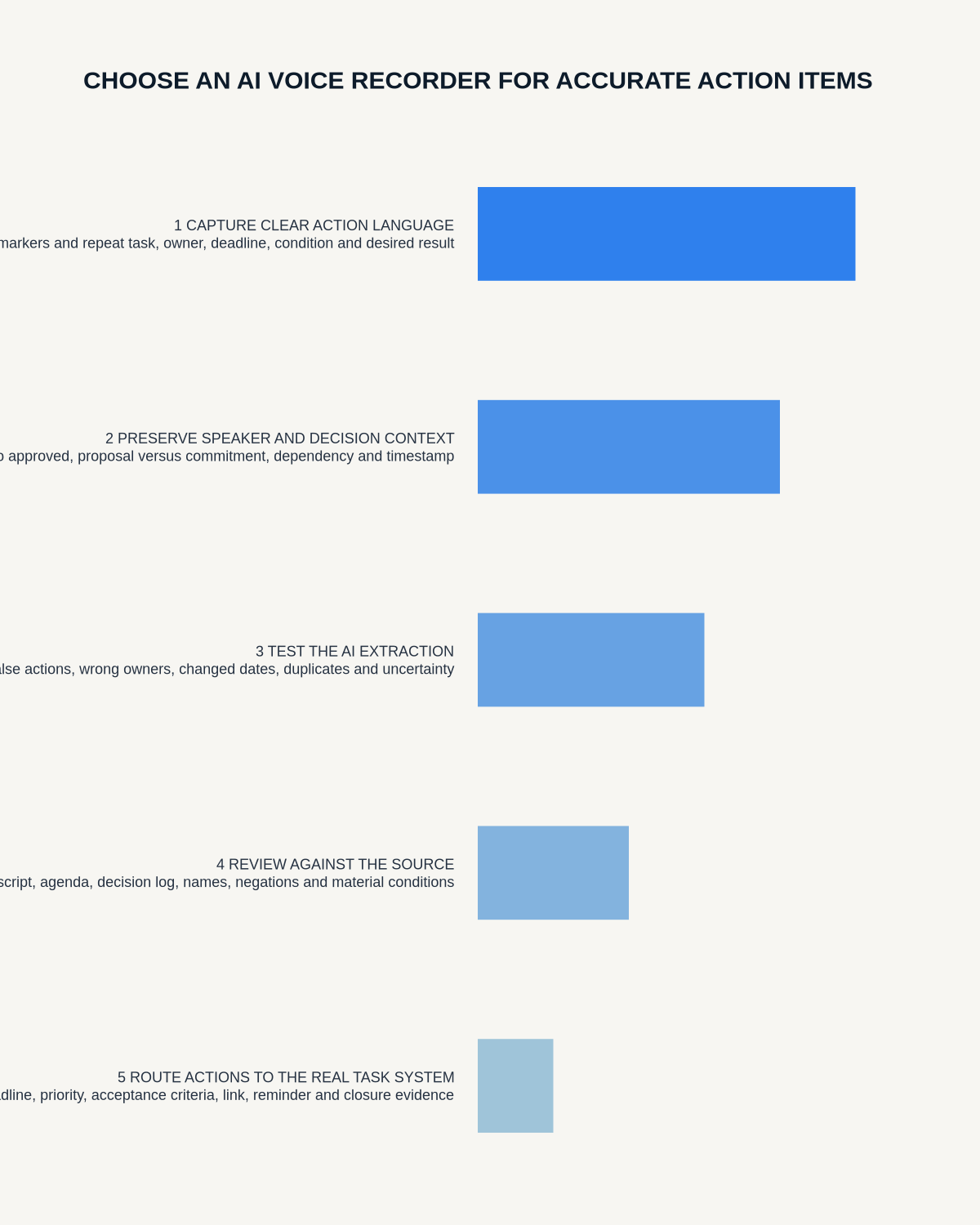
Visual map for AI Voice Recorder for Action Items: Accuracy, Owners and Deadlines
- Prepare the approved useDefine purpose, safe position, permission and the required formal record.
- Capture context firstState the case, asset, person, location or event identifier before detail.
- Human-verify evidenceCheck technical terms, units, names, dates, decisions and uncertainty.
- Complete the formal recordTransfer only verified information and apply access and retention controls.
On this page
More in this topic: Meeting capture and follow-up workflows
Show 6 closely related guides
- How to Test CALL Mode Before an Important Conversation
- How to Standardise AI Meeting Notes Across a Team
- How to Choose One AI Voice Recorder for Calls and Meetings
- AI Voice Recorder for Transcript Export: Portability and File Test
- How to Turn Meeting Recordings into Client Follow-Up Emails
- How to Summarise a 60-Minute Meeting in 10 Minutes
Related guides
See whether Halo fits this workflow
Review the NERALVO Halo specifications, included services, delivery information and current offer only after completing the guide.
Found an error or an out-of-date claim? Email support@neralvo.com with the article address and a supporting source.