The 60-second verdict
Quick answer: AI voice recording can form part of a workplace reasonable adjustment when it addresses a specific barrier and is agreed through an individual, collaborative process. Define permitted and excluded uses, participant handling, security, review responsibilities, fallback support and an effectiveness review date.
Decision focus: use the method below only where it produces a recoverable source, a verifiable output and a clear next action. If one of those fails, change the workflow rather than trusting a polished summary.
Evidence basis and limits
- Decision factors covered: Start with the barrier; Discuss the employee’s preferred approach; Agree where recording is permitted.
- Evidence rule: Claims are weighted by consequence: capture failure, changed meaning, access and recovery matter more than polished wording.
- Boundary: Examples and workflow recommendations must be tested with representative recordings, the intended users and the actual approval process before rollout.
The appropriate adjustment depends on the employee, role, workplace and task. Recording is one option among several and should not be presented as a universal solution or medical treatment.

This article provides general workplace information, not legal advice.
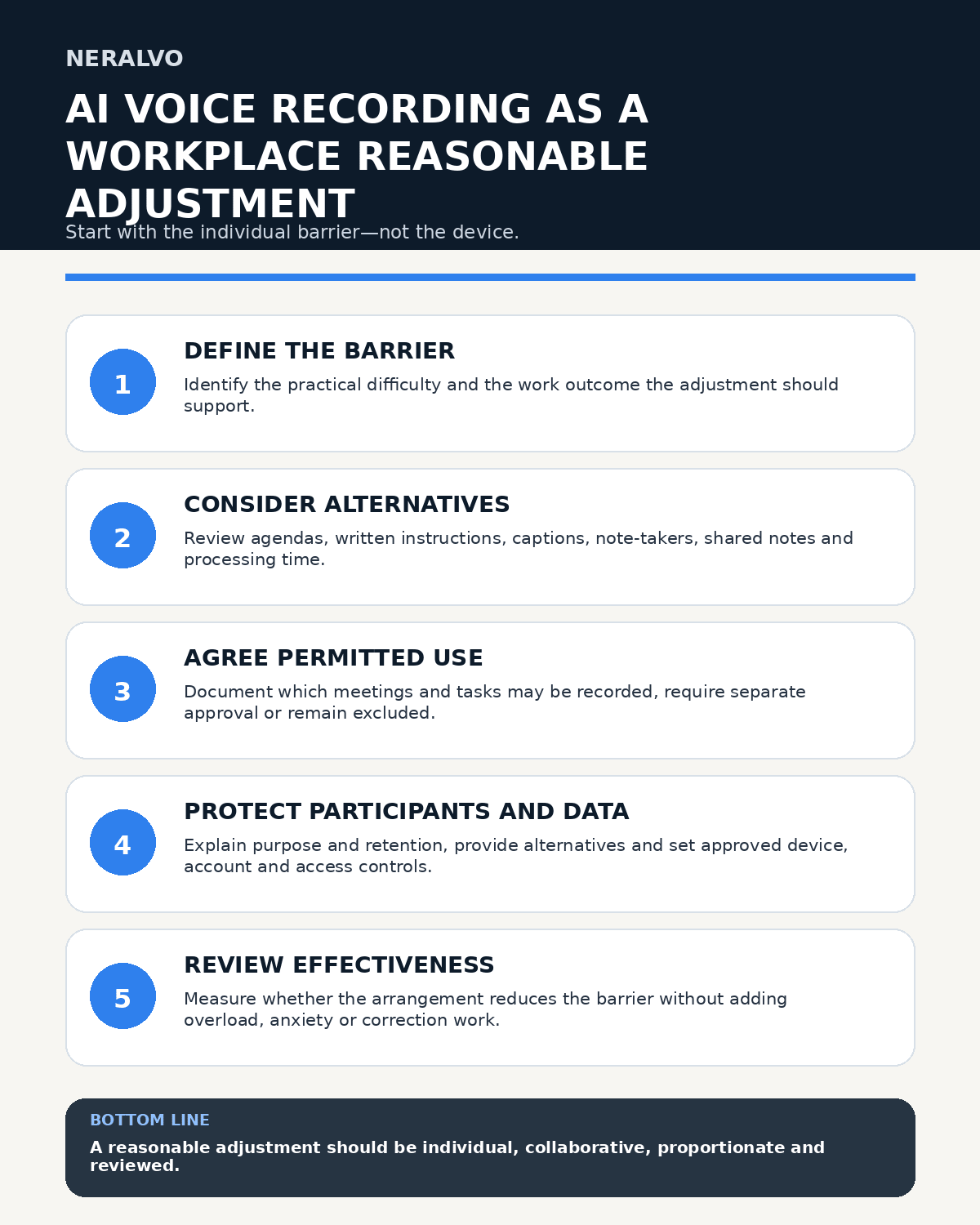
Start with the barrier
Describe the practical disadvantage or difficulty. An employee may need support to listen and take notes simultaneously, process rapid verbal instructions, remember actions or access information in another format.
Define the work outcome that needs support, such as reliable action points, more complete participation or reduced duplicate administration.
Discuss the employee’s preferred approach
Involve the employee in identifying options. Alternatives or complementary measures may include:
- agendas and papers in advance;
- written instructions after verbal discussions;
- live captions or organisation-provided transcription;
- a designated note-taker;
- shared meeting notes;
- additional processing time;
- assistive software or adjusted meeting practice.
Do not require more medical or personal information than is necessary for the process.
Agree where recording is permitted
Document the meetings, tasks and situations covered. Routine project meetings may be treated differently from grievance, disciplinary, health, safeguarding, legal or highly confidential discussions.
State when separate approval is required, when recording is excluded and what alternative will be available. Distinguish private spoken drafts from recordings that capture other people.
Protect other participants
Where other people may be recorded, agree how they will be informed and how any required authority will be obtained. Explain purpose, access and retention. Provide a workable alternative when recording is unsuitable.
Do not use covert recording simply because the device is discreet.
Set data and security controls
The written arrangement can cover:
- approved device and application;
- audio and transcript storage;
- who may access them;
- whether cloud processing is permitted;
- how personal information is minimised;
- retention and deletion;
- lost-device and accidental-recording reporting;
- export and sharing restrictions.
Do not capture passwords, payment details, access codes or unrelated personal information.
Define the practical workflow
- Start and label a permitted recording.
- Identify decisions, actions and deadlines.
- Check important details.
- Move final notes and tasks to the approved system.
- Delete source audio at the agreed point.
- Use the fallback method if technology fails.
Names, figures, technical terms, commitments and negative wording should be verified before professional use.
Provide equipment, training and support
Consider setup support, approved accounts, secure storage, charging, compatible software, headphones, processing allowance and time to review recordings. Training should cover privacy, meeting boundaries, transcript correction and deletion.
The employee should not be disadvantaged when the technology fails or cannot be used in a particular meeting.
Record the arrangement clearly
A concise record should include:
- the barrier and intended outcome;
- the agreed adjustment;
- permitted and excluded uses;
- participant-information process;
- security, access and deletion rules;
- equipment and support;
- start and review dates;
- the contact for changes or problems.
Keep health information to the minimum necessary and restrict access.
Review effectiveness
Set a trial or review period. Assess whether actions are captured more reliably, the employee participates more fully, processing time is manageable and confidentiality boundaries work.
If recording creates anxiety, transcript overload, excessive correction or unresolved objections, modify or replace the arrangement. Review again when the role, workplace, technology or employee’s needs change.
How NERALVO Halo may support an agreed adjustment
Check whether NERALVO Halo fits this workflow can support recording, transcription and structured outputs through DOWAY where the workplace has agreed the complete arrangement. The product does not determine whether an adjustment is reasonable or legally required; that depends on the employee’s barrier, the role, alternatives, proportionality and the workplace process.
Workflow choice matrix for AI Voice Recording as a Workplace Reasonable Adjustment
Choose the method that protects the source and reduces downstream correction. The table makes the non-hardware options explicit.
| Condition | Preferred route | Why |
|---|---|---|
| Repeatable remote work with approved integrations | Cloud software | Automation and central collaboration may outweigh device independence. |
| In-person, mobile or unreliable-connectivity work | Dedicated recorder | Independent capture and a recoverable local source are usually more resilient. |
| Recording is refused, prohibited or unnecessary | Manual notes / no recording | Respecting the boundary is the correct workflow, not a product failure. |
| High-risk or mixed work | Governed hybrid | Separate capture, review, approval and retention rather than trusting one tool. |
Frequently asked questions
Is an AI voice recorder automatically a reasonable adjustment?
No. Suitability depends on the individual barrier, role, task and workplace process.
Can recording be used in every meeting once agreed?
No. The agreement should define covered and excluded situations and any separate approval needed.
Who should pay for equipment and training?
That depends on the workplace process and circumstances. The agreed adjustment should include the support needed to make it usable.
What happens if another participant objects?
Use the agreed participant and alternative process rather than pressuring either person.
Useful resources
- Acas reasonable-adjustments guidance
- GOV.UK reasonable adjustments for disabled workers
- Check whether NERALVO Halo fits this workflow
Adjustment checklist
- Barrier and desired outcome defined
- Employee’s preferred approach considered
- Alternatives assessed
- Permitted and excluded uses clear
- Participant treatment addressed
- Security, access and deletion documented
- Equipment, training and fallback available
- Review date and change process agreed
Related guides
On this page
Related guides
See whether Halo fits this workflow
Review the NERALVO Halo specifications, included services, delivery information and current offer only after completing the guide.
Found an error or an out-of-date claim? Email support@neralvo.com with the article address and a supporting source.