The 60-second verdict
Quick answer: an AI voice recorder can help bid managers preserve authorised workshop discussions, buyer insight, proof points and review decisions. Every material claim should be linked to a requirement, evidence source, approval status and accountable owner.
Best fit: Bid Managers who need recoverable audio and human-verified notes in an authorised workflow. Use another method when: recording is prohibited, a participant declines or the approved process requires manual notes.
Evidence basis and limits
- Decision factors covered: Anchor every session to the opportunity; Separate insight from assumption; Capture the buyer problem in operational terms.
- Evidence rule: Claims are weighted by consequence: capture failure, changed meaning, access and recovery matter more than polished wording.
- Boundary: Examples and workflow recommendations must be tested with representative recordings, the intended users and the actual approval process before rollout.
Bid teams create valuable material in live conversation: customer insight, win themes, solution choices, proof points, pricing assumptions, delivery risks and review comments. Without disciplined capture, the strongest evidence is lost while weak claims survive into the submission.
The useful workflow turns speech into controlled bid assets: an insight register, proof-backed win themes, review actions and an auditable decision trail.
Anchor every session to the opportunity
At the start, state:
- opportunity or tender reference
- buyer and procurement stage
- submission deadline
- session purpose
- participants and roles
- documents being reviewed
- confidentiality or partner restrictions
This reduces the risk of notes, claims or actions being attached to the wrong bid.
Separate insight from assumption
| Status | Meaning |
|---|---|
| Buyer-provided | Stated in tender documents, clarification or authorised communication |
| Internally evidenced | Supported by account history, delivery data or approved research |
| Partner-provided | Supplied by a named consortium or subcontractor source |
| Inference | Reasoned interpretation from available evidence |
| Assumption | Used temporarily and requiring confirmation |
| Unknown | Material question still unanswered |
An AI summary can make a confident assumption sound like customer fact. Keep the source status attached to every material insight.
Capture the buyer problem in operational terms
For each requirement or theme, record:
- buyer objective
- current pain or risk
- people or service affected
- evidence available
- consequence if unresolved
- desired outcome
- evaluation criterion linked
Generic statements such as “the buyer wants innovation” are weak unless the team can explain what must improve and how the tender will score it.
Build win themes with a proof chain
A useful win theme includes:
- Customer issue: the specific need or risk.
- Promise: the outcome the solution will deliver.
- Differentiator: why this approach is meaningfully distinct.
- Mechanism: how the outcome will be achieved.
- Proof: case study, metric, credential or delivery evidence.
- Relevance: why the proof applies to this buyer.
If proof is missing, create an evidence action. Do not allow the claim to remain simply because it sounds persuasive.
Use a claim register
For every significant statement, capture:
- claim text
- section and requirement
- evidence source
- source owner
- date or period
- limitations
- approval status
- final wording owner
This is especially important for performance figures, customer outcomes, certifications, partner capability and future commitments.
Compliance comes before creativity
Link workshop decisions to the compliance matrix. For each response area, confirm:
- requirement answered
- mandatory form or structure
- word or page limit
- evidence requested
- contractual commitment created
- approval required
- submission dependency
A strong narrative cannot recover a non-compliant response.
Solution workshops need decision status
Label every option as:
- idea
- under evaluation
- technically feasible
- commercially approved
- partner confirmed
- selected for submission
- contractually committed
An automatic summary should not present a brainstormed feature as part of the final solution.
Review meetings should produce evidence-linked actions
For each reviewer comment, record:
- requirement or section
- problem identified
- reason it matters
- evidence gap
- specific change required
- owner
- deadline
- reviewer for closure
- status
“Strengthen this section” is not an actionable review comment. The note should identify what is missing and how closure will be judged.
Preserve disagreement between reviewers
Different reviewers may give conflicting advice. Record:
- point of disagreement
- evaluation criterion affected
- evidence each view relies on
- decision owner
- decision and rationale
- change made
Do not average contradictory comments into vague copy.
Pricing and commercial discussion need strict boundaries
Bid recordings may contain margins, partner rates, negotiation limits and assumptions. Define:
- which sessions may be recorded
- who may access source audio
- whether commercially sensitive sections should be excluded
- where transcription occurs
- how exports are controlled
- retention and deletion
The reviewed action log should normally circulate more widely than the raw recording.
Use a submission freeze checklist
Before final sign-off, confirm:
- all mandatory requirements are answered
- every material claim has evidence
- figures and dates are verified
- partner commitments are confirmed
- pricing matches the approved commercial model
- contractual statements have the required approval
- review actions are closed or consciously accepted
- the final version is the one being submitted
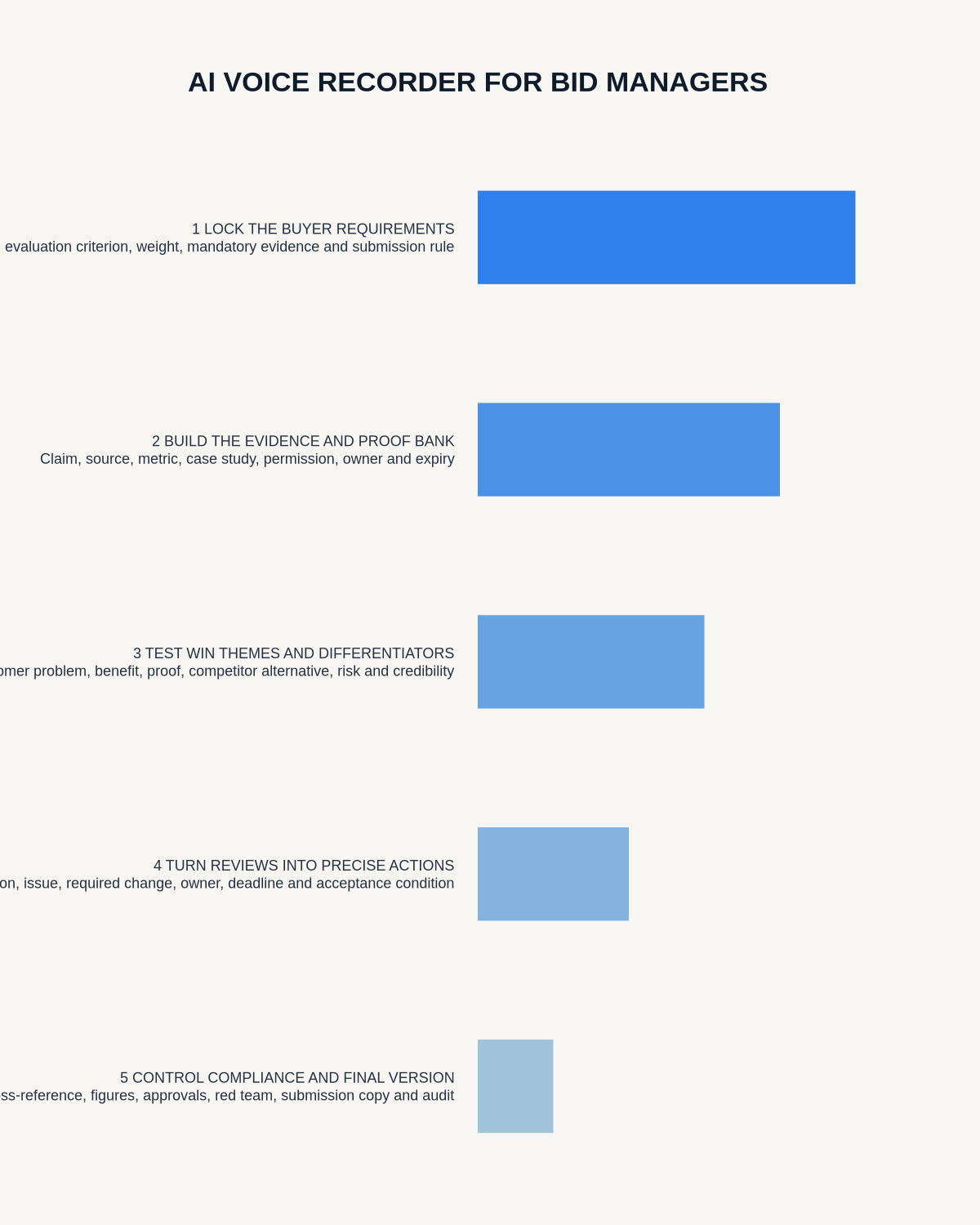
A capture-to-submission workflow
- Confirm recording and confidentiality rules.
- Anchor the session to the opportunity.
- Label insight, inference, assumption and unknowns.
- Build proof-backed win themes.
- Update the requirement and claim registers.
- Convert review discussion into specific actions.
- Resolve conflicting advice through an accountable decision.
- Link approved changes to the version-controlled draft.
- Complete compliance, commercial and contractual sign-off.
- Delete or retain source audio under the bid policy.
How NERALVO Halo may support approved bid work
Check whether NERALVO Halo fits bid managers work provides portable NOTE recording, supported CALL capture, 64GB local storage and DOWAY transcription and structured-note tools. It may support authorised capture sessions, solution workshops and review meetings.
Bid teams should approve handling of buyer, partner and commercially sensitive information before use. Test multi-speaker workshops and verify every figure, claim, owner and deadline manually.
Bid-record check
- Is every insight labelled by source status?
- Does each win theme include relevant proof?
- Are requirements linked to the compliance matrix?
- Are ideas separated from approved commitments?
- Are review actions specific and owned?
- Were conflicting comments resolved visibly?
- Are pricing and contractual statements approved?
- Has the final submission passed version and evidence checks?
An AI voice recorder can help bid managers preserve workshop intelligence and accelerate review actions. A winning submission still depends on customer relevance, credible proof, compliance and controlled approval—not the volume of captured words.
Cloud software, a dedicated recorder or manual notes?
For Bid Managers, the right answer changes with the setting. This matrix deliberately gives each method a situation where it can be the strongest choice.
| Situation | Best starting point | Reason |
|---|---|---|
| scheduled remote client meetings | Cloud meeting software | Calendar automation and shared integrations are usually the strongest advantage. |
| in-person visits and travel | Dedicated recorder | Independent capture reduces reliance on an active phone or laptop. |
| a client declines or policy requires manual notes | Manual notes or an approved alternative | The boundary takes priority over convenience. |
| mixed CRM and field work | Governed hybrid | Use each method only in the setting it actually fits. |
Related guides
Profession workflow
Visual map for AI Voice Recorder for Bid Managers: Better Win Themes and Review Actions
- Prepare the approved useDefine purpose, safe position, permission and the required formal record.
- Capture context firstState the case, asset, person, location or event identifier before detail.
- Human-verify evidenceCheck technical terms, units, names, dates, decisions and uncertainty.
- Complete the formal recordTransfer only verified information and apply access and retention controls.
On this page
More in this topic: Management and business workflows
Show 9 closely related guides
- AI Voice Recorder for Management Consultants: Better Interviews, Workshops and Evidence
- AI Voice Recorder for Account Managers: Clearer Client Commitments and CRM Notes
- AI Voice Recorder for Operations Directors: Better Reviews, Incidents and Action Closure
- AI Voice Recorder for Corporate Development: Controlled Diligence and Deal Decisions
- AI Voice Recorder for Programme Managers: Stronger Governance and Dependencies
- AI Voice Recorder for Sustainability Managers: Better Audits, Claims and Action Plans
- All-Day AI Voice Recorder: Battery, Storage and Workflow Test
- AI Voice Recorder for Retail Managers: Close Every Store-Walk Action
- AI Voice Recorder for Small Business Owners: Clear the Voice Inbox Daily
Related guides
See whether Halo fits this workflow
Review the NERALVO Halo specifications, included services, delivery information and current offer only after completing the guide.
Found an error or an out-of-date claim? Email support@neralvo.com with the article address and a supporting source.