The 60-second verdict
Quick answer: sustainability managers can use an authorised AI voice recorder to preserve supplier interviews, site debriefs and target-setting discussions. Every external claim still needs a defined boundary, reporting period, method, evidence source, caveat and approval before publication.
Best fit: Sustainability Managers who need recoverable audio and human-verified notes in an authorised workflow. Use another method when: recording is prohibited, a participant declines or the approved process requires manual notes.
Evidence basis and limits
- Decision factors covered: Give every claim a passport; Separate aspiration, target, activity and outcome; Record the boundary before the number.
- Evidence rule: A claim earns weight only when the source, date, configuration and limitation are clear enough for a reader to check.
- Boundary: Examples and workflow recommendations must be tested with representative recordings, the intended users and the actual approval process before rollout.

Sustainability teams translate conversations into metrics, reports and public claims. Automatic summaries can make incomplete statements sound publication-ready, so the workflow must connect every claim to controlled evidence.
Give every claim a passport
- Exact claim wording.
- Subject and organisational boundary.
- Reporting period.
- Metric and unit.
- Baseline or comparison.
- Calculation method.
- Data source and owner.
- Assumptions and exclusions.
- Assurance or review status.
- Approved use and expiry date.
Separate aspiration, target, activity and outcome
| Statement type | Meaning |
|---|---|
| Aspiration | Broad direction or ambition |
| Target | Defined future result with scope and date |
| Activity | Action completed or underway |
| Output | Direct product of the activity |
| Outcome | Measured change |
| Impact | Wider effect requiring a credible causal method |
“Installed efficient lighting” is not the same as “reduced total emissions by a verified amount.”
Record the boundary before the number
Confirm included sites, entities, products and operations; exclusions; reporting period; absolute or intensity basis; methodology; conversion factors; estimates; extrapolation and whether the comparison uses a consistent boundary.
Make interviews produce evidence requests
For each statement, record speaker and role, basis of knowledge, system or document referenced, data owner, uncertainty, evidence requested, deadline and reviewer. A conversation identifies the route to evidence; it is rarely sufficient evidence for a published metric.
Use a supplier confidence ladder
- Supplier statement only.
- Supporting document received.
- Methodology reviewed.
- Data checked against scope and period.
- Independent assurance or certification reviewed where relevant.
- Approved for the intended use.
Preserve negative and conflicting evidence
- Missing sites or suppliers.
- Method changes.
- Data-quality problems.
- Performance deterioration.
- Targets dependent on future funding.
- Transferred impacts or rebound effects.
- Conflicting stakeholder views.
Do not remove these points merely to make an executive summary more positive.
Turn workshops into controlled decisions
Record the question, evidence considered, options, trade-offs, assumptions, decision authority, approved target, metric, owner, dependencies and review trigger. Preserve dissent where it identifies a material risk.
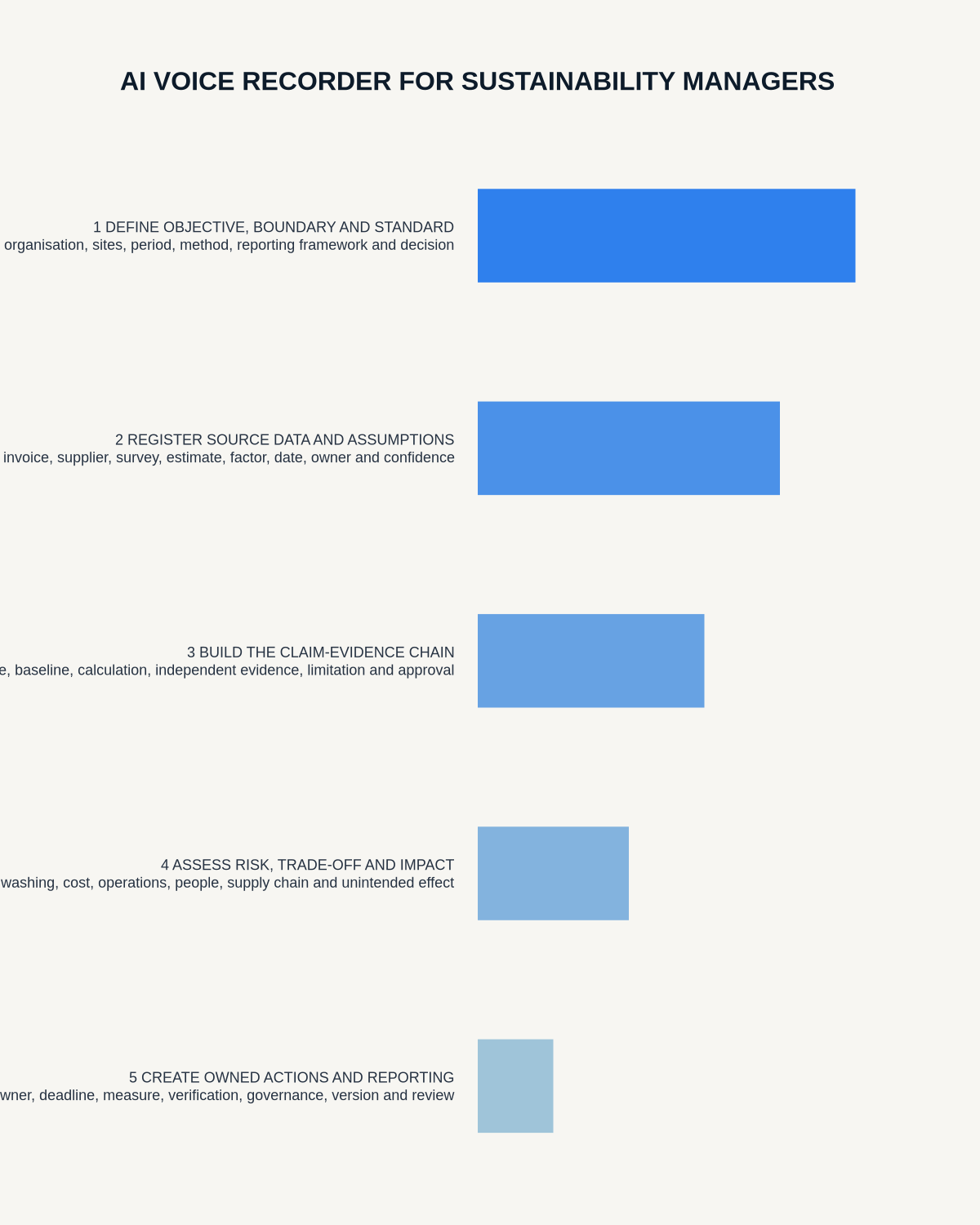
Use a claim-development workflow
- Confirm purpose and recording authority.
- Use claim, metric or project references.
- Apply statement-type labels.
- Capture boundary, period, method and evidence.
- Generate and correct the transcript.
- Create claim passports and evidence requests.
- Verify against source systems.
- Review wording for overstatement.
- Obtain technical, legal and leadership approval.
- Store the approved claim and evidence trail.
Review high-risk wording
Terms such as zero, carbon neutral, renewable, recycled, sustainable, eliminated, science-based and net positive should be used only where the evidence and methodology support them.
Where NERALVO Halo fits
Assess Halo against the sustainability managers workflow matrix can support approved supplier interviews, site debriefs and workshops with portable NOTE recording, 64GB local storage and structured DOWAY notes. It supports evidence gathering; it does not approve environmental claims.
Cloud software, a dedicated recorder or manual notes?
For Sustainability Managers, the right answer changes with the setting. This matrix deliberately gives each method a situation where it can be the strongest choice.
| Situation | Best starting point | Reason |
|---|---|---|
| scheduled remote client meetings | Cloud meeting software | Auto-join and central collaboration can remove routine admin. |
| in-person visits and travel | Dedicated recorder | Dedicated hardware suits movement, variable rooms and offline source capture. |
| a client declines or policy requires manual notes | Manual notes or an approved alternative | A clear alternative respects policy and participant choice. |
| mixed CRM and field work | Governed hybrid | One governed process prevents gaps between desk and field work. |
Frequently asked questions
Can an AI summary be used in a sustainability report?
Only after the underlying data, method, boundary, caveats and approval have been checked.
Is a supplier statement evidence?
It is an attributed source, but material claims normally require supporting documentation and review.
Can activity be reported as impact?
No. Impact requires a credible method connecting activity to the wider effect.
Should missing data be omitted from the summary?
No. Gaps, estimates and exclusions should be visible.
How long should interview audio be retained?
Only for the defined evidence and review purpose under the organisation’s retention policy.
Authoritative guidance and related reading
- GHG Protocol Corporate Standard
- AI Voice Recorder for Environmental Consultants
- AI Voice Recorder for Risk Managers
Final claim-readiness checklist
- Statement type clear
- Boundary, period and unit defined
- Metric traceable to source data
- Assumptions and exclusions visible
- Supplier evidence reviewed
- Negative findings preserved
- Wording approved for its audience
On this page
More in this topic: Management and business workflows
Show 9 closely related guides
- AI Voice Recorder for Management Consultants: Better Interviews, Workshops and Evidence
- AI Voice Recorder for Account Managers: Clearer Client Commitments and CRM Notes
- AI Voice Recorder for Operations Directors: Better Reviews, Incidents and Action Closure
- AI Voice Recorder for Corporate Development: Controlled Diligence and Deal Decisions
- AI Voice Recorder for Programme Managers: Stronger Governance and Dependencies
- AI Voice Recorder for Bid Managers: Better Win Themes and Review Actions
- All-Day AI Voice Recorder: Battery, Storage and Workflow Test
- AI Voice Recorder for Retail Managers: Close Every Store-Walk Action
- AI Voice Recorder for Small Business Owners: Clear the Voice Inbox Daily
Related guides
See whether Halo fits this workflow
Review the NERALVO Halo specifications, included services, delivery information and current offer only after completing the guide.
Found an error or an out-of-date claim? Email support@neralvo.com with the article address and a supporting source.