The 60-second verdict
Quick answer: keep a voice recording only for as long as its defined purpose, legal requirement or approved business need continues. Treat raw audio, machine transcripts, corrected text, final notes, exports and backups as separate records with their own triggers, owners and controls.
Decision focus: use the method below only where it produces a recoverable source, a verifiable output and a clear next action. If one of those fails, change the workflow rather than trusting a polished summary.
Evidence basis and limits
- Decision factors covered: Retention begins with purpose; Different records need different periods; Use a retention trigger, not only a calendar date.
- Evidence rule: A claim earns weight only when the source, date, configuration and limitation are clear enough for a reader to check.
- Boundary: Examples and workflow recommendations must be tested with representative recordings, the intended users and the actual approval process before rollout.

Voice recordings are often kept longer than intended because nobody owns deletion. A file created to verify meeting minutes may remain on the recorder, in an app, in a cloud account, in personal downloads and inside backups long after the approved note is complete. A defensible retention process begins before recording, not when storage becomes full.
Quick verdict: there is no universal retention period for every recording. Define the purpose, separate raw audio from transcripts and final records, identify the event that ends each need, assign an owner, cover every copy and document any exception.
This guide provides general information, not legal advice. Organisations should use current official guidance and their own records, legal, professional and contractual requirements.
Retention begins with purpose
The first question is not “How many days should we keep audio?” It is:
What specific purpose requires this identifiable recording, and what event shows that purpose has ended?
Examples include:
- Approved minutes have been checked and issued.
- An attendance note has been verified and filed.
- Research transcription and quality checks are complete.
- A customer complaint has closed.
- A contractual dispute or appeal period has ended.
- A permitted training resource has been created and approved.
- A legal hold has been released.
“It might be useful one day” is not a useful deletion trigger.
Different records need different periods
| Record type | Typical purpose | Retention question |
|---|---|---|
| Raw audio | Verification of what was said | When is source checking complete? |
| Raw AI transcript | Working draft and navigation | When has correction finished? |
| Corrected transcript | Research, evidence or detailed record | Is the full text still necessary? |
| AI summary | Drafting support | When is the authorised output approved? |
| Approved minutes or note | Authoritative business record | Which formal record schedule applies? |
| Extract or quotation | Publication, research or reporting | What rights and audit period apply? |
| Exported copy | Transfer or review | Can it be deleted after successful transfer? |
| Backup copy | Resilience | When will normal backup expiry remove it? |
Keeping the approved final note does not automatically justify retaining every earlier version.
Use a retention trigger, not only a calendar date
A fixed number of days can be useful, but a business event is often clearer. Examples:
- Delete raw audio seven days after approved minutes are issued.
- Delete the working transcript when the final attendance note is approved.
- Retain research audio until transcript validation is complete, then apply the approved study schedule.
- Retain complaint audio until closure and expiry of the relevant review or appeal period.
- Retain transaction material until the authorised destruction instruction.
The actual period must be assessed for the specific purpose and requirements.
Map every location where a copy can exist
| Location | Control to define |
|---|---|
| Recorder storage | Transfer verification and device deletion |
| Mobile app or cloud account | Account retention and deletion workflow |
| Phone or tablet | Local cache, downloads and device backups |
| Laptop | Downloads, temporary folders and recycle bin |
| Attachments, sent items and recipient copies | |
| Messaging platform | Uploaded files and channel retention |
| Document system | Approved final record and version history |
| Backups | Expiry cycle and restoration controls |
| Supplier account | Contract-end return or deletion |
| Reassigned device | Secure wipe before reuse or disposal |
Assign an accountable owner
The owner should be responsible for:
- Confirming the purpose.
- Setting or applying the retention period.
- Knowing where copies are stored.
- Approving exceptions.
- Responding to access or correction requests.
- Triggering deletion.
- Recording that deletion occurred.
- Reviewing the schedule when the process changes.
“The meeting organiser” is not enough unless that role understands and can operate the full workflow.
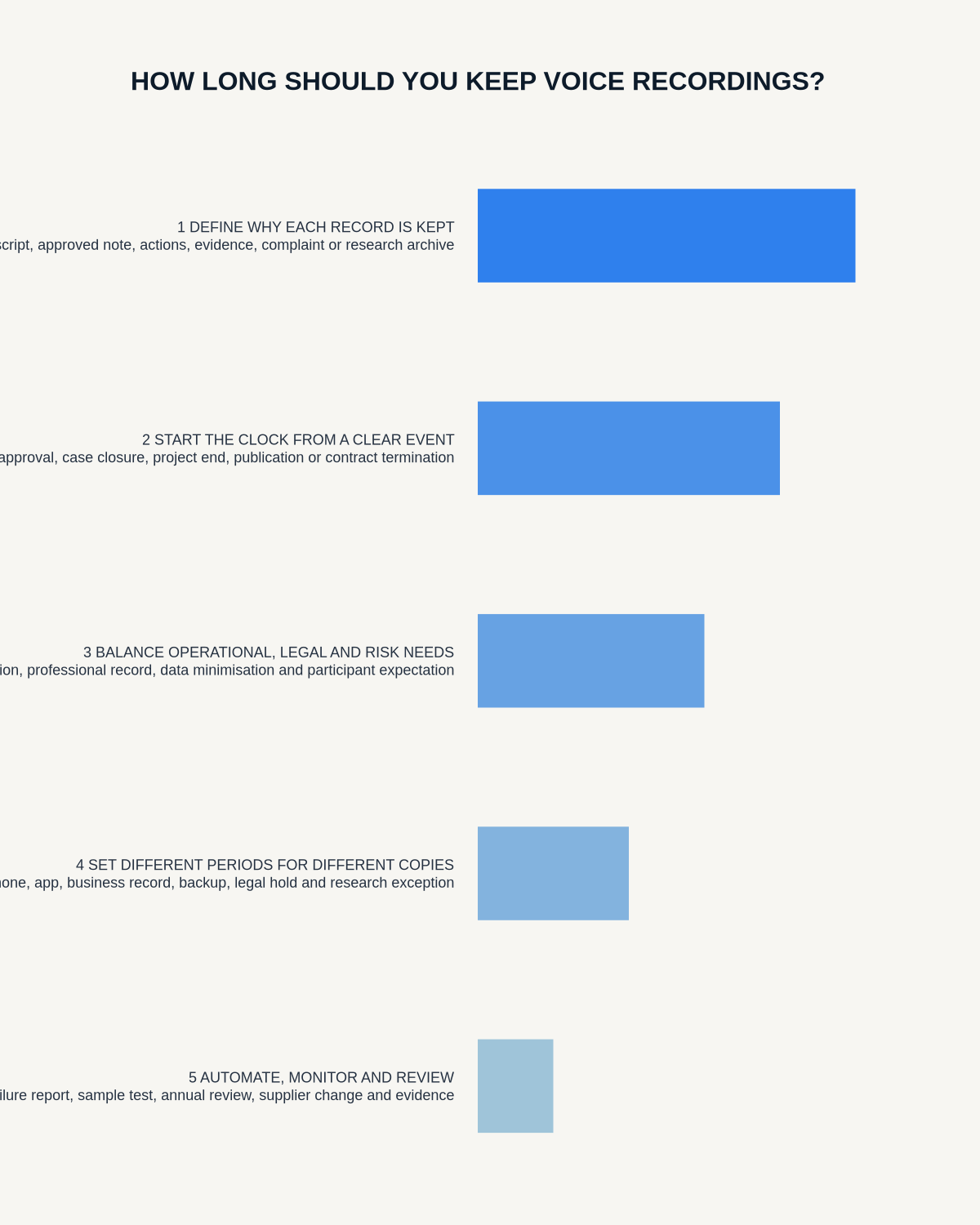
Build deletion into the standard procedure
- Create the recording under the approved process.
- Transfer it to the authorised account or system.
- Confirm that the file is complete.
- Generate and correct the transcript.
- Create the approved final record.
- Confirm that verification is complete.
- Delete temporary and device copies.
- Allow approved backup expiry to operate.
- Record any exception or hold.
- Audit the process periodically.
Do not keep audio merely because the final note might be challenged
Potential challenge can be relevant, but the organisation should define the actual risk and applicable review period. Consider:
- The type and importance of the meeting.
- Whether the audio is evidential or only a drafting source.
- How factual corrections are handled.
- Whether an appeal, limitation or complaint period applies.
- Professional or regulatory requirements.
- The sensitivity and security burden of continued retention.
- Whether the approved written record is sufficient.
Document lawful exceptions
Longer retention may be justified by a legal hold, active litigation or dispute, a formal complaint, grievance or appeal, safeguarding requirements, an active regulatory investigation, approved scientific or historical research, a professional recordkeeping duty or a contractual audit requirement.
For each exception, record the reason, authority, scope, access controls, review date and release trigger. An exception should not become indefinite retention by default.
Separate deletion from taking a file offline
Moving audio into an archive or offline storage may reduce routine access, but the organisation still holds and processes it. Archived material still needs a purpose, access controls, rights handling and a review schedule.
Understand backups
Immediate deletion from every backup may be technically impractical. A controlled approach should define the backup cycle, how long backups persist, who can restore them, whether deleted data is put back into live use after restoration, how deletion requests are reapplied following recovery and when old media are destroyed.
Backups should not become an unreviewed second archive.
Retention and individual rights
Recordings and transcripts may be relevant to access, rectification, restriction or erasure requests, depending on the circumstances. A longer retention period increases the volume that must be found and reviewed. Maintain searchable naming and matter references, identity-verification procedures, third-party redaction capability, a correction and challenge log, processes for restricted or disputed records and a record of lawful reasons for continued retention.
Keep accuracy in view
Old transcripts can become misleading when a draft is mistaken for approved minutes, a speaker label is wrong, an allegation is later resolved, a figure or plan changes, a correction is stored elsewhere or an AI summary removes the original qualification.
Label record status clearly and link material corrections to every retained version that still matters.
A sample retention decision record
| Field | Example entry |
|---|---|
| Purpose | Prepare and verify project steering minutes |
| Owner | Project governance manager |
| Raw audio trigger | Delete seven days after approved minutes |
| Transcript trigger | Delete when corrections are accepted |
| Final record | Retain under project-governance schedule |
| Locations | Recorder, DOWAY, controlled project folder |
| Exception | Pause deletion if formal dispute starts |
| Review date | Annual or after supplier/process change |
This is an example structure, not a universal recommended period.
How NERALVO Halo fits the retention lifecycle
Apply this guide before assessing NERALVO Halo records locally and can sync audio to DOWAY for transcription and other AI outputs. A complete deletion plan must therefore consider the recorder, the DOWAY account, exports, connected devices and any later storage location.
Deleting the copy on Halo does not prove that synced or exported copies have also been removed.
Retention questions before recording
- What exact purpose requires the audio?
- Which record will become authoritative?
- When will source checking finish?
- Which formal schedule applies to the final record?
- Where will every copy exist?
- Who owns deletion?
- How are backups handled?
- What exceptions may pause deletion?
- How will individual rights be supported?
- How will deletion be verified?
Workflow choice matrix for How Long Should You Keep Voice Recordings? UK Retention Guide
Choose the method that protects the source and reduces downstream correction. The table makes the non-hardware options explicit.
| Condition | Preferred route | Why |
|---|---|---|
| Repeatable remote work with approved integrations | Cloud software | Automation and central collaboration may outweigh device independence. |
| In-person, mobile or unreliable-connectivity work | Dedicated recorder | Independent capture and a recoverable local source are usually more resilient. |
| Recording is refused, prohibited or unnecessary | Manual notes / no recording | Respecting the boundary is the correct workflow, not a product failure. |
| High-risk or mixed work | Governed hybrid | Separate capture, review, approval and retention rather than trusting one tool. |
Frequently asked questions
Is there one universal legal period for voice recordings?
No. The appropriate period depends on the stated purpose, applicable requirements and risk.
Can files be kept “just in case”?
Open-ended precautionary retention is difficult to justify. Define a purpose and review or deletion trigger.
Should raw audio be deleted as soon as a transcript exists?
Not necessarily. Keep it for the period required to verify the transcript and complete the approved process, then reassess.
Does deleting the recorder copy delete everything?
No. Check synced accounts, exports, downloads, messages, backups and other systems.
Official ICO guidance
Bottom line: a recording plan is incomplete until it states which files will exist, who owns them and when each copy will cease to be needed.
Related guides
On this page
Related guides
See whether Halo fits this workflow
Review the NERALVO Halo specifications, included services, delivery information and current offer only after completing the guide.
Found an error or an out-of-date claim? Email support@neralvo.com with the article address and a supporting source.