The 60-second verdict
Quick answer: customer-call recording should combine clear notice, a defined service or evidence purpose, secure processing, payment and authentication pauses, accurate call notes, fair worker monitoring, controlled access and category-specific retention.
Use this guide when: the recording purpose, authority, participants, access and retention can be defined. Pause when: any of those controls is unclear.
Evidence basis and limits
- Decision factors covered: Define each purpose separately; Tell customers clearly; Explain the full processing route.
- Evidence rule: Claims are weighted by consequence: capture failure, changed meaning, access and recovery matter more than polished wording.
- Boundary: This is practical information, not legal advice. Verify current ICO guidance, sector rules, contracts and organisational policy for the real use case.

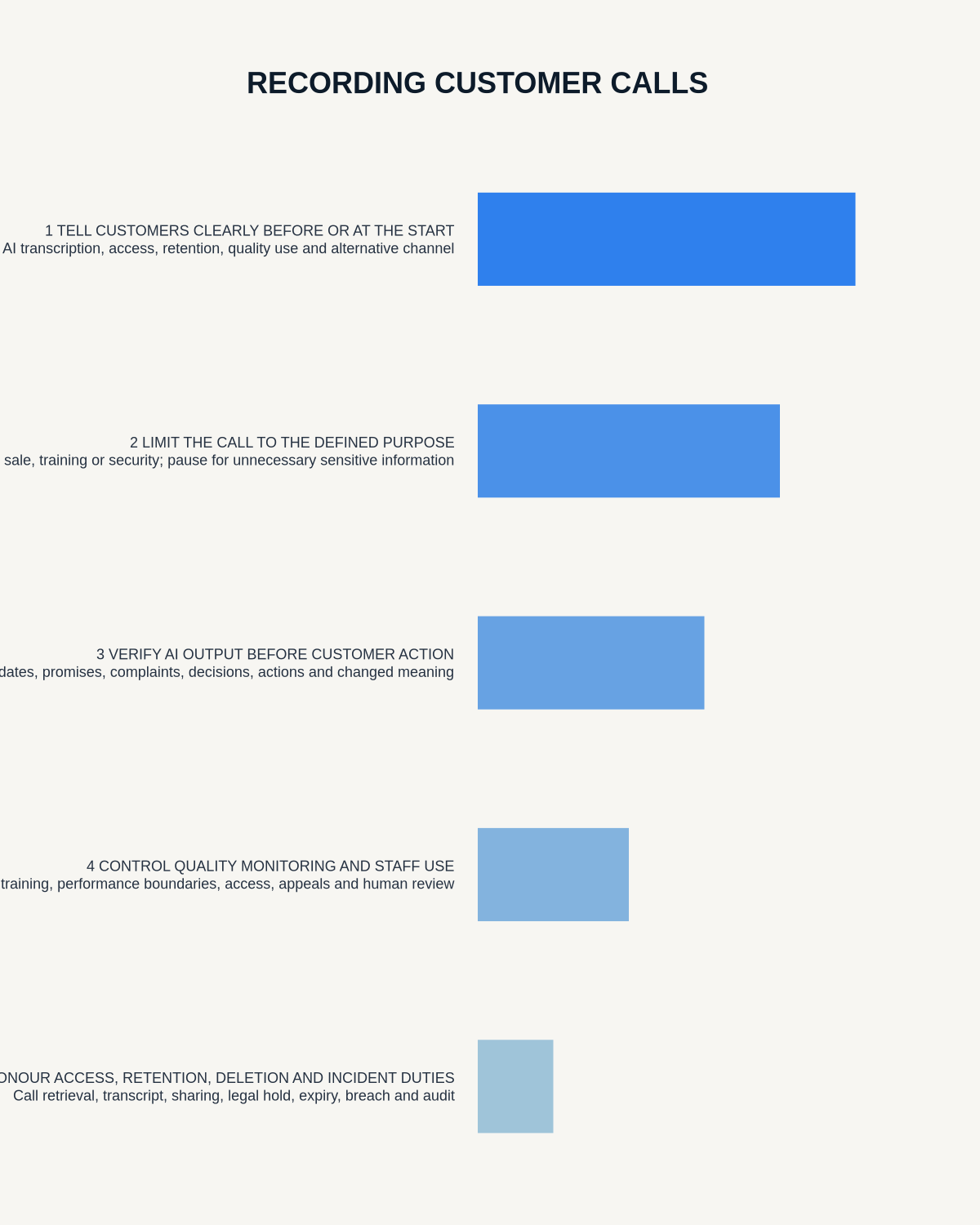
Customer calls may be recorded for service quality, evidence of transactions, complaint handling, training, accessibility or regulatory obligations. Each purpose needs a defined process; “quality and training” should not become an unlimited reason to record, analyse and retain every conversation.
This guide explains practical UK governance for customer-call recording and AI transcription. It is general information, not legal, regulatory or data-protection advice.
Define each purpose separately
- Evidence of a transaction or instruction.
- Quality assurance.
- Staff training.
- Complaint or dispute handling.
- Accessibility support.
- Fraud prevention.
- A specific regulatory recording duty.
Do not reuse calls for AI model training, marketing, employee profiling or sentiment analysis without a separate assessment and transparent basis.
Tell customers clearly
The ICO says callers should be told that the call is being recorded and why. A recorded message is good practice; where that is not possible, staff should explain it. Further privacy information can cover retention, rights and sharing.
See the ICO’s guidance on monitoring telephone calls.
Explain the full processing route
Privacy information should address:
- The controller.
- Main recording purposes.
- Lawful basis.
- AI transcription or analysis.
- Recipients and suppliers.
- International transfers where relevant.
- Retention.
- Customer rights and contact route.
Offer another channel where appropriate
A non-recorded option may be needed or appropriate for vulnerable customers, sensitive matters or optional recording. Alternatives might include secure messaging, branch service, written confirmation or a call segment recorded only after a specific transaction starts.
Map and test the call route
- Phone and operating system.
- Cellular or calling app.
- Headset, handset or speakerphone.
- Local device storage.
- Transcription supplier.
- CRM or case export.
- Retention and deletion.
Test every essential route separately and retest after material updates.
Pause for payment and authentication data
Do not capture full card details, PINs, passwords, security answers or one-time codes in an ordinary recording workflow. Use pause-and-resume controls and a secure payment or verification channel. Confirm that recording actually stops and that sensitive data is not reproduced in logs or transcripts.
Minimise sensitive information
Customer calls can reveal health, finances, allegations, family circumstances and criminal-offence data. Train staff to avoid repeating unnecessary identifiers and to pause or switch channels when highly sensitive information is not required for the recording purpose.
Separate customer recording from worker monitoring
Call recording inevitably captures employees as well as customers. Workers should understand the purpose, extent, sampling method and consequences of monitoring. Do not introduce hidden individual performance scoring through an AI feature that was presented as customer-service note-taking.
Use quality monitoring proportionately
Rather than reviewing every call indefinitely, define a risk-based sample, reviewer training, calibration, appeal route and limits on automated scoring. Use AI flags to prioritise human review, not as unchallenged evidence of poor performance or customer emotion.
Create a reviewed call note
The final note should identify the customer or case, call purpose, material information, decisions, instructions, conditions, complaints, actions, owner and next contact date. The transcript should not automatically become the CRM record.
Verify transcripts before acting
- Both sides of the call are captured.
- Speaker labels are correct.
- Names and account references are accurate.
- Amounts and dates are correct.
- Conditional offers are not shown as commitments.
- Negative wording is preserved.
- Unclear sections are marked rather than guessed.
A transcript should not be used to reject a complaint, alter an account or discipline a worker without human review.
Restrict playback and export
Use individual accounts, role-based access and audit logs. The agent may need to create a note but not download the audio. External advisers may need a redacted extract rather than the full call.
Handle access requests and complaints
Call recordings may be personal data and may need to be located, reviewed and disclosed in response to a valid request, subject to applicable exemptions and third-party rights. Maintain searchable record IDs and a redaction process.
Set a justified retention period
Different call categories may require different periods. A regulated transaction, complaint call and routine service enquiry should not automatically share one indefinite schedule. Include audio, transcript, quality score, downloads and backups.
Using NERALVO Halo for individual business calls
Review NERALVO Halo against these controls supports CALL mode for compatible phones and social-app calls where recording is lawful, disclosed and permitted. It also provides NOTE mode, 64GB storage, up to 35 hours of recording and Bluetooth connection to DOWAY for transcripts, summaries, templates, translations, mind maps and exports. One year of DOWAY Max is included.
Compatibility and permission are separate. Test the exact phone, case and application and use the organisation’s approved disclosure and retention process. Halo is not a substitute for a centrally governed contact-centre platform.
Workflow choice matrix for Recording Customer Calls in the UK
Apply the strongest control before choosing a device. The table makes the non-hardware options explicit.
| Condition | Preferred route | Why |
|---|---|---|
| High-risk or mixed work | Governed hybrid | Separate capture, review, approval and retention rather than trusting one tool. |
| Recording is refused, prohibited or unnecessary | Manual notes / no recording | Respecting the boundary is the correct workflow, not a product failure. |
| In-person, mobile or unreliable-connectivity work | Dedicated recorder | Independent capture and a recoverable local source are usually more resilient. |
| Repeatable remote work with approved integrations | Cloud software | Automation and central collaboration may outweigh device independence. |
Frequently asked questions
Can a business record calls for “quality purposes”?
That may be a legitimate purpose in some contexts, but it still needs necessity, transparency, proportionality, worker governance, access controls and retention limits.
Can a recording resolve a customer dispute?
It may provide useful evidence, but check completeness, identity, accuracy and the legal context.
Can calls be used to train an AI model?
That is a separate use requiring supplier, purpose, lawful-basis, fairness, confidentiality and transparency assessment.
Should every employee hear every recording?
No. Access should be role-based and limited to a defined purpose.
Customer-call checklist
- Purpose and lawful basis documented.
- Customer notice given before capture.
- Detailed privacy information available.
- Worker-monitoring implications assessed.
- Payment and authentication recording blocked.
- Special-category data minimised.
- Supplier and account approved.
- AI scoring limited and human-reviewed.
- Playback and export restricted.
- Access-request process tested.
- Category-specific retention assigned.
- Deletion covers all copies.
Bottom line: trustworthy call recording is transparent, narrowly used, securely controlled and human-reviewed from the first notice to final deletion.
Related guides
On this page
Related guides
Check permission, retention and access before choosing hardware
Once the policy requirements in this guide are satisfied, compare Halo’s specifications, local storage, included services and current offer against your approved workflow.
Found an error or an out-of-date claim? Email support@neralvo.com with the article address and a supporting source.