The 60-second verdict
A fire risk assessment is not a room-by-room list of defects. It is an evidence-led judgement about how people use a building, how fire could start or spread, which safeguards are present and whether management arrangements work in practice.
Best fit: Fire Risk Assessors who need recoverable audio and human-verified notes in an authorised workflow. Use another method when: recording is prohibited, a participant declines or the approved process requires manual notes.
Evidence basis and limits
- Decision factors covered: A better inspection method: three passes through the building; Pass one: occupancy and use; Pass two: physical safeguards.
- Evidence rule: A claim earns weight only when the source, date, configuration and limitation are clear enough for a reader to check.
- Boundary: Examples and workflow recommendations must be tested with representative recordings, the intended users and the actual approval process before rollout.
An AI voice recorder for fire risk assessors can help preserve observations during an authorised inspection, especially when the assessor is moving through plant rooms, stairwells, service corridors and occupied areas. The transcript should support the assessment. It must not assign legal compliance, risk priority or remedial action without competent review.
A better inspection method: three passes through the building
Pass one: occupancy and use
Establish how the premises operates:
- normal and maximum occupancy
- working or opening hours
- sleeping risk where relevant
- people who may need assistance
- public, staff, contractor and visitor movements
- high-risk activities and processes
- areas occupied out of normal hours
- changes in use, layout or staffing
Record the source of the information. A manager’s description of occupancy should be labelled as reported until checked against available records and direct observation.
Pass two: physical safeguards
Inspect the building features and protective measures in a consistent route. The note should identify the exact location and evidence for each observation, including photographs where appropriate.
- means of escape
- doors, routes and final exits
- compartmentation and service penetrations
- fire detection and alarm arrangements
- emergency lighting
- firefighting equipment
- signage and wayfinding
- storage and ignition sources
- plant, electrical and charging areas
- access for emergency response
Pass three: management and evidence
Physical safeguards can fail if management systems are weak. Review:
- testing and maintenance records
- staff instruction and training
- evacuation arrangements
- personal emergency planning where applicable
- contractor control
- housekeeping and waste routines
- defect reporting and closure
- previous assessment actions
- change-control arrangements
The recording should preserve the explanation, but the final assessment should state whether evidence was seen, merely described or unavailable.
Use four evidence labels throughout the visit
| Label | Meaning | Example |
|---|---|---|
| Observed | Directly seen by the assessor | Fire door fails to close fully |
| Reported | Explained by a responsible person | Manager states weekly alarm tests are completed |
| Verified | Supported by a record, test or other evidence | Current test log reviewed |
| Not inspected | Access or conditions prevented examination | Locked roof plant room unavailable |
These labels stop an AI summary from converting “we test it weekly” into a verified control.
Describe defects precisely enough for another person to find them
Weak note: “Poor fire door.”
Stronger note: “Second-floor east stair enclosure, door from office 2.17: fails to latch when released from approximately 30 degrees; photograph 31; frame and closer require competent inspection.”
A usable observation contains:
- building and area
- specific element
- condition observed
- evidence reference
- limitation
- immediate control, if any
- further action to assess
Do not let the recorder set the priority
AI may group issues or suggest an action list, but priority depends on the assessor’s methodology, the people exposed, likelihood, consequence, existing controls and timescale.
For every action, record the reasoning:
- hazard or deficiency
- people or objective affected
- existing control
- why the control is insufficient
- recommended outcome
- interim measure where needed
- responsible role
- completion and review timescale
Capture immediate controls separately from permanent remedies
Separate immediate containment, corrective work, management improvement and verification. A manager moving an obstruction during the visit does not automatically close the underlying control failure.
Record inaccessible areas and assessment limitations
A complete assessment states what was not seen. Note locked rooms, concealed voids, occupied bedrooms, high-level areas, incomplete documentation, temporary conditions and work in progress. Include the consequence and whether a return visit or specialist inspection is required.
A practical voice-led inspection workflow
- Confirm the premises permits recording and explain the purpose.
- State the assessment reference, date, assessor and people present.
- Complete the occupancy-and-use discussion first.
- Follow a planned physical route, using location headers.
- Reference photographs and documents aloud.
- Use the labels observed, reported, verified and not inspected.
- Record immediate actions without treating them as permanent closure.
- Generate the transcript after the visit.
- Check locations, dates, system names and evidence references.
- Apply professional judgement to findings, priorities and the final action plan.
Where voice capture is inappropriate
Public areas, confidential staff discussions, sensitive residential settings and locations where the device affects safety may require ordinary notes or a private post-inspection debrief instead.
How NERALVO Halo may support field capture
Assess Halo against the fire risk assessors workflow matrix provides portable NOTE recording, 64GB local storage and DOWAY transcription and structured-note tools. It may support location-led observations, responsible-person interviews and a private post-visit debrief.
Test it in stairwells, plant rooms and spaces with alarms, ventilation or machinery.
Source check: UK government guidance says the responsible person must carry out and regularly review a fire risk assessment, keep a written record and record the findings. Read the official guidance.
Final assessment check
- Is occupancy and use accurately described?
- Can every physical finding be located?
- Are reported controls distinguished from verified evidence?
- Are inaccessible areas and limitations visible?
- Are immediate and permanent actions separated?
- Does each priority have professional reasoning?
- Has the reviewed assessment entered the approved system?
An AI voice recorder can reduce lost detail during a fire risk assessment. The defensible result still comes from competent inspection, evidence checking and a proportionate action plan.
Cloud software, a dedicated recorder or manual notes?
For Fire Risk Assessors, the right answer changes with the setting. This matrix deliberately gives each method a situation where it can be the strongest choice.
| Situation | Best starting point | Reason |
|---|---|---|
| scheduled remote meetings | Cloud meeting software | Auto-join and central collaboration can remove routine admin. |
| in-person or mobile work | Dedicated recorder | Dedicated hardware suits movement, variable rooms and offline source capture. |
| recording is refused or prohibited | Manual notes or an approved alternative | A clear alternative respects policy and participant choice. |
| mixed online and offline work | Governed hybrid | One governed process prevents gaps between desk and field work. |
Related AI voice recorder guides
Profession workflow
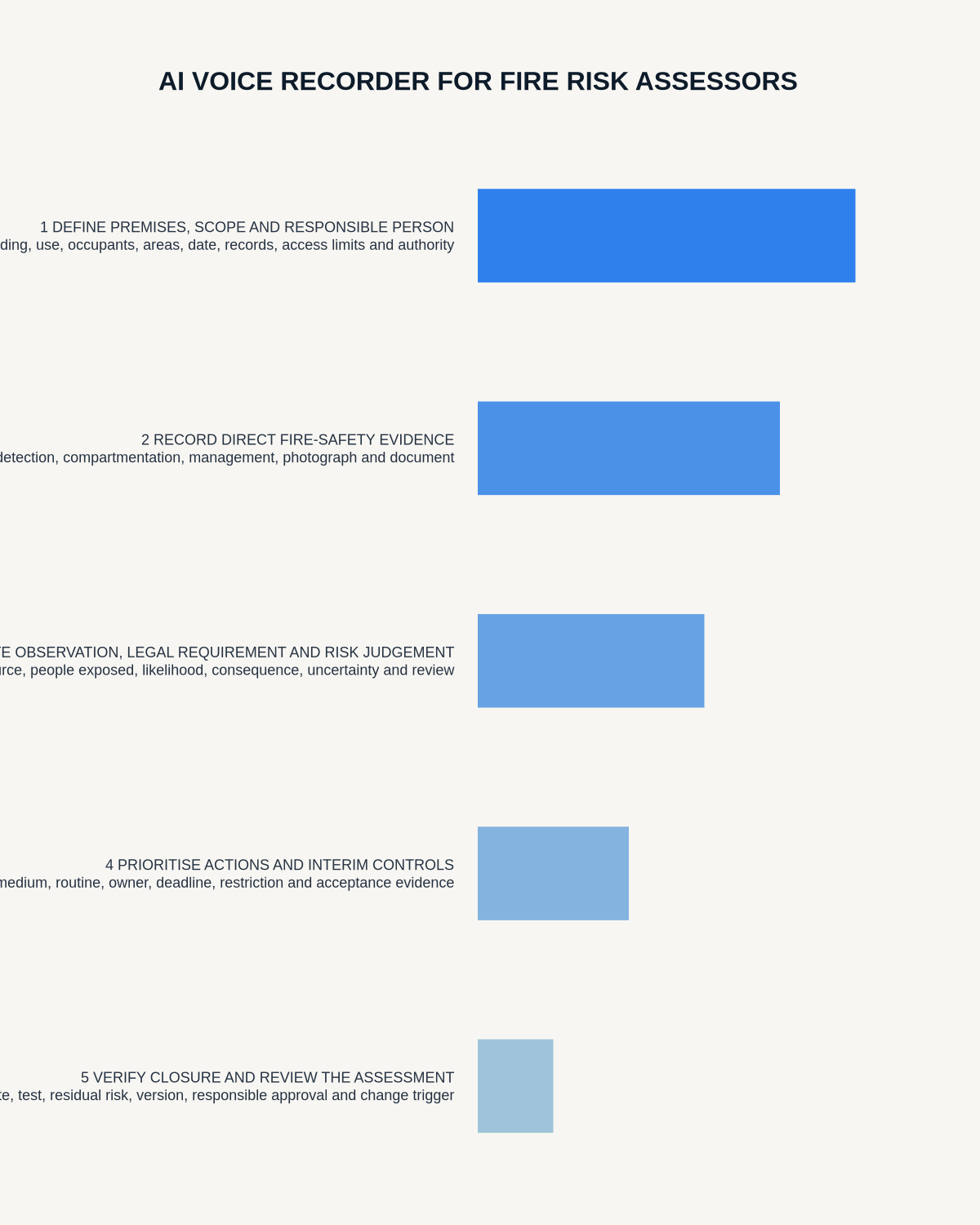
Visual map for AI Voice Recorder for Fire Risk Assessors: Better Evidence, Actions and Review
- Prepare the approved useDefine purpose, safe position, permission and the required formal record.
- Capture context firstState the case, asset, person, location or event identifier before detail.
- Human-verify evidenceCheck technical terms, units, names, dates, decisions and uncertainty.
- Complete the formal recordTransfer only verified information and apply access and retention controls.
On this page
More in this topic: Property, inspections and investigations
Show 7 closely related guides
- AI Voice Recorder for Fire Investigators: Stronger Scene Notes, Interviews and Evidence
- AI Voice Recorder for Building Control Inspectors: Better Site Evidence and Clearer Decisions
- AI Voice Recorder for Domestic Energy Assessors: Better Survey Evidence and Data Provenance
- AI Voice Recorder for Property Developers: Better Decision Logs and Project Handover
- AI Voice Recorder for Auctioneers: Better Lot Notes, Provenance and Seller Instructions
- AI Voice Recorder for Private Investigators: Better Interviews, Chronologies and Evidence Control
- AI Voice Recorder for Loss Adjusters: Better Site Evidence and Damage Notes
Related guides
See whether Halo fits this workflow
Review the NERALVO Halo specifications, included services, delivery information and current offer only after completing the guide.
Found an error or an out-of-date claim? Email support@neralvo.com with the article address and a supporting source.