The 60-second verdict
International students may understand a subject well while needing more time to process unfamiliar accents, rapid discussion, specialist vocabulary and academic conventions. Recording can create valuable review time, but only when the source transcript is checked and translation is used selectively.
Best fit: International Students who need recoverable audio and human-verified notes in an authorised workflow. Use another method when: recording is prohibited, a participant declines or the approved process requires manual notes.
Evidence basis and limits
- Decision factors covered: Stage 2: Build discipline-specific meaning; Stage 3: Use the language independently; Stage 4: Communicate for the audience.
- Evidence rule: Claims are weighted by consequence: capture failure, changed meaning, access and recovery matter more than polished wording.
- Boundary: Examples and workflow recommendations must be tested with representative recordings, the intended users and the actual approval process before rollout.
An AI voice recorder for international students can support permitted lecture review, academic vocabulary building and private presentation practice. It cannot replace language development, reliable course sources, professional interpretation or the student’s original academic work.
The source → meaning → use → communicate cycle
| Stage | Student question | Output |
|---|---|---|
| Source | What was actually said and which material confirms it? | Corrected transcript |
| Meaning | What does the term or idea mean in this discipline? | Contextual understanding |
| Use | Can I apply the language in my own explanation? | Active vocabulary |
| Communicate | Can I explain the argument clearly to the intended audience? | Academic confidence |
This cycle prevents an incorrect transcript from becoming an incorrect translation and then an incorrect assignment claim.
Stage 1: Verify the source language
Follow university or college rules before recording lectures, seminars or online sessions. A recording permitted for personal study may still be restricted from sharing.
When reviewing the transcript, check:
- Names and specialist terminology.
- Numbers, dates, units and negative signs.
- Speaker attribution.
- Quotations and citations.
- Definitions and qualifications.
- Code-switched phrases or abbreviations.
Compare important passages with the audio, slides, reading list and lecturer guidance. Do not translate the transcript until the source wording is reasonably accurate.
Stage 2: Build discipline-specific meaning
Many academic terms do not translate word for word. A familiar word may carry a specialised meaning in economics, law, engineering, medicine or literary theory.
Create each vocabulary entry with:
- Correct spelling.
- Original-language term where useful.
- Meaning in the discipline.
- Pronunciation.
- Common collocation or phrase.
- Register and audience.
- An example from a reliable source.
- A concept it connects to.
Keep the original term beside any translation. Check bilingual glossaries, textbooks or lecturer explanations rather than relying on a general dictionary alone.
Stage 3: Use the language independently
Recognition is not the same as being able to use a term. Close the transcript and explain the concept in the student’s own words.
Try:
- A one-sentence definition.
- A short example.
- A contrast with a related term.
- An explanation of why the concept matters.
- A response to a likely seminar or examination question.
Compare the explanation with reliable course material. Correct missing logic or inaccurate vocabulary, then repeat the task without memorising an AI-generated answer.
Stage 4: Communicate for the audience
Academic communication changes by task. A seminar contribution, laboratory explanation, reflective presentation and formal essay require different structure and register.
| Task | Communication focus |
|---|---|
| Seminar contribution | Clear point, evidence and connection to discussion |
| Presentation | Structure, signposting, pace and explanation of visuals |
| Supervisor meeting | Progress, uncertainty, questions and next action |
| Written assignment | Original analysis, accurate sources and appropriate academic style |
| Group project | Roles, decisions, deadlines and shared understanding |
Use a private rehearsal to check whether the central argument is understandable. The goal is clarity and confidence—not erasing the student’s accent or identity.
Preview vocabulary before lectures
Where slides or learning outcomes are available, identify likely specialist terms before the session. Familiarity reduces the pressure to translate every sentence in real time.
During the lecture, mark only:
- An unfamiliar term.
- A fast or unclear explanation.
- A connection to an assessment.
- A quotation or source to verify.
- A question for teaching staff.
Use timestamps rather than attempting to transcribe everything while listening.
Translate selectively
Translate the key term, difficult sentence or short explanation that genuinely blocks understanding. Translating every line can hide the lecturer’s argument and create a large verification burden.
Automatic translation is especially risky with:
- Technical or legal terminology.
- Idioms and culturally specific examples.
- Negation and qualifications.
- Names and acronyms.
- Ambiguous pronouns.
- Long sentences with several claims.
Where accuracy affects immigration, health, safeguarding, discipline or another high-stakes decision, use the institution’s qualified support or an appropriate professional interpreter rather than relying on automatic translation.
Protect academic integrity
Translation, grammar correction and generative AI may be treated differently across modules and assessments. Check the relevant instructions and disclose assistance where required.
Do not submit AI-generated analysis, sources or wording as independent work where that use is prohibited. Keep drafts and be able to explain:
- How the argument was developed.
- Which sources were read.
- What translation or language support was used.
- How factual claims were verified.
- Why the final wording was chosen.
QAA publishes resources on academic integrity and generative AI in higher education.
Protect classmates and cultural privacy
Seminars and study groups may include personal experiences, political views, migration histories and sensitive information. Explain recording before it begins and use only the section needed for the stated study purpose.
Do not upload identifiable group discussion to an unapproved AI service or distribute raw audio. A checked action summary is often more proportionate.
A lecture-to-vocabulary script
- Topic: identify module, lecture and main argument.
- Source check: mark the section and material used to verify it.
- Term: record correct spelling and disciplinary meaning.
- Translation: add a selective explanation where useful.
- Use: create one original sentence or example.
- Communication: explain the concept aloud for a specific audience.
- Next action: state the question, reading or practice needed.
How NERALVO Halo can support multilingual study
Check whether NERALVO Halo fits international students work can support permitted lectures, vocabulary notes and private presentation rehearsal. It includes NOTE mode, supported CALL capture, 64GB local storage, up to 35 hours of recording and Bluetooth sync with DOWAY. DOWAY can create transcripts, summaries, speaker-separated notes, templates, translations, mind maps and exportable files, with one year of DOWAY Max included from activation.
Transcription and translation quality varies by language, accent, subject, environment and speech clarity. Halo is a study aid—not a professional interpreter or academic authority.
International-student note quality check
- Was the teaching recording permitted?
- Was the source transcript corrected before translation?
- Is each key term defined in its discipline-specific context?
- Did the student use the language independently?
- Was communication practised for the correct audience?
- Were high-stakes matters directed to qualified support?
- Does assessed work follow AI and translation rules?
- Are classmates and sensitive personal information protected?
- Has temporary audio been retained or deleted appropriately?
A strong multilingual study workflow verifies the source, builds contextual meaning and turns new language into independent academic communication.
Cloud software, a dedicated recorder or manual notes?
For International Students, the right answer changes with the setting. This matrix deliberately gives each method a situation where it can be the strongest choice.
| Situation | Best starting point | Reason |
|---|---|---|
| scheduled remote consultations | Cloud meeting software | Calendar automation and shared integrations are usually the strongest advantage. |
| in-person consultations or ward handovers | Dedicated recorder | Independent capture reduces reliance on an active phone or laptop. |
| a patient declines or policy prohibits recording | Manual notes or an approved alternative | The boundary takes priority over convenience. |
| mixed remote and clinical work | Governed hybrid | Use each method only in the setting it actually fits. |
Related AI voice recorder guides
See the guides for language tutors, distance learners, students with dyslexia and university lecturers.
Related guides
Profession workflow
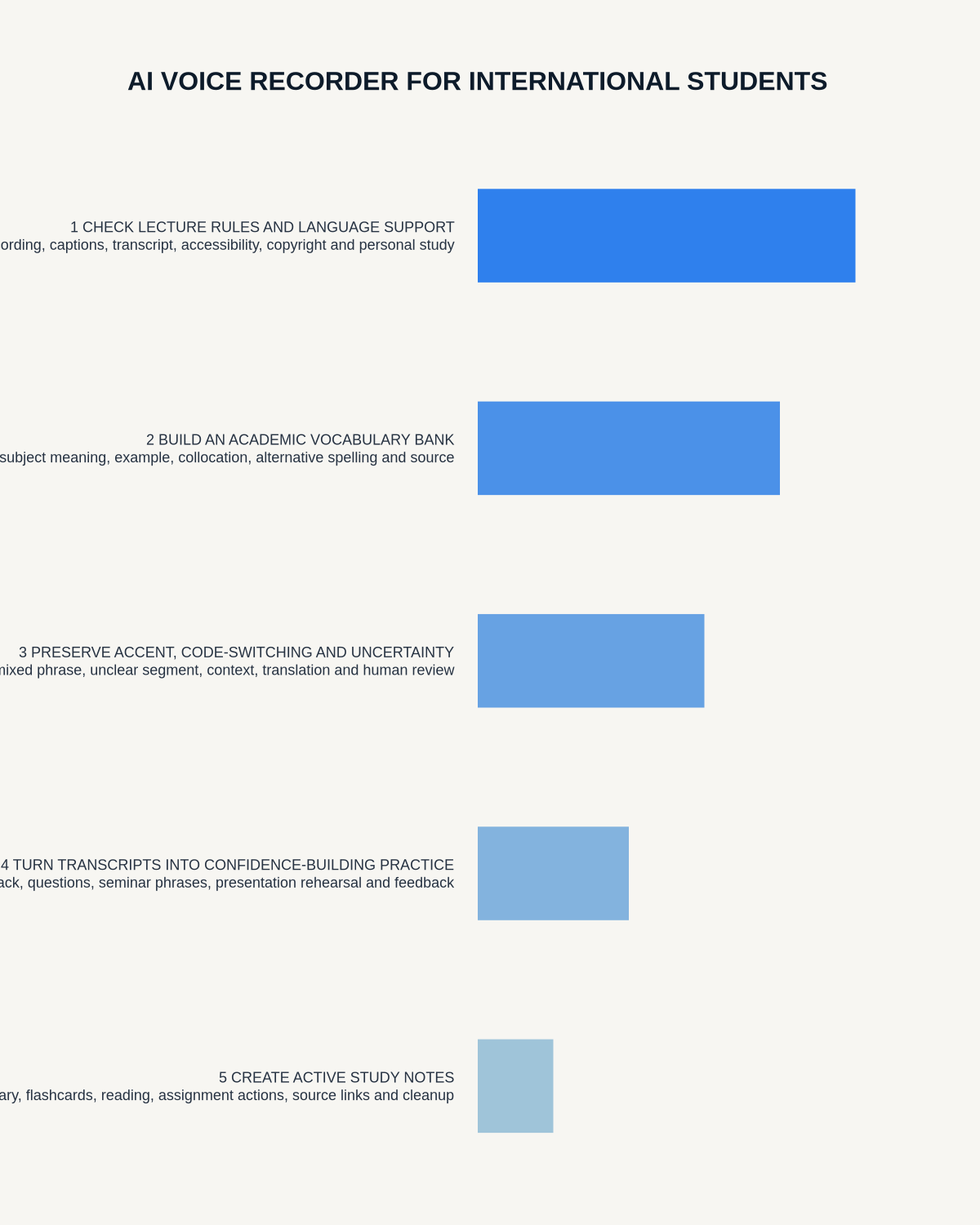
Visual map for AI Voice Recorder for International Students: Lectures, Vocabulary and Academic Confidence
- Prepare the approved useDefine purpose, safe position, permission and the required formal record.
- Capture context firstState the case, asset, person, location or event identifier before detail.
- Human-verify evidenceCheck technical terms, units, names, dates, decisions and uncertainty.
- Complete the formal recordTransfer only verified information and apply access and retention controls.
On this page
Related guides
See whether Halo fits long-form study capture
After checking permission and your institution’s rules, compare Halo’s stated battery, storage and export workflow with the way you actually study.
Found an error or an out-of-date claim? Email support@neralvo.com with the article address and a supporting source.