The 60-second verdict
Clinical research recordings can support interviews, focus groups and operational meetings only when the protocol, consent materials, approvals and data-management plan allow them. An AI voice recorder can accelerate transcription, but it must not introduce an undeclared processing route or weaken the study’s audit trail.
Best fit: Clinical Researchers who need recoverable audio and human-verified notes in an authorised workflow. Use another method when: recording is prohibited, a participant declines or the approved process requires manual notes.
Evidence basis and limits
- Decision factors covered: Start with the protocol; Participant-interview file chain; AI transcription can alter research data.
- Evidence rule: Claims are weighted by consequence: capture failure, changed meaning, access and recovery matter more than polished wording.
- Boundary: Examples and workflow recommendations must be tested with representative recordings, the intended users and the actual approval process before rollout.
Start with the protocol
Before recording, confirm:
- the approved purpose
- participant information and consent
- who controls the data
- where audio and transcripts will be stored
- whether an external AI service is permitted
- pseudonymisation process
- retention period
- access and deletion arrangements
A convenient app feature should not change the research process without the required review.
Participant-interview file chain
| Stage | Record |
|---|---|
| Consent | Approved participant consent record |
| Capture | Source audio with study identifier |
| Transfer | Documented destination and date |
| Transcript | Versioned first draft |
| Review | Corrections, redactions and speaker checks |
| Analysis copy | Pseudonymised approved dataset |
| Retention | Handled under the data-management plan |
AI transcription can alter research data
Automatic systems may normalise grammar, omit pauses, mishear medication or clinical terms, and remove uncertainty. Decide whether the study needs:
- verbatim transcription
- intelligent verbatim
- non-verbal markers
- speaker turns
- timestamps
- redaction conventions
- translation procedures
Document corrections so the analysis dataset has a clear provenance.
Protocol and site meetings
For authorised operational meetings, useful outputs include:
- protocol questions
- site responsibilities
- training needs
- deviations discussed
- data queries
- safety or escalation actions through the proper route
- owners and dates
The AI summary is not the official decision or safety record unless incorporated through the approved process.
Deviations and corrective action
A recorded discussion can help reconstruct chronology, but the final deviation or corrective-action record must be completed and approved in the relevant system. AI should not determine root cause or seriousness.
A controlled interview workflow
- Confirm the protocol permits recording and AI processing.
- Use the approved consent process.
- Identify the file with the study code, not unnecessary personal details.
- Capture the complete session.
- Transfer through the approved route.
- Generate the transcript using the permitted service.
- Check terminology, speaker turns and redactions.
- Create the approved analysis copy.
- Version and document changes.
- Apply retention requirements.
Translation and multilingual research
Translation adds another interpretive stage. Preserve the source audio and source-language transcript where required. Critical translated meaning should be checked through the study’s approved language process.
Where NERALVO Halo fits
Check whether NERALVO Halo fits clinical researchers work can provide local source capture for approved research interviews and operational meetings. Its current specification includes 64GB local storage, NOTE and CALL modes, up to 35 hours of recording and Bluetooth transfer to DOWAY.
DOWAY can create transcripts, summaries, speaker-separated notes, templates, translations and mind maps. Use depends on whether the protocol and data plan permit this processing route.
Research-record quality check
- Was recording and AI processing approved?
- Is consent documented?
- Is the source file linked to a study identifier?
- Are transcription conventions defined?
- Are redactions and corrections versioned?
- Is the analysis dataset traceable to the source?
Cloud software, a dedicated recorder or manual notes?
For Clinical Researchers, the right answer changes with the setting. This matrix deliberately gives each method a situation where it can be the strongest choice.
| Situation | Best starting point | Reason |
|---|---|---|
| scheduled remote consultations | Cloud meeting software | Calendar automation and shared integrations are usually the strongest advantage. |
| in-person consultations or ward handovers | Dedicated recorder | Independent capture reduces reliance on an active phone or laptop. |
| a patient declines or policy prohibits recording | Manual notes or an approved alternative | The boundary takes priority over convenience. |
| mixed remote and clinical work | Governed hybrid | Use each method only in the setting it actually fits. |
Related guides
Bottom line
For clinical researchers, AI recording is valuable only inside the approved protocol and data lifecycle. It can reduce transcription effort, but consent, version control, pseudonymisation and auditability determine whether the output is usable research data.
Profession workflow
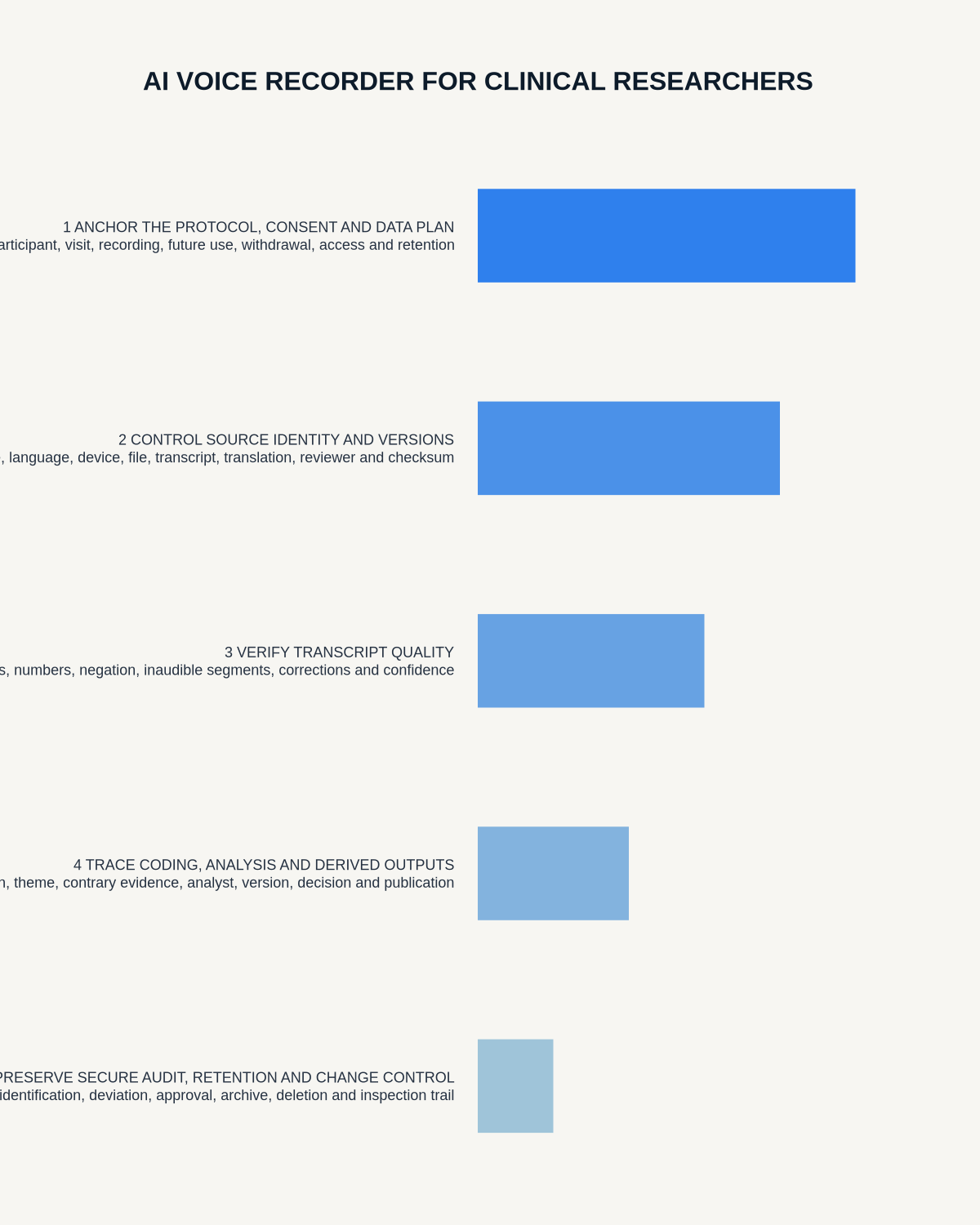
Visual map for AI Voice Recorder for Clinical Researchers: Better Interviews and Audit Trails
- Prepare the approved useDefine purpose, safe position, permission and the required formal record.
- Capture context firstState the case, asset, person, location or event identifier before detail.
- Human-verify evidenceCheck technical terms, units, names, dates, decisions and uncertainty.
- Complete the formal recordTransfer only verified information and apply access and retention controls.
On this page
More in this topic: Health, care and clinical recording
Show 9 closely related guides
- AI Voice Recorder for Care Coordinators: Person-Centred Plans and Clear Handover
- AI Voice Recorder for Radiographers: Safer Training, Debriefs and Reflection
- AI Voice Recorder for Optometrists: Clearer Consultations and Safer Clinical Notes
- AI Voice Recorder for Audiologists: Better Hearing Assessments and Follow-Up Notes
- AI Voice Recorder for Coroners’ Officers: Clearer Family Calls and Case Coordination
- AI Voice Recorder for Occupational Health Advisers: Consultations and Adjustments
- AI Voice Recorder for Environmental Health Officers: Better Inspections and Evidence
- AI Voice Recorder for Food Safety Inspectors: Better Site Evidence and Follow-Up
- AI Voice Recorder for Lab Technicians: Better Procedures, Deviations and Handover
Related guides
See whether Halo fits this workflow
Review the NERALVO Halo specifications, included services, delivery information and current offer only after completing the guide.
Found an error or an out-of-date claim? Email support@neralvo.com with the article address and a supporting source.