The 60-second verdict
Quick answer: retail managers can use an AI voice recorder to capture store-walk observations, customer issues, stock actions and staff follow-up, but urgent safety, safeguarding, security and food risks must be controlled immediately. Every material observation needs a precise location, the correct route, one owner and a closure check.
Best fit: Retail Managers who need recoverable audio and human-verified notes in an authorised workflow. Use another method when: recording is prohibited, a participant declines or the approved process requires manual notes.
Evidence basis and limits
- Decision factors covered: Use the store-walk closure board; Use five separate routes; Use the FLOOR voice note.
- Evidence rule: The decision is based on the complete capture-to-action workflow, not a single feature or marketing accuracy percentage.
- Boundary: Examples and workflow recommendations must be tested with representative recordings, the intended users and the actual approval process before rollout.

View Halo specifications for retail managers use can support private post-walk drafting. It is not a safety, incident, task, stock, security or HR system.
Use the store-walk closure board
| Stage | Required record | Failure to avoid |
|---|---|---|
| Find | Exact department, fixture, product or asset | Vague note attached to the wrong area |
| Control | Immediate safety or customer action | Recording before making the situation safe |
| Assign | Named owner and deadline | “Team to fix” with no accountability |
| Evidence | Photo, ticket, stock record or customer reference | Task closed without proof |
| Verify | Manager confirms the required outcome | Assuming completion because somebody said it was done |
Use five separate routes
- Operational task: merchandising, replenishment, cleaning or routine execution.
- Safety: hazard, injury, equipment or premises issue.
- Customer: complaint, accessibility request or promised follow-up.
- Security: restricted loss-prevention, threat or key-control matter.
- People: welfare, conduct or performance information requiring a private management record.
Do not paste one general AI summary into all five systems. Route only the verified information each system needs.
Use the FLOOR voice note
- F — Find: exact location, SKU, fixture or asset.
- L — Look: objective observation against the standard.
- O — Operate safely: immediate control already applied.
- O — Owner: person, team or supplier responsible.
- R — Review: deadline and evidence needed for closure.
“Front entrance, left automatic door. Water pooling inside the threshold after heavy rain. Area isolated with barrier and warning sign at 14:20. Facilities ticket 882 raised. Duty manager to inspect every 20 minutes until contractor arrival at 16:00. Reopen only after the surface is dry and the fault has been reviewed.”
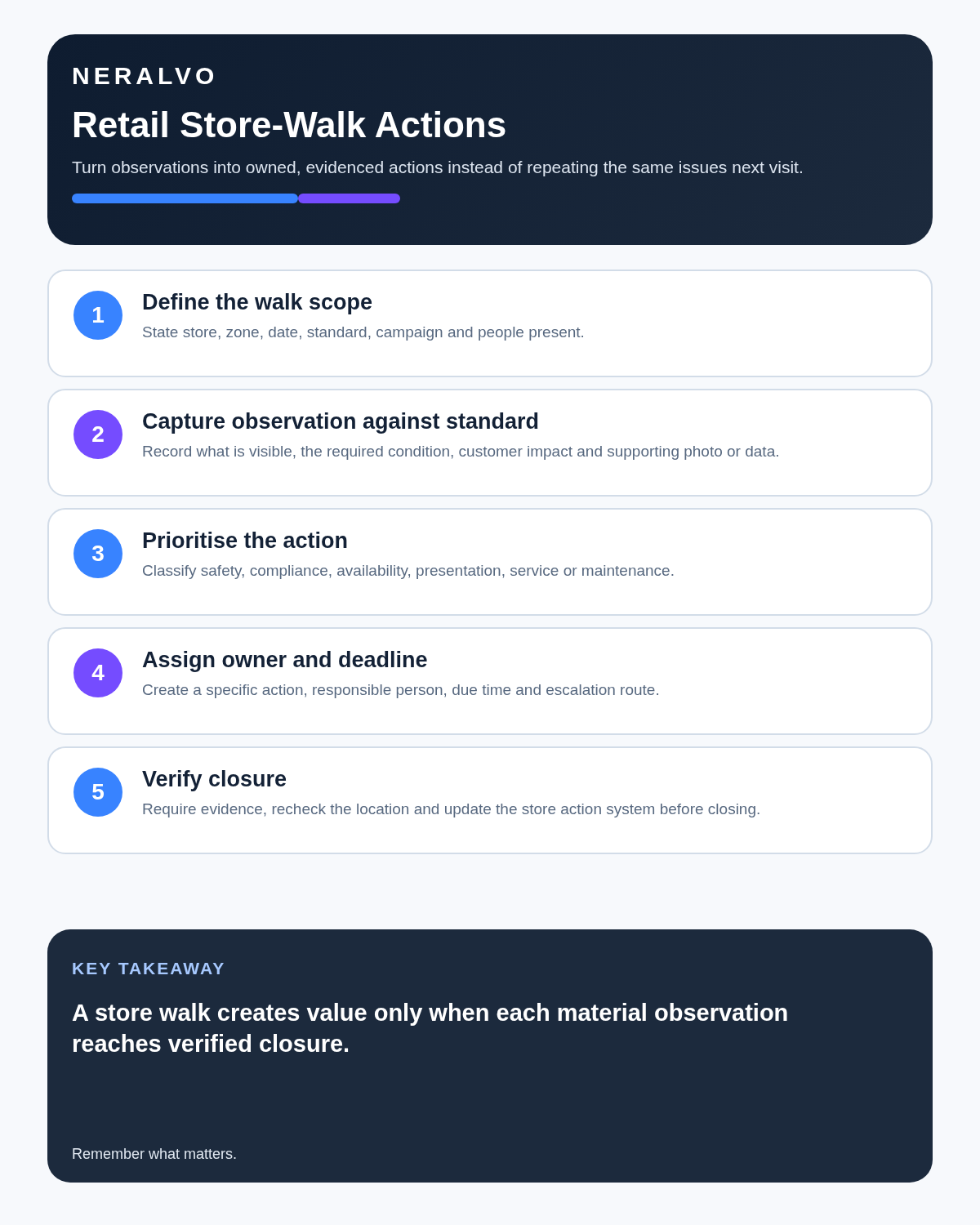
The location → standard → observation → impact → action → closure workflow
| Stage | Question | Output |
|---|---|---|
| Location | Which store, department, fixture or room? | Traceable place |
| Standard | What should be true? | Clear expectation |
| Observation | What is actually present? | Objective evidence |
| Impact | What does it affect? | Priority |
| Action | Who will do exactly what? | Owned task |
| Closure | What proves the outcome? | Verified completion |
Use an immediate-risk fast lane
Stop and route urgent issues before completing the walk:
- Slip, trip, electrical, fire or structural risk.
- Safeguarding or vulnerable-customer concern.
- Security threat, violence or serious loss incident.
- Food safety, allergen or temperature issue.
- Unsafe product, damaged equipment or blocked exit.
Documentation must not delay protection or emergency response.
Anchor and classify every observation
State store, visit date, department, aisle, fixture, product, equipment, trading condition, expected standard and photo or system reference. Classify as safety, customer experience, commercial, operational, people, compliance or maintenance.
“Front display poor” is weak. “Entrance promotional bay, left side: two missing price tickets and one empty hero line against current planogram” is actionable.
Write measurable actions
Replace “sort display” with:
- Exact required outcome.
- One accountable owner.
- Deadline or trading window.
- Dependency such as stock, maintenance or approval.
- Evidence required for closure.
- Escalation trigger if not resolved.
Use the same-shift processing routine
- Move to a private safe position.
- Record one issue per note using FLOOR.
- Generate and correct the transcript.
- Check times, prices, SKUs, names and asset references.
- Route the item into the correct system.
- Assign one owner and deadline.
- Record the evidence required for closure.
- Carry only unresolved items into handover.
- Delete temporary audio under policy.
Control customer promises
Separate:
- What the customer requested.
- What the manager verified.
- What remedy was proposed.
- Who authorised it.
- What was communicated.
- When the customer will receive the next update.
- What proves delivery and closure.
An AI-generated apology must not create an unauthorised refund, admission or guarantee.
Do not confuse attendance with completion
A staff member acknowledging an action, a contractor visiting or a message saying “done” does not prove the standard was met. Verify the physical location, system status, photograph or customer outcome.
Use store walks to find patterns
Compare repeated observations by department, time, product and root condition. A recurring empty shelf may reflect replenishment timing, inaccurate inventory, supplier service, planogram capacity or staffing—not simply poor effort.
Keep the observed pattern separate from the proposed cause until evidence supports it.
Protect employee privacy
A defined briefing is different from continuous worker monitoring. Do not leave a recorder running on the shop floor or use transcripts to infer attitude, productivity, emotion or misconduct.
Keep welfare, disciplinary, medical and performance information out of general store-walk and handover records. Route it into the authorised restricted process.
Create a concise leadership summary
- Immediate risks controlled.
- Top customer or commercial issues.
- Actions due before the next trading period.
- Cross-functional dependencies.
- Repeated issues requiring root-cause work.
- Closed actions verified since the previous walk.
How NERALVO Halo fits retail management
NERALVO Halo includes NOTE mode, supported CALL mode, 64GB local storage, up to 35 hours of recording and Bluetooth sync with DOWAY. DOWAY can provide transcripts, summaries, speaker-separated notes, templates, translations, mind maps and exports, with one year of DOWAY Max included.
Record from a safe stationary position and transfer each output into the store task, safety, complaint, security or HR system that owns it.
Cloud software, a dedicated recorder or manual notes?
For Retail Managers, the right answer changes with the setting. This matrix deliberately gives each method a situation where it can be the strongest choice.
| Situation | Best starting point | Reason |
|---|---|---|
| scheduled remote client meetings | Cloud meeting software | Native remote-meeting workflows can be more efficient here. |
| in-person visits and travel | Dedicated recorder | A separate battery and recoverable local source improve resilience. |
| a client declines or policy requires manual notes | Manual notes or an approved alternative | Manual notes are the correct control when recording is unavailable. |
| mixed CRM and field work | Governed hybrid | A hybrid can combine automation with reliable physical capture. |
Frequently asked questions
Should every observation become an action?
No. Prioritise material issues, combine duplicates and define the outcome that matters.
Can AI assign priorities automatically?
It can suggest categories, but the manager must assess actual safety, customer and commercial impact.
Can photographs replace written detail?
No. Link the image to the exact location, standard, issue and required action.
Can a contractor visit close a maintenance action?
No. Verify the required result and evidence.
Final store-walk checklist
- Exact location and standard identified.
- Urgent risk controlled immediately.
- Correct operational, safety, customer, security or people route chosen.
- FLOOR note complete.
- Observation separated from explanation.
- Actions specific, owned and dated.
- Customer promises authorised and tracked.
- Employee information protected.
- Closure checked against evidence.
- Store systems updated.
Bottom line: an AI recorder can make store walks faster without creating voice-note clutter. Make the area safe, route the issue correctly, assign it, demand evidence and verify closure.
Related guides
See the guides for operations managers, facilities managers and health and safety managers.
On this page
More in this topic: Management and business workflows
Show 9 closely related guides
- AI Voice Recorder for Management Consultants: Better Interviews, Workshops and Evidence
- AI Voice Recorder for Account Managers: Clearer Client Commitments and CRM Notes
- AI Voice Recorder for Operations Directors: Better Reviews, Incidents and Action Closure
- AI Voice Recorder for Corporate Development: Controlled Diligence and Deal Decisions
- AI Voice Recorder for Programme Managers: Stronger Governance and Dependencies
- AI Voice Recorder for Bid Managers: Better Win Themes and Review Actions
- AI Voice Recorder for Sustainability Managers: Better Audits, Claims and Action Plans
- All-Day AI Voice Recorder: Battery, Storage and Workflow Test
- AI Voice Recorder for Small Business Owners: Clear the Voice Inbox Daily
Related guides
See whether Halo fits this workflow
Review the NERALVO Halo specifications, included services, delivery information and current offer only after completing the guide.
Found an error or an out-of-date claim? Email support@neralvo.com with the article address and a supporting source.