Reviewed and fact-checked: 21 July 2026.
The 60-second verdict
Research audio can preserve language, emphasis and context that field notes miss. It also creates identifiable data that may expose participants, communities and third parties long after the interview ends. AI transcription adds suppliers, derived outputs and potential reuse that must be designed into the protocol.
Use this guide when: the recording purpose, authority, participants, access and retention can be defined. Pause when: any of those controls is unclear.
This guide covers practical UK research-ethics and data-governance questions. It is general information, not a substitute for institutional ethics review, sponsor requirements or legal advice.
Quick verdict: recording should be specified in the approved protocol, participant information and consent process. Explain AI processing, quotations, access, withdrawal limits, future use, retention and destruction exactly as they will operate.
Evidence basis and limits
- Decision factors covered: Design recording into the protocol; Obtain the required ethics and governance approvals; Explain the complete data journey.
- Evidence rule: Claims are weighted by consequence: capture failure, changed meaning, access and recovery matter more than polished wording.
- Boundary: This is practical information, not legal advice. Verify current ICO guidance, sector rules, contracts and organisational policy for the real use case.
Design recording into the protocol
Document:
- Why audio is necessary
- Which participants and settings are involved
- Whether remote, phone or in-person capture is used
- How consent will be obtained and recorded
- Which AI supplier performs transcription
- How identifiers and third-party data are handled
- Who can access raw and processed data
- How quotations, archives and future reuse work
- Retention and destruction dates
A field researcher should not switch to a convenient consumer app without an approved amendment.
Obtain the required ethics and governance approvals
The Health Research Authority and Medical Research Council provide current guidance on participant information and consent, stressing that forms should be appropriate and proportionate rather than copied mechanically from a template.
Official source: HRA guidance on informing participants and seeking consent.
UKRI ethics guidance expects protocols to address freely given and adequately informed consent, risk, secure data handling, sharing, confidentiality, privacy and data management.
Official source: UKRI ethics-review guidance.
Explain the complete data journey
Participants should understand:
- That audio will be recorded
- The purpose
- Whether AI transcription or summaries are used
- Where processing occurs
- Who can hear audio and read text
- Whether identifiers are removed
- How quotations will be attributed
- Whether data may be archived or reused
- Realistic withdrawal limits
- When raw and processed files will be destroyed
Do not bundle optional permissions
Participation, audio recording, direct quotation, identifiable publication, archive deposit and future research reuse may need separate choices. A participant may agree to the interview and transcription but decline publication of their voice.
Choose an appropriate consent method
Written consent is not universally required. UKRI notes that verbal consent can be ethically preferable where signatures create risk, but the approach and justification should be included in ethics review. Whatever method is used, record what information was provided and what the participant agreed to.
Official source: UKRI research-consent guidance.
Make withdrawal limits honest
State the point after which withdrawal may be impossible—for example after anonymised aggregation, publication or secure archive deposit. Do not promise deletion “at any time” when copies may already be incorporated into analysis or outputs.
Assess sensitive and vulnerable-participant risk
Research may reveal health, political opinions, ethnicity, sexuality, criminal activity, migration status or trauma. Identify the Article 6 lawful basis, Article 9 condition and safeguarding or disclosure procedure. Avoid collecting sensitive information that the research question does not require.
Approve the transcription supplier
- Controller and processor roles
- Confidentiality and contract terms
- Subprocessors and data locations
- International-transfer safeguards
- Whether content trains models
- Security and authentication
- Deletion and backup handling
- Support for participant rights
- Account closure and data return
Do not upload identifiable recordings into a personal AI account.
Use fieldwork safeguards
- Confirm consent before recording.
- Use a neutral file reference rather than participant name.
- Keep the device under researcher control.
- Avoid recording bystanders.
- Pause if a participant becomes distressed.
- Use the approved response for disclosures or danger.
- Transfer data promptly through the secure route.
- Delete device copies under the protocol.
Correct transcripts without rewriting participants
Verify names, numbers, key quotations and specialist terms. Preserve uncertainty, dialect and meaning where relevant. Maintain a clear distinction between:
- Verbatim speech
- Researcher clarification
- Translation
- AI-generated summary
- Analytical coding
Keep analysis auditable
Record transcript corrections, coding decisions, AI prompts, generated themes, researcher overrides and version history where methodological integrity requires it. AI-generated themes should be tested against source material and alternative interpretations.
Pseudonymisation is not anonymity
Removing names does not automatically anonymise rare experiences, workplaces, villages or quotations. Assess re-identification from context and public information. Keep any re-identification key separately with tighter access.
Plan quotations and publication
Decide whether quotations are attributed, pseudonymised, translated or paraphrased. Searchable distinctive phrases can reveal identity. For public audio clips, voice itself may identify the speaker.
Set a research data-management plan
Assign separate rules to:
- Raw audio
- Master transcript
- Redacted analysis copy
- Consent evidence
- Codebook and audit trail
- Published outputs
- Archive deposit
- Backups and exports
Using NERALVO Halo for approved fieldwork
Review NERALVO Halo against these controls provides NOTE mode, CALL mode for supported and permitted calls, 64GB local storage, up to 35 hours of recording and Bluetooth connection to DOWAY for transcripts, summaries, templates, translations, mind maps and exports. One year of DOWAY Max is included.
Researchers should accurately describe local capture and DOWAY processing in the protocol and participant materials. The device does not provide ethics approval or automatically anonymise the data.
Research-recording checklist
- Audio necessity documented
- Protocol and ethics approval obtained
- Participant information matches reality
- Recording, quotation and reuse choices separated
- Consent method and evidence approved
- Withdrawal limits stated honestly
- Sensitive-data and safeguarding risks assessed
- Supplier and transfers approved
- Fieldwork security planned
- Transcript corrections and analysis auditable
- Re-identification risk tested
- Retention, archive and destruction dates assigned
Workflow choice matrix for Recording Research Participants
Apply the strongest control before choosing a device. The table makes the non-hardware options explicit.
| Condition | Preferred route | Why |
|---|---|---|
| High-risk or mixed work | Governed hybrid | Separate capture, review, approval and retention rather than trusting one tool. |
| Recording is refused, prohibited or unnecessary | Manual notes / no recording | Respecting the boundary is the correct workflow, not a product failure. |
| In-person, mobile or unreliable-connectivity work | Dedicated recorder | Independent capture and a recoverable local source are usually more resilient. |
| Repeatable remote work with approved integrations | Cloud software | Automation and central collaboration may outweigh device independence. |
Frequently asked questions
Is verbal consent valid?
It can be appropriate in some research, but follow the approved protocol and document the justification and evidence.
Can a pseudonymised transcript be shared openly?
Not automatically. It may still be personal data and identifiable through context.
Can old recordings be used for a new study?
Only after assessing the original permissions, ethics approval, lawful basis, participant expectations and archive terms.
Can AI generate the final themes?
It can assist analysis, but researchers must test outputs, document decisions and remain accountable for interpretation.
Respect participants beyond the interview
Ethical recording covers the complete lifecycle: informed choice, safe capture, controlled AI processing, faithful interpretation, responsible quotation and the promised end of the data.
Related guides
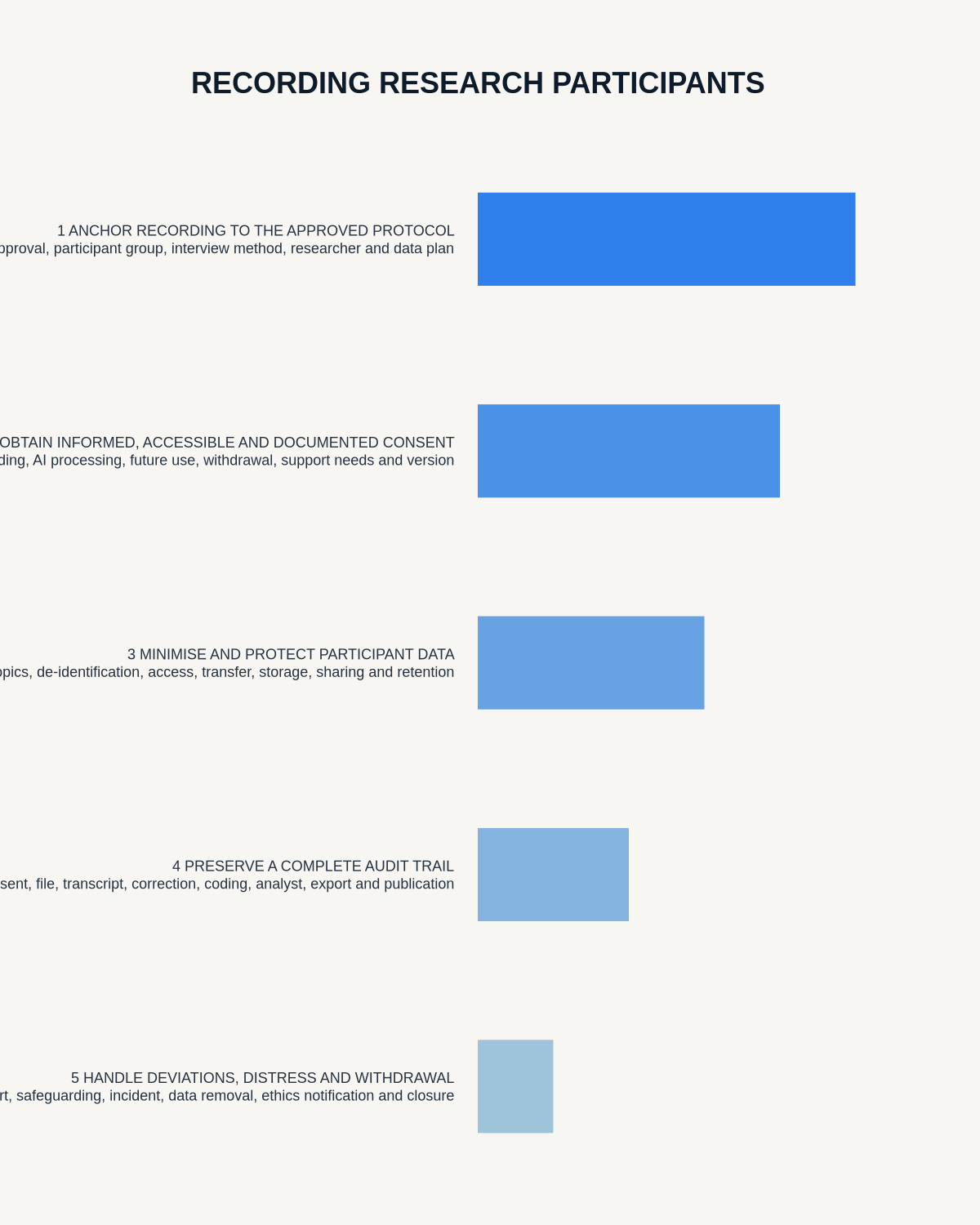
Governance control flow
Visual map for Recording Research Participants: Consent, Ethics, AI and Audit Trails
- Confirm purpose and authorityCheck law, policy, participant information and an approved alternative.
- Minimise captureRecord only what the stated purpose requires.
- Verify and restrict accessHuman-check material details and protect raw audio and transcripts.
- Retain or delete deliberatelyApply the matter, policy or statutory retention rule.
On this page
Related guides
Check permission, retention and access before choosing hardware
Once the policy requirements in this guide are satisfied, compare Halo’s specifications, local storage, included services and current offer against your approved workflow.
Found an error or an out-of-date claim? Email support@neralvo.com with the article address and a supporting source.