The 60-second verdict
Quick answer: capture competitor-analysis notes by researching one question at a time, saying the source and date aloud, separating observed evidence from interpretation and verifying important claims before using them in strategy.
Decision focus: use the method below only where it produces a recoverable source, a verifiable output and a clear next action. If one of those fails, change the workflow rather than trusting a polished summary.
Evidence basis and limits
- Decision factors covered: Use a spoken note template; Label evidence correctly; Record the date and market.
- Evidence rule: Claims are weighted by consequence: capture failure, changed meaning, access and recovery matter more than polished wording.
- Boundary: Examples and workflow recommendations must be tested with representative recordings, the intended users and the actual approval process before rollout.
Voice notes are useful when reviewing websites, adverts, products, reviews and events quickly. A device such as Check whether NERALVO Halo fits this workflow can preserve observations while the researcher navigates the source, but the final record must not mix facts, rumours and assumptions.
Start with a precise question
Examples include:
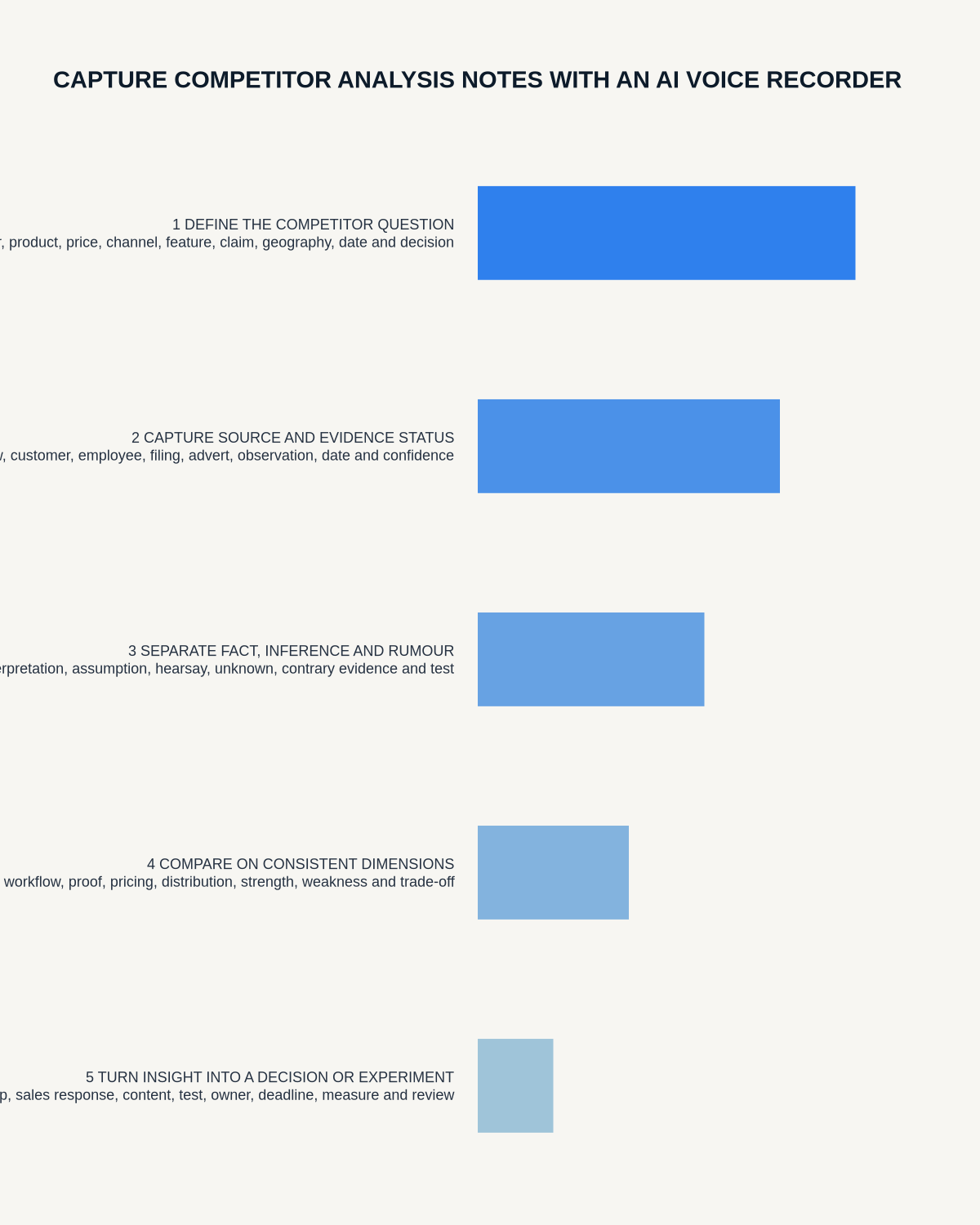
- How is the competitor positioning the product?
- Which customer problem receives the strongest emphasis?
- What is included at each price point?
- Which proof, reviews or guarantees are used?
- Where does the buying journey create friction?
- Which channels and creative angles recur?
Use a spoken note template
- Competitor and source
- Date and market observed
- Direct evidence
- Interpretation
- Uncertainty or limitation
- Possible implication
- Follow-up evidence required
Label evidence correctly
- Observed: directly visible in a current source.
- Reported: stated by a customer, employee, review or publication.
- Inferred: an explanation drawn from the evidence.
- Unverified: a claim that needs another source.
- Test: an experiment your business may run.
Record the date and market
Prices, offers and positioning change by country, audience and campaign. State the page, advert, platform, location and date. Save an authorised link or screenshot where appropriate.
Compare consistently
Use the same fields across competitors: audience, promise, proof, price, offer, features, friction, customer feedback, channel and strategic trade-off. Consistent comparison is more useful than a collection of isolated observations.
Stay lawful and ethical
Use public or authorised sources. Do not record restricted events, private conversations, confidential documents or personal employee information without authority. Avoid misrepresentation or access controls designed to keep information private.
Workflow choice matrix for How to Capture Competitor Analysis Notes with an AI Voice Recorder
Choose the method that protects the source and reduces downstream correction. The table makes the non-hardware options explicit.
| Condition | Preferred route | Why |
|---|---|---|
| High-risk or mixed work | Governed hybrid | Separate capture, review, approval and retention rather than trusting one tool. |
| Recording is refused, prohibited or unnecessary | Manual notes / no recording | Respecting the boundary is the correct workflow, not a product failure. |
| In-person, mobile or unreliable-connectivity work | Dedicated recorder | Independent capture and a recoverable local source are usually more resilient. |
| Repeatable remote work with approved integrations | Cloud software | Automation and central collaboration may outweigh device independence. |
Frequently asked questions
Can customer reviews be treated as facts?
They are reported experiences. Look for patterns and verify product or service claims separately.
Should competitor audio notes be shared widely?
Share the verified analysis needed for the decision, not raw recordings containing unnecessary personal information.
How often should analysis be refreshed?
Refresh it when pricing, positioning, products or campaigns change, and record the observation date.
Useful resources
- GOV.UK marketing and advertising law
- Competition and Markets Authority
- Check whether NERALVO Halo fits this workflow
Competitor-analysis checklist
- Question defined
- Source, market and date stated
- Evidence separated from interpretation
- Claims verified
- Competitors compared consistently
- Private information avoided
- Action or experiment assigned
Competitor evidence and experiment toolkit
A useful analysis should allow another person to reproduce the observation and understand why it matters. Add a source-quality score and decision link to every material finding.
| Evidence grade | Definition | Permitted use |
|---|---|---|
| A — primary and current | Official current page, contract, filing, direct product test or verified statement | May support a factual comparison after checking scope |
| B — strong secondary | Credible independent test with method and current version | Supports a qualified conclusion |
| C — customer report | Specific attributable experience with context | Shows experience, not universal performance |
| D — unverified claim | Forum post, sales assertion, old page or unclear version | Research lead only |
| E — inference | Researcher interpretation or strategic hypothesis | Must be tested before decision |
Build a like-for-like comparison card
- Customer segment and use case.
- Country, currency, taxes and current plan.
- Hardware, software and subscription cost over the same period.
- Test environment, device, file length, speaker count and language.
- Published claim versus independently observed performance.
- Privacy, export, retention and support conditions.
- Date, version and next refresh trigger.
Turn an observation into an experiment
Do not copy a competitor feature simply because it is visible. Create an experiment card with the customer problem, evidence, proposed response, segment, success measure, cost limit, duration and stop rule.
Example: “Competitor A leads with one-year included transcription. Evidence grade A from its UK pricing page on 3 August. Hypothesis: reducing first-year software anxiety will improve checkout conversion. Test: show the included-year value above the buy button for 14 days. Success: at least a 15% improvement in product-to-checkout rate without a higher refund rate.”
Protect against false strategic certainty
Record contradictory evidence, product versions that differ by market, reviews tied to older hardware, sponsored content, unavailable stock and claims you could not reproduce. A strategy note should contain an uncertainty section rather than silently deleting inconvenient facts.
Research red lines
- Do not impersonate a customer, employee or partner to obtain restricted information.
- Do not bypass authentication or technical controls.
- Do not encourage staff or contractors to breach confidentiality.
- Do not record a private event or call without the required permission.
- Do not copy protected creative work when analysis and attribution would meet the purpose.
Review triggers
Recheck a finding when a price, product generation, app version, policy, claim, warranty, retailer, market or customer segment changes. Assign an expiry date to every comparison so outdated intelligence cannot remain in a live strategy deck indefinitely.
NERALVO Halo research workflow
Use Halo for private spoken observations or transparent authorised interviews, not covert collection. State the source, page, date, market and evidence grade at the beginning of each note. After transcription, link the checked statement to the saved source and move only verified conclusions into the competitor register.
Quality-control questions
- Could another researcher find the same source?
- Is the version and market clear?
- Did the note preserve the competitor’s exact claim?
- Is a customer report labelled as a report?
- Does the conclusion reflect contradictory evidence?
- Is the proposed action a test rather than an imitation?
Related AI voice recorder guides
Workflow map
Visual map for How to Capture Competitor Analysis Notes with an AI Voice Recorder
- Define the decisionState the question, required output and acceptance rule.
- Capture the sourceUse the approved route and preserve context, identity and limitations.
- Verify material detailsReplay or check names, numbers, negatives, decisions and actions.
- Move into the real recordAssign an owner, retain evidence and apply the deletion rule.
On this page
More in this topic: Ideas, planning and reusable processes
Show 6 closely related guides
- How to Capture Ideas While Walking with an AI Voice Recorder
- How to Record and Organise Business Ideas Before They Disappear
- How to Turn Recorded Ideas into Practical Project Plans
- How to Create SOPs from Recorded Process Walkthroughs
- How Wedding Planners Can Capture Couple Decisions and Supplier Actions
- How to Use an AI Voice Recorder for Brain Dumps Without Creating More Chaos
Related guides
See whether Halo fits this workflow
Review the NERALVO Halo specifications, included services, delivery information and current offer only after completing the guide.
Found an error or an out-of-date claim? Email support@neralvo.com with the article address and a supporting source.