The 60-second verdict
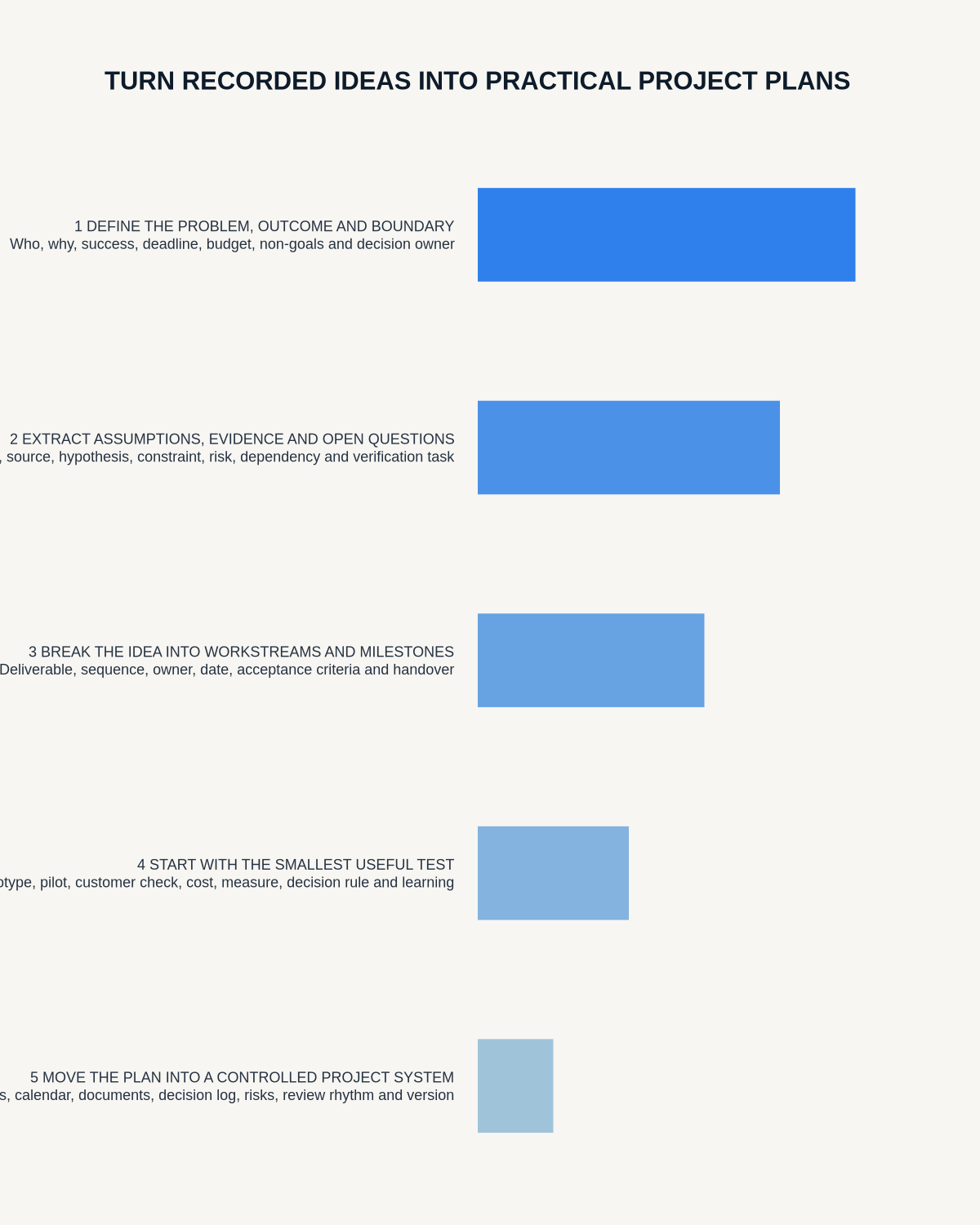
Quick answer: turn recorded ideas into practical project plans by defining the user problem and measurable outcome, separating evidence from assumptions, testing the riskiest uncertainty, setting scope and acceptance criteria, and assigning milestones, owners, dependencies, risks and stop rules before committing significant time or money.
Decision focus: use the method below only where it produces a recoverable source, a verifiable output and a clear next action. If one of those fails, change the workflow rather than trusting a polished summary.
Evidence basis and limits
- Decision factors covered: Use a structured idea recording; Start with the outcome—not the features; Extract the project core.
- Evidence rule: A claim earns weight only when the source, date, configuration and limitation are clear enough for a reader to check.
- Boundary: Examples and workflow recommendations must be tested with representative recordings, the intended users and the actual approval process before rollout.

A transcript can preserve enthusiasm and useful connections, but it does not prove that the problem is real, the solution is viable or the organisation has approved the work. Apply this guide before assessing NERALVO Halo can capture and structure the source idea; project authority, resources and delivery decisions remain human-owned.
Use a structured idea recording
- What problem exists?
- Who experiences it?
- Why does it matter now?
- What outcome would improve?
- What evidence supports the idea?
- What assumptions are being made?
- What constraints exist?
- What is the smallest useful test?
Start with the outcome—not the features
“Build an app with dashboards and AI” is not a project definition. Write one sentence explaining who benefits, what changes and how success will be measured.
For [user], improve [current outcome] from [baseline] to [target] by [date or decision point], without breaching [critical constraints].
Extract the project core
| Field | Question |
|---|---|
| Problem | What is happening now? |
| User | Who needs the change? |
| Outcome | What measurable result matters? |
| Evidence | What supports the claim? |
| Constraint | What limits time, money, people, law, security or technology? |
| Done | What proves completion and acceptance? |
Separate decisions, assumptions, questions and ideas
- Decision: an approved boundary or choice.
- Assumption: believed but unproven.
- Question: requires evidence or authority.
- Idea: an optional possibility.
AI summaries often flatten these categories. Label them manually and preserve the decision authority and rationale.
Create an evidence register
- Verified customer or user problem.
- Data or observed pattern.
- Source and date.
- Assumptions requiring testing.
- Constraints and dependencies.
- Alternative explanations.
- Evidence that would stop or change the project.
Enthusiasm, repetition and seniority are not substitutes for evidence.
Score the idea before creating a project
Rate:
- User value.
- Evidence strength.
- Strategic fit.
- Effort.
- Cost.
- Risk.
- Urgency.
- Reversibility.
Use the score to support a transparent discussion, not to create false mathematical certainty. Not every recorded idea deserves delivery resources.
Identify the riskiest assumption
Examples include:
- Customers will pay.
- The integration is technically possible.
- The supplier can meet security requirements.
- The process saves enough time.
- The intended audience wants the feature.
- The team has enough capacity.
Choose the smallest credible test that can reduce the most important uncertainty before the organisation builds the full solution.
Define the first experiment
- Hypothesis.
- Target user or sample.
- Method.
- Measure and baseline.
- Cost and time limit.
- Owner.
- Decision date.
- Pass, pivot and stop criteria.
An experiment should generate a decision, not merely activity.
Write a one-page project brief
- Project name.
- Problem and target user.
- Desired outcome and success measures.
- Evidence and assumptions.
- Scope.
- Out of scope and deferred work.
- Deliverables and acceptance criteria.
- Constraints and dependencies.
- First experiment.
- Roles and authority.
- Milestones and review rhythm.
- Budget and capacity.
- Risks and controls.
- Stop, pivot or scale criteria.
Define scope before the plan expands
List what is included, excluded and deferred. State the minimum useful version, quality standard, required integrations and boundaries that prevent the idea expanding without approval.
When scope changes, record the request, reason, impact, authority and revised baseline.
Build milestones from outcomes
Examples:
- Problem validated.
- Security or supplier approval completed.
- Prototype tested.
- Pilot launched.
- Success measures reviewed.
- Rollout decision made.
A milestone should represent a meaningful state or decision—not simply “work continues.”
Convert milestones into accountable tasks
Every task needs:
- One owner.
- Specific deliverable.
- Due date.
- Dependency.
- Acceptance criteria.
- Evidence of completion.
Move approved tasks into the normal project system rather than leaving them in the transcript or a private AI workspace.
Create a risk register
| Risk | Impact | Control or mitigation | Owner |
|---|---|---|---|
| Supplier review delays pilot | Launch decision moves | Start due diligence before build | Procurement owner |
| Target users do not adopt the workflow | Expected value is not realised | Run a small representative pilot with clear measures | Product owner |
| Integration effort exceeds estimate | Budget or schedule breach | Technical spike and architecture review | Engineering owner |
Record causes, evidence, assumptions, triggers, controls, actions and review dates. AI can draft the register, but authorised owners must assess and approve it.
Use a challenge review
Ask a second person or cross-functional group to identify:
- Unsupported assumptions.
- Missing stakeholders.
- Hidden costs.
- Unclear ownership.
- Unrealistic dates.
- Security, legal or operational dependencies.
- Alternative solutions.
- Reasons to stop.
Preserve material disagreement and the final decision rather than allowing a summary to create false consensus.
Maintain decision and assumption logs
For each decision, record:
- Decision.
- Authority.
- Date.
- Rationale.
- Conditions.
- Evidence used.
- Review trigger.
For assumptions, record the test, owner, due date and outcome. When evidence changes the plan, update the current position while preserving what changed and why.
Define stop rules before major commitment
Examples:
- The pilot does not meet minimum adoption or outcome thresholds.
- Security or legal risk remains unacceptable.
- Cost exceeds the approved limit.
- The underlying problem is not validated.
- A required integration or supplier capability is unavailable.
- A simpler alternative produces the same outcome.
A project plan should make stopping possible rather than treating sunk cost as evidence to continue.
Use AI estimates cautiously
AI can suggest tasks, dependencies and timelines, but it does not know actual team capacity, procurement delays, organisational politics, technical debt or delivery complexity. Delivery owners must validate every estimate and distinguish target dates from approved commitments.
Where NERALVO Halo fits
NERALVO Halo provides NOTE mode, supported CALL capture, 64GB local storage, up to 35 hours of recording and Bluetooth connection to DOWAY. DOWAY can generate transcripts, summaries, speaker-separated notes, templates, translations, mind maps and exports, with one year of DOWAY Max included from activation.
Record a structured idea, use a transcript or mind map to extract the project core, and then transfer only approved decisions, tasks, risks and milestones into the organisation’s project system.
Workflow choice matrix for How to Turn Recorded Ideas into Practical Project Plans
Choose the method that protects the source and reduces downstream correction. The table makes the non-hardware options explicit.
| Condition | Preferred route | Why |
|---|---|---|
| Repeatable remote work with approved integrations | Cloud software | Automation and central collaboration may outweigh device independence. |
| In-person, mobile or unreliable-connectivity work | Dedicated recorder | Independent capture and a recoverable local source are usually more resilient. |
| Recording is refused, prohibited or unnecessary | Manual notes / no recording | Respecting the boundary is the correct workflow, not a product failure. |
| High-risk or mixed work | Governed hybrid | Separate capture, review, approval and retention rather than trusting one tool. |
Frequently asked questions
Should every idea become a project?
No. Use evidence, value, effort, risk, urgency and strategic fit to decide.
Can AI estimate the timeline?
Only as a draft. Delivery owners should validate capacity, dependencies and uncertainty.
What is the first action?
Test the riskiest assumption cheaply before building the full solution.
Where should the final plan live?
In the organisation’s trusted project system, not as an unprocessed recording or private AI output.
When should a project stop?
When predefined evidence, risk, cost or feasibility thresholds are not met, subject to the authorised decision process.
Official planning source
The Association for Project Management describes planning as integrated with the other disciplines needed for successful project management. Define scope, owners, dependencies, risks and review points rather than treating a transcript as the plan. Read the official APM planning guide.
Related guides
- Best AI Voice Recorders for Meetings
- Data Processing Agreements for AI Transcription
- How to Turn Voice Notes into Social Media Content
- How to Update a Risk Register from Recorded Discussions
Idea-to-project checklist
- Problem and user defined.
- Outcome measurable.
- Evidence, assumptions, questions and ideas separated.
- Constraints identified.
- Idea scored transparently.
- Riskiest assumption selected.
- Small credible test designed.
- Scope and out-of-scope written.
- Deliverables and acceptance criteria clear.
- Milestones and tasks assigned.
- Risks and controls recorded.
- Challenge review completed.
- Decisions and assumptions logged.
- Stop, pivot and scale rules agreed.
- Approved plan transferred into the project system.
Bottom line: move from energy to evidence. A strong project plan preserves the original idea while adding proof, boundaries, ownership, measurable outcomes and a rational reason to continue, change or stop.
On this page
More in this topic: Ideas, planning and reusable processes
Show 6 closely related guides
- How to Capture Ideas While Walking with an AI Voice Recorder
- How to Record and Organise Business Ideas Before They Disappear
- How to Create SOPs from Recorded Process Walkthroughs
- How to Capture Competitor Analysis Notes with an AI Voice Recorder
- How Wedding Planners Can Capture Couple Decisions and Supplier Actions
- How to Use an AI Voice Recorder for Brain Dumps Without Creating More Chaos
Related guides
See whether Halo fits this workflow
Review the NERALVO Halo specifications, included services, delivery information and current offer only after completing the guide.
Found an error or an out-of-date claim? Email support@neralvo.com with the article address and a supporting source.